People looking for a “sugar-free” claim
You want to check a specific claim rather than rely on a general statement about reduced sugar. The “of which sugars” line and the ingredients list are still useful when comparing products.


If sugar content is your top priority, distinguish between “sugar-free” and “no added sugar”: these claims don’t guarantee the same final sugar content. For a village fête, also check the ingredients, allergens, number of portions and storage instructions. Savoury biscuits for sharing aren’t necessarily a substitute for a sugar-free option.
You want to check a specific claim rather than rely on a general statement about reduced sugar. The “of which sugars” line and the ingredients list are still useful when comparing products.
For a village fête, you’ll need to work out how many packs to buy, choose between individually portioned biscuits and ones to share, then check the allergens in each recipe before serving.
You’d like to compare the nutritional values and ingredients of similar biscuits, without assuming what they contain based on a “sugar-free” claim or a displayed Nutri-Score alone.
Start with the sugar claim that matches your requirements, then check the recipe and pack size based on how you plan to serve the biscuits.
Consider these: if you’re specifically looking for this claim, which under EU regulations is reserved for products containing no more than 0.5 g of sugars per 100 g.
Bear in mind: “sugar-free” doesn’t mean carbohydrate-free, calorie-free or free from sweeteners. Check the exact recipe.
Consider these: if you’re looking for no sugar to have been added during production, but don’t require a “sugar-free” claim.
Bear in mind: sugars that occur naturally in the ingredients may still be present. Check the “of which sugars” line.
Consider these: to add variety to a shared buffet when not every biscuit needs to meet a “sugar-free” requirement.
Bear in mind: a biscuit made for an aperitif doesn’t, by itself, tell you its sugar content or which allergens it contains.
| Criteria | What to check | Who is this for? |
|---|---|---|
| Sugar claim | Look for the exact claim and the “of which sugars” value per 100 g. Under EU regulations, “sugar-free” means no more than 0.5 g of sugars per 100 g. | I want to buy biscuits that genuinely carry a “sugar-free” claim, not just “no added sugar”. Around 40% of consumers would make this their top priority. |
| Nutritional values | Compare biscuits in the same category per 100 g: energy, sugars, fat, saturated fatty acids, salt and fibre. Take the Nutri-Score into account if it’s displayed. | For breakfast, I want to compare the ingredients and nutritional content of several biscuits beyond what’s shown on the front of the pack. This overall assessment would be the top priority for around 30% of consumers. |
| Ingredients and allergens | Read the ingredients and allergens highlighted for each variety, as well as any statements about possible traces. | Before serving guests, I need to be able to identify ingredients that some people may be allergic to. Around 20% of consumers would put this check first. |
| Portions and storage | Check the net weight, number of biscuits or packets, and the storage instructions on the pack. | If I’m organising the buffet, I want to know how many packs to buy and how to store them until the fête. This would be the main concern for around 10% of consumers. |
The first claim relates to a sugar-content threshold; the second doesn’t rule out sugars that occur naturally in the ingredients.
If you’re looking for a “sugar-free” claim, check that it’s stated explicitly and look at the “of which sugars” value per 100 g.
According to Santé publique France, displaying it is voluntary in France. It complements nutritional information but doesn’t replace it.
If it appears on the pack, use it alongside the ingredients list and nutrition table rather than as your only criterion.
A sugar claim doesn’t tell you everything about a recipe. Gerblé’s Plain biscuit, featured here, contains polyols and wheat. Information about possible traces also needs to be checked carefully.
Check the pack for each variety before making the biscuits available to guests.
A savoury biscuit can still contain sugar. The Sablés de l’apéritif La Bretonne featured by St Michel don’t meet a strict requirement for “sugar-free” biscuits.
If you need to cater for this requirement at the fête, clearly distinguish this option from the classic biscuits available to share.
The brand offers several recipes in its “Sugar-Free / No Added Sugar” range, including plain biscuits.
Carrefour lists products from this brand with either a “sugar-free” or “no added sugar” claim, depending on the biscuit.
This retailer lists Gerblé plain biscuits, with information about the pack size and ingredients.
The brand’s range includes Sablés de l’apéritif La Bretonne, a savoury recipe made for sharing.
These two RAMDAM SOCIAL products are savoury biscuits sold in 100 g packs, suitable for the aperitif part of a village fête. If your priority is a “sugar-free” biscuit for the buffet or breakfast, check the claim on another product that meets this requirement.
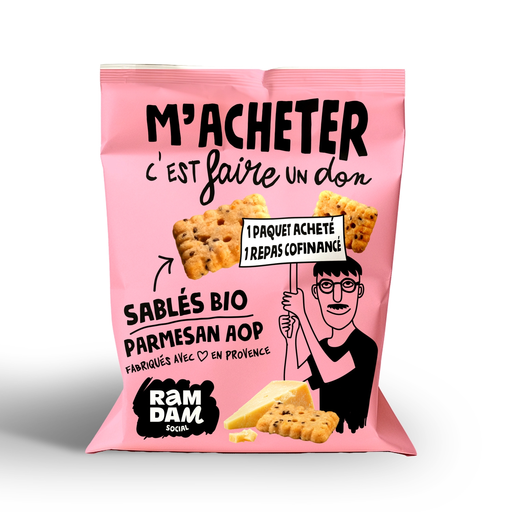 Image unavailable
A recipe with Parmesan and chia seeds to add to a savoury buffet. The pack contains 100 g of biscuits. If you’re looking for a “sugar-free” option, this product won’t meet that requirement. Check the allergens and storage instructions on the packaging before serving.
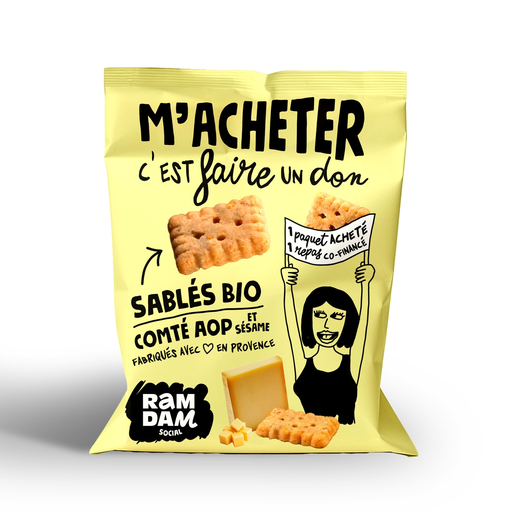 Image unavailable
Another savoury buffet option, made with Comté and sesame seeds, also available in a 100 g pack. It doesn’t meet a strict requirement for “sugar-free” biscuits. Check the allergens on the packaging, especially if any guests need to avoid sesame.
Under EU regulations on nutrition claims, “sugar-free” means a maximum of 0.5 g of sugars per 100 g of biscuits. “No added sugar” doesn’t rule out sugars that occur naturally in the ingredients, so check the “of which sugars” line for the specific product.
No. Santé publique France says that displaying the Nutri-Score is voluntary. It doesn’t replace the nutrition declaration on prepacked foods, so its absence alone isn’t enough to conclude that a pack is non-compliant.
Read the ingredients and allergens on each pack, and make sure this information is available when serving. Gerblé and Auchan’s Plain biscuit lists wheat and may contain traces of other allergens. Don’t assume the same information applies to another recipe.
Start with the number of guests, how you plan to serve the biscuits and the number of portions stated on each pack. Auchan’s listing for Gerblé plain biscuits specifies 3 sachets of 4 biscuits in a 132 g pack. Also follow the storage instructions for the product you buy.