
Livraison le jour même ou le lendemain

Qualité garantie

Débloquez vos offres de bienvenue: Livraison GRATUITE | Jusqu'à -80 % | 30 jours d'essai gratuits à JoyPlus
Téléchargez l'application
A cluttered bathroom quickly becomes frustrating to use: bottles left on the floor, soap sitting in water, a razor that is difficult to reach or towels with nowhere to go. A suction-cup shower organiser offers a simple, practical solution, particularly for tenants, students and anyone who would rather avoid drilling into tiles.
However, not every fixing system is suitable for every bathroom. Before buying a drill-free shower caddy, check the type of surface, the stated maximum load and the caddy’s ability to drain water.
A suction cup holds through a watertight seal on a smooth, clean and non-porous surface. Glass, mirrors, smooth tiles, stainless steel, polished metal and some acrylic panels are generally suitable.
By contrast, tile joints, painted walls, wallpaper, wood, porous stone and textured tiles can prevent the suction cup from sticking. A wall that appears perfectly flat is therefore not necessarily compatible with a suction-cup bathroom shelf.
The stated load applies under specific conditions: a suitable surface, a correctly fitted suction cup and weight distributed evenly. In a shower, wet bottles and repeated handling place greater strain on the support.
It is better to leave a safety margin and reserve a shampoo caddy for the products you genuinely need. Heavy or fragile items should be stored elsewhere until the fixing has proved reliable.
A closed caddy traps water and soap residue. To avoid this, choose a sloped or perforated base with enough drainage holes. A suction-cup soap dish with a removable tray will also be easier to clean.
Before fitting, clean the area with a mild product, then dry it thoroughly. The suction cup should be installed away from joints, on a surface free from unevenness. For a corner model, also check the geometry: some caddies are designed only for a 90° right angle.
The same precaution applies to suction-cup shower hooks and drill-free towel rails. A fixing suitable for a glass panel will not necessarily work on a painted wall.
ABS is very commonly used for caddies and soap dishes: it is lightweight and easy to clean with water and mild soap. TPE is often used for the suction cup, while PC or stainless steel can reinforce certain hooks and supports.
Choose removable components wherever possible. A removable bathroom organiser can be taken down for washing, then put back once completely dry. Avoid abrasive products, which may damage the surface or reduce the suction cup’s flexibility.
Compare the stated capacity with your needs:
Dimensions are also important. A caddy that is too deep may get in the way in a small shower enclosure, while a model that is too compact will not hold larger family-sized bottles.
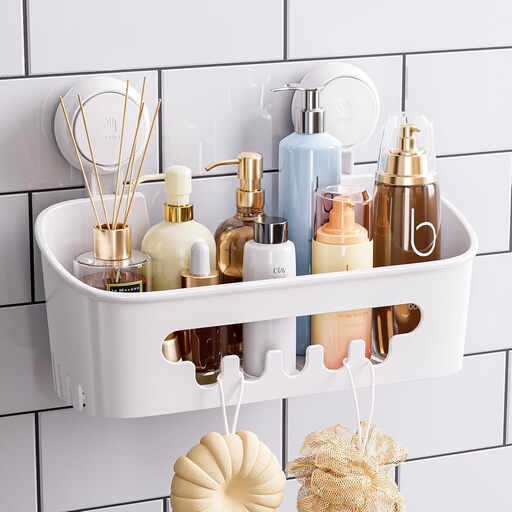
Why this choice suits this profile : This single caddy is ideal for a first installation in rented accommodation, a student room or a small bathroom. It can be fitted without screws, adhesive or tools.
Its 22 drainage openings and 6° sloped base help limit the risk of standing water. However, it is suitable only for smooth, non-porous surfaces.
ABS caddy, TPE suction cups, stated capacity of up to 10 kg and residue-free removal according to the product details.
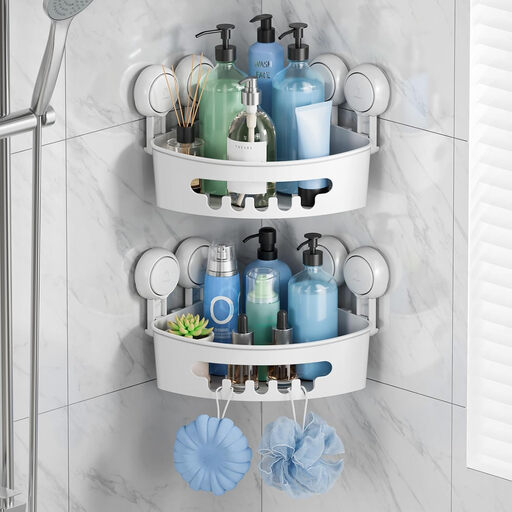
Why this choice suits this profile : The corner design makes use of often-unused space and distributes storage between two caddies. It is suitable for bathrooms with a clear right-angled corner.
The product details specify that this model is compatible only with 90° corners. This is useful information to help you avoid choosing it for a curved enclosure or an irregular corner.
Two removable compartments, perimeter drainage and a stated capacity of up to 10 kg on a compatible surface.
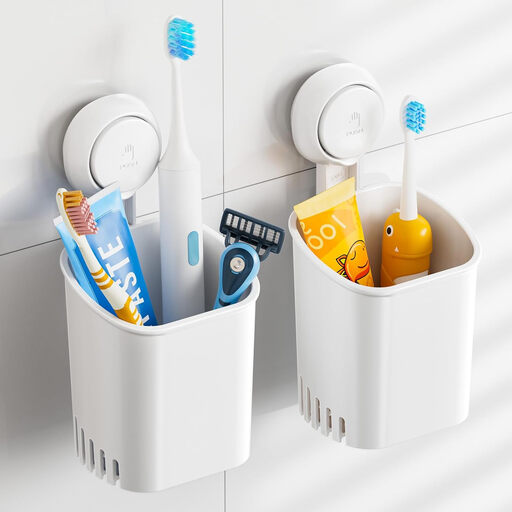
Why this choice suits this profile : This holder keeps cups and accessories away from the edge of the basin. It can also be used in a kitchen or temporary accommodation.
The side and bottom openings help water drain away. However, the holder must be installed on a dry, clean, smooth and non-porous surface.
Two removable ABS and TPE holders, with a stated load of up to 5 kg and installation without adhesive or tools.
We have selected a complete range, updated in real time, of products that meet these demanding criteria and European safety standards.
If the suction weakens, remove the suction cup by gently lifting its edge. Wash it in warm water, dry it completely, then reinstall it on a suitable surface. Avoid extreme heat and prolonged exposure to sunlight.
No. A suction cup needs a smooth, watertight and non-porous surface. Textured tiles, joints, painted walls and wallpaper are generally unsuitable. Always check the recommendations for the model you have chosen.
Its lifespan depends on the quality of the surface, humidity levels, load and maintenance. Check the fixing regularly, particularly after cleaning or moving the holder. Never exceed the load specified by the manufacturer.
It depends on your accommodation and how you plan to use it. An adhesive shower caddy may offer a more stable installation, but removing it could leave marks or damage certain finishes. A hole-free bathroom accessory with a suction cup is generally easier to reposition, provided that the wall is compatible.