
Livraison le jour même ou le lendemain

Qualité garantie

Débloquez vos offres de bienvenue: Livraison GRATUITE | Jusqu'à -80 % | 30 jours d'essai gratuits à JoyPlus
Téléchargez l'application
Shampoo bottles piling up on the edge of the tub, shower gel slipping through your fingers… Does this sound familiar? The suction cup shower caddy seems like the miracle solution: no drills, no tools, and an installation that takes just seconds. However, the dream can quickly turn into a nightmare. There's often a world of difference between the promises on the packaging and the harsh reality—especially that dull thud in the middle of the night that signals the crash of your entire setup.
Before you make a decision, it's crucial to know the deal-breaking flaws that destine a no-drill shower storage solution for the trash after just a few months:
This guide is here to help you avoid these pitfalls by arming you with the right technical criteria.
To choose a suction cup shower shelf that will live up to its promises, you need to look beyond the design. Here are the three technical points to inspect closely.
Not all suction cups are created equal. Forget the models that rely on a simple, flexible plastic cup. The systems that truly work are based on a reinforced, mechanical vacuum principle.
Prioritise models equipped with a pressure or locking mechanism (screw or lever-based). Some technologies, for example, are inspired by octopus tentacles (TPE material) and create an ultra-powerful vacuum with a simple push. This type of design guarantees a durable hold, even in the hot, humid atmosphere of a shower. A good removable shower shampoo holder must be repositionable at will without losing its effectiveness.
The choice of material is decisive. ABS plastic is a reliable choice: it's robust, lightweight, and completely rust-proof, unlike some low-end chrome-plated metals whose coating peels away pathetically after a few months.
The second critical point is drainage. A well-designed shower basket must have large slots or perforations, or even a sloped base, to allow water to drain instantly. This is the essential condition for preventing mould, keeping your soap bars dry, and preserving your products.
This is the most frequently overlooked criterion, and yet, it's a deal-breaker. A no-drill bathroom shelf with suction cups only works on perfectly smooth, non-porous surfaces.
Before any purchase, inspect your wall. Trying to fix a suction cup straddling a grout line is a guaranteed disaster.
To help you see how these criteria apply in practice, here are a few models that meet specific needs while avoiding the aforementioned pitfalls.
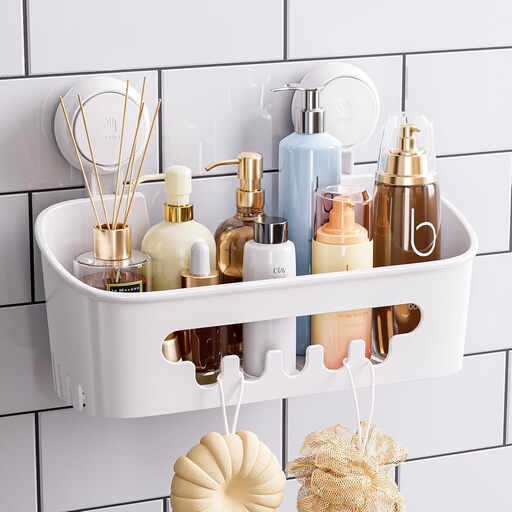
The ideal user: Perfect for a student or single person looking for a simple, effective solution to declutter a small shower stall without breaking the bank.
This model relies on TPE suction cups with a push-lock mechanism for a rock-solid hold. Its 6° sloped base and 22 drainage slots prevent water from stagnating and stop mould from forming.
Installs in one second flat. An advertised load capacity of 10 kg gives you more than enough room for several large bottles.

The ideal user: Perfect for a family or a couple sharing the same shower where bottles tend to multiply. This two-pack allows everyone to have their own space or to organise products by category.
The 10 kg maximum load is distributed across two sturdy ABS plastic baskets. Each basket has its own ultra-strong TPE suction cups, which cuts the risk in half compared to a single large caddy.
Very large storage capacity and flexible installation (side-by-side, stacked, etc.). The rapid drainage keeps a multitude of products dry.
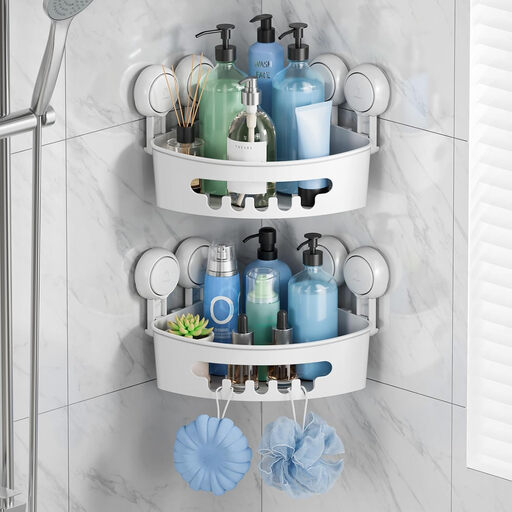
The ideal user: Designed for those who want to make the most of every nook and cranny in their shower, especially in square stalls where corners are all-too-often unused storage space.
Its shape is specifically designed for right-angle (90°) corners, offering a stability that's impossible to achieve with a standard basket. The drainage is also optimised for perfect water evacuation from a corner.
Maximum space utilisation. The basket is detachable from its mount, which makes cleaning both the basket and the corner of the wall much easier.
We have compiled a complete and up-to-date list of products that meet these strict selection criteria and safety standards.
My suction cup shower caddy keeps falling. What should I do? The most common cause is a dirty or unsuitable surface. Make sure the wall is perfectly smooth, non-porous, and spotless. Clean both the surface and the suction cup with rubbing alcohol to remove any soap scum or limescale residue. When installing, press very firmly to force out all the air. If the problem persists, the suction cup is likely deformed, worn out, or simply low quality.
Can you install a suction cup shower shelf over tile grout lines? Absolutely not. That's the surest way to guarantee a fall. Grout lines are porous and raised, which prevents the suction cup from creating an airtight seal. The suction cup must rest entirely on the flat surface of a single tile.
How do I maintain my shower caddy to make it last longer? Ideally, once a month, detach the caddy from the wall. Clean it and the suction cup with soapy water to remove any build-up. Dry everything thoroughly before reinstalling it. This simple step helps maintain maximum adhesion and prevents grime.