A studio with a narrow doorway or niche
If width is your main concern, consider a top-loading washing machine. UFC-Que Choisir gives a width of 40 to 46 cm for this format. You will, however, need enough clearance above the machine to open the lid.


For a student studio, choose a top-loading machine if width is limited, a slim front-loader if depth is an issue, or an integrated model if the niche and cabinet door are designed for one. Measure the route into the room, the space needed to open the door and the room available for connections, too. ADEME says that 7 kg is usually enough: compare this guideline with your usual loads, then check the energy label and spin noise.
If width is your main concern, consider a top-loading washing machine. UFC-Que Choisir gives a width of 40 to 46 cm for this format. You will, however, need enough clearance above the machine to open the lid.
If you have enough width but limited depth, a slim front-loader is worth measuring. Remember to allow room in front of the door and behind the machine for the connections.
An integrated model is suitable if the niche, cabinet door and connections match the installation instructions. Fitting an appliance inside a cabinet does not mean it is narrow.
Start with the space available and the route into your studio, then compare the model’s capacity and performance information with your usual laundry loads.
| Factor | What to check | What I need |
|---|---|---|
| Size | Measure the niche and the route into the room. UFC-Que Choisir says top-loaders are 40 to 46 cm wide and slim front-loaders are 33 to 45 cm deep; also check the clearance needed to open the machine and the space for the hoses. | The machine needs to fit through the route into my studio, go into its allocated space and open without hitting furniture. |
| Capacity | Match the capacity in kg to your loads and check the capacity for the Eco 40-60 programme. ADEME says that 7 kg is usually enough, but this is no substitute for considering the laundry you typically wash. | I regularly wash my clothes, as well as the occasional sheets and towels, without wanting to run lots of separate cycles. |
| Noise and cycles | Check the energy label for kWh per 100 cycles, water per cycle, programme duration and spin noise, as set out by the European Commission. Also check the model’s spin performance information. | In a room where I live close to the machine, spin noise and programme duration matter just as much as the space it takes up. |
| Installation and care | Check the instructions for the transit bolts, levelling and hoses. Make sure the filter and door seal will still be accessible once the machine is installed. | I want to be able to maintain the machine without having to pull it out of a hard-to-reach niche. In UFC-Que Choisir’s survey of 4,350 newsletter readers, carried out from 15 to 24 May 2025, unpleasant odours lingered in 19% of cases. |
| Washing and drying | If you are considering a washer-dryer, compare the washing and drying capacities separately, along with the label information for the full cycle. Do not assume it takes up less room than a front-loading washing machine. | I would only consider this format if I also want to dry laundry in the same appliance and its dimensions suit the space. |
A top-loader is mainly designed to solve a width problem, while a slim front-loader mainly reduces depth. Top-loading models listed by Conforama can be around 60 to 61 cm deep.
Measure the width, height and depth separately, along with the clearance needed to open the machine and the space required for connections.
A smaller capacity may mean splitting your laundry into separate loads when sheets, towels and clothes will not fit together.
Estimate how much laundry you get through in a week and check the capacity for the Eco 40-60 programme. ADEME gives 7 kg as a guideline that is usually enough, but you should choose a capacity that suits your needs.
Splitting loads can mean extra cycles in your routine.
These figures can differ: Whirlpool lists 9 kg for washing and 6 kg for drying on the BIWDWG961485FR. So a full-capacity wash load would exceed the stated drying capacity for this model.
If you choose a washer-dryer, check both capacities and the label information for the complete cycle.
You may need to split a washed load to stay within the drying capacity.
Bosch’s technical guidance includes removing the transit bolts, levelling the machine and checking the hoses.
Follow the instructions for your chosen model and keep the filter, door seal and connections accessible for checks and maintenance.
These brand examples illustrate different formats and things to check. The specifications apply to the models mentioned, not every machine made by the brand.
The Bosch WGE02406FR front-loader is an example to compare with a niche around 60 cm wide, rather than a very narrow doorway.
Candy’s slim and compact ranges include models worth considering when depth is your main constraint.
Whirlpool’s integrated models are a useful reference when checking whether a fitted niche is genuinely suitable for this format.
These three front-loaders are designed for everyday washing. Compare their capacity with your loads, then check the full dimensions and installation requirements before deciding whether one will suit your studio.
 Image unavailable
Compare its stated 7 kg capacity with your regular loads; this is also the capacity ADEME considers enough in most cases.
The model name indicates a 1,400 rpm spin speed and an A energy rating. Check the dimensions of the WGE02407FR, the route into the room, the clearance for the door and the space for the hoses at your chosen location.
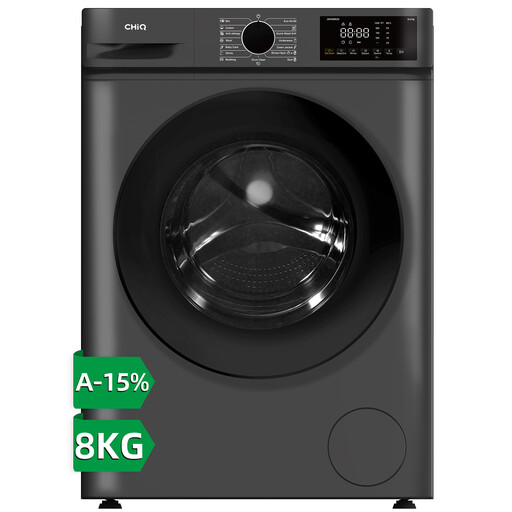 Image unavailable
If depth is your main constraint, compare this front-loader’s full dimensions with the niche and the route into the room.
The model name lists 8 kg, 1,400 rpm and 16 programmes. Also check the space needed in front of the door and behind the machine, along with the detailed figures on its energy label.
 Image unavailable
Consider this model if your loads call for 9 kg and you have enough space for it: ADEME says that 7 kg is usually enough.
The model name indicates a 1,600 rpm spin speed. Measure the available depth, including the connections, and the clearance in front of the door before choosing this front-loader.
Measure the niche and the entire route into the room, then compare them with the unpackaged dimensions of the exact model. Allow for the lid to open above a top-loader or the door to open in front of a front-loader, as well as space for the connections. UFC-Que Choisir notes that a top-loader can be narrow without being shallow.
Start with the amount of laundry you actually wash, including sheets and towels. ADEME says that a 7 kg washing machine is usually enough; a smaller capacity may work for frequent, smaller loads if it does not mean you regularly have to split your laundry.
Compare the energy rating, kWh per 100 cycles, water per cycle, programme duration and spin noise shown on the label described by the European Commission. For a washer-dryer, check the washing information and the figures for the full wash-and-dry cycle separately.
Not necessarily: check both capacities for the model. For example, Whirlpool lists the BIWDWG961485FR as 9 kg for washing and 6 kg for drying, so a 9 kg wash load would exceed its stated drying capacity.
Follow the instructions for your model, remove the transit bolts and level the machine. Bosch’s technical advice also recommends checking the inlet and drain hoses; keep them accessible once the machine is in place.