In a studio flat, a top-loading washing machine can keep the walkway in front of the appliance clear when width is limited. A shallow front-loading model is a better fit when depth is the issue, provided there’s enough room to open the door. If you need to dry clothes at home, a washer-dryer saves you from finding space for a second appliance. However, UFC-Que Choisir notes that its drying capacity is lower than its washing capacity, and cycles can be long. Before choosing, check how much room you’ll need to load the machine and whether you can access the connections.
Who are these options for?
If depth is your main constraint
If you’re fitting a machine into an alcove or along a narrow kitchen, measure the available depth before comparing shallow front-loading models. Dimensions and capacities vary between models, as UFC-Que Choisir points out.
If you need to keep the walkway clear
If an open door would get in the way, it’s worth considering a top-loading model, as long as there’s enough clear space above the machine.
If you don’t have space to dry clothes
A washer-dryer combines washing and drying in one appliance. Check the maximum load for each function separately, along with the cycle time and energy and water consumption of the programme you plan to use.
Which key points should you check first?
Start with the location and the space needed to open the machine. Then compare the capacity with your usual loads, and only consider built-in drying if you genuinely need it.
| Consideration | What to check | Who is this for? |
|---|
| Space and opening |
Measure the width, depth and height, as well as the clearance needed to open and load the machine, including space for the connections. UFC-Que Choisir distinguishes slim front-loading models by their depth and top-loading models by their width. |
If the walkway is narrow, I want to be able to load the machine without blocking it. Around 36% of consumers rank the machine’s actual footprint as their top priority. |
| Washing capacity |
Compare your usual dry laundry load, especially bedding and towels, with the capacity allowed by the programmes you use. UFC-Que Choisir suggests 5 to 7 kg as a guide for one or two people. |
If I often wash bulky items, a drum that’s too small could mean more loads. For around 29% of consumers, capacity matters more than saving a few centimetres. |
| Built-in drying |
For a washer-dryer, check the washing and drying capacities separately, then look at the duration and consumption of the cycle you plan to use. |
If there’s no room to hang clothes or install a second appliance, I’d prioritise drying in the same machine, even if I need to adjust the load. This is the main priority for around 21% of consumers. |
| Installation |
Check where the water supply, drain and power supply are at the intended location, and make sure they’ll still be accessible once the machine is installed. |
Before choosing a model, I need to know whether it can be connected where it will fit. Installation feasibility is the top priority for around 14% of consumers. |
Which mistakes should you avoid?
-
Choosing the smallest drum without considering your loads
Saving space could mean doing more loads if your usual laundry won’t fit in the machine. UFC-Que Choisir also advises against choosing a capacity that’s much larger than you need.
Think about your usual dry laundry load, including bedding and towels, then check the capacity allowed by the programmes you’ll use.
Extra cycles take more time, water and electricity.
-
Comparing washing capacity alone
According to UFC-Que Choisir, a washer-dryer’s drying capacity is lower than its washing capacity. So you may not be able to dry a full load in one go after washing it.
Compare both capacities and the length of the wash-and-dry programme before deciding whether the space saved is worth this limitation.
-
Measuring the alcove but not checking the door clearance
A front-loading machine needs space in front for its door to open, while a top-loading model needs to be accessible from above. Even a machine that fits the dimensions can be difficult to install if its connections aren’t accessible.
Before choosing a machine, measure the space, check there’s enough clearance to load your laundry and note where the connections are.
-
Changing a rented property’s fittings without written permission
If adding a connection counts as an alteration to the rented property or its fittings, ANIL says you’ll need the landlord’s written permission. This does not apply in the same way to simply using existing connections.
Find out whether your plans require an alteration and, if they do, get permission before any work begins.
Brands to consider
There are no brands to feature in this section.
A front-loading model to consider on Joybuy
This model is a front-loading washing machine intended for a shallow space. Before planning to install it in a studio flat, check its full dimensions and door clearance against the space available.
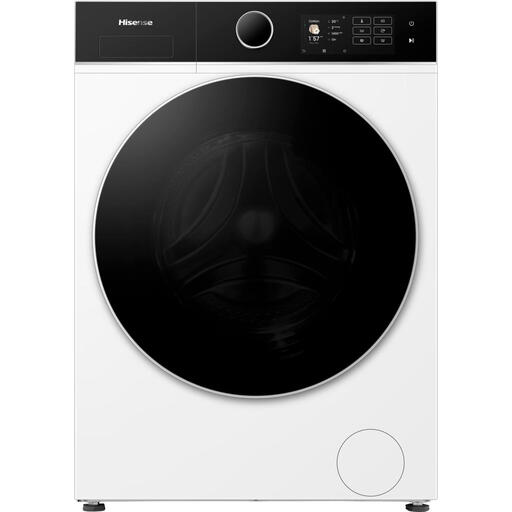 Image unavailable
Hisense WF5I8043BWF, 8 kg front-loading washing machine
Worth considering if depth limits your options and your usual loads call for an 8 kg capacity. The model name indicates a 1,400 rpm spin speed, an Inverter motor and a white finish. Check the total depth, including the connections, the door clearance and the space available for installation.
View on Joybuy
Frequently asked questions
What capacity should I choose for one person or a couple?
UFC-Que Choisir suggests 5 to 7 kg as a guide for one or two people. Choose a capacity that suits your dry laundry loads, how often you wash and the limits for the programmes you use.
Does a top-loading washing machine take up less space than a front-loader?
It’s mainly narrower and doesn’t need space in front for a door to open. UFC-Que Choisir gives a width of around 40 to 46 cm for a top-loader, compared with around 60 cm for a front-loader. However, you’ll still need clear access from above to load it.
Can a washer-dryer dry the whole load it has washed?
Not necessarily: UFC-Que Choisir says that drying capacity is lower than washing capacity. Compare both figures for the model you’re considering, and remove some of the laundry before drying if the washed load exceeds the permitted limit.
Which connections should I check before buying?
Check the water supply, drain and power supply at the spot where the machine will go, and make sure they’ll remain accessible after installation. If you’re unsure about the connections or electrical installation, ask a professional for advice before settling on a location.
Can I add a connection in a rented property?
If adding one would alter the rented property or its fittings, get the landlord’s written permission first, as ANIL advises. Ask what work would be needed before ordering a machine that depends on the new connection.


