Renters with existing connections
If there’s a water supply, drain and suitable socket nearby, your choice mainly comes down to the dimensions, how the drum opens and whether you can install the appliance without making changes to the property.


For regular washing in a studio flat, choose a machine format after measuring the space, connections and room needed to open the drum: a shallow front-loader if depth is limited, a top-loader if width is the issue and there’s clear space above, or a standard front-loader if all the dimensions work. Choose a compact, low-capacity machine only for small loads that you’re happy to wash more often. UFC-Que Choisir points out that a drum that’s too small means more cycles, while ADEME says that a 7 kg capacity is usually enough.
If there’s a water supply, drain and suitable socket nearby, your choice mainly comes down to the dimensions, how the drum opens and whether you can install the appliance without making changes to the property.
A capacity that suits your sheets, towels and everyday washing matters just as much as the space the machine takes up. UFC-Que Choisir points out that a drum that’s too small means more cycles.
A compact machine may suit you if you do small loads and its dimensions, capacity and connection requirements work for your space. Check these details for the model you’re considering before making it your main washing machine.
The right format depends first on which dimension is the main obstacle to installation, then on access to your laundry and the capacity you need day to day.
Consider this if: depth is limited, but the door can open without blocking the way.
Bear in mind: the stated depth doesn’t account for the space needed for hoses or to open the door.
Consider this if: width is the main constraint and you’re happy to load the machine from the top.
Bear in mind: the lid needs room to open; a fixed worktop above the machine may get in the way.
Consider this if: no larger domestic machine will fit and you do small loads.
Bear in mind: a low capacity may mean splitting your laundry into several loads. Check the model’s connections and drainage requirements too.
Consider this if: the width, height, depth and door clearance all work for the space.
Bear in mind: check the manual to see whether the model can be installed under your worktop.
| Priority | What to check | What you need |
|---|---|---|
| Size and access | Measure the available width, height and depth, then allow space for the hoses. Check that the door or lid can open and, if needed, that the machine can be installed under a worktop. | I want to load the laundry without blocking the way or hitting a piece of furniture. |
| Capacity | Compare the stated capacity in kilograms of dry laundry with your usual loads, especially sheets and towels. ADEME says that a 7 kg capacity is usually enough; UFC-Que Choisir warns that a drum that’s too small means more cycles. | My usual loads should fit in the drum without always having to split them. |
| Installation | Check where the water supply, drain and suitable socket are. Consult the model’s manual for instructions on securing the drain hose, levelling the machine and connecting it. | If I’m renting, I’d like to know before buying whether the space is ready or whether I need to discuss work with the landlord. |
| Noise and consumption | As explained by the European Commission, compare the class, energy use per 100 cycles, water use per cycle, duration and noise emissions on the EU energy label. Also check the durability index where it applies to the model. | If the washing machine is near my living or sleeping space, I want to consider its noise as well as its size. |
An appliance may fit in its space but still leave too little room for the hoses or to open the door or lid.
Measure the space and the access route, then check the clearance needed around the model you’re considering.
UFC-Que Choisir says that a drum that’s too small means more cycles. So weigh the space you’ll save against the amount of laundry you usually do.
Compare the stated capacity with your usual loads before choosing a compact machine as your main appliance.
Splitting the same amount of laundry into several loads also means more washing to plan.
Whether you can connect and secure the drain hose depends on the space and the model’s instructions.
Locate the drain and check the manual for the permitted height, hose length and how the hose should be secured.
Adding or moving a connection changes the installation plans: it’s no longer just a question of the appliance’s dimensions.
If work is needed, discuss it with your landlord and confirm what’s permitted before ordering the appliance or installation.
These two front-loading washing machines are worth considering if you’re looking for an 8 kg capacity and depth is a concern. Check their installation dimensions and door clearance against your space. This selection doesn’t replace the choice between a front-loader, top-loader and compact machine.
 Image unavailable
Worth considering for regular washing if a front-loader suits your studio flat. The product name lists an 8 kg capacity, an inverter motor and a white finish. Check the manual for the space needed behind the appliance and in front of the door, and whether it can be installed under a worktop.
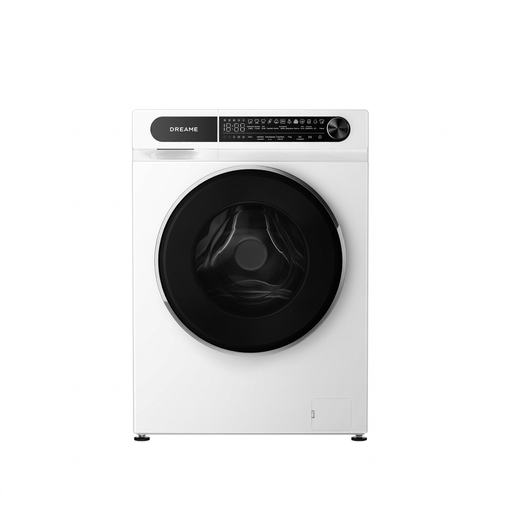 Image unavailable
Its stated 8 kg capacity makes it worth considering for everyday washing, without immediately having to opt for a small, occasional-use machine. Before choosing it for a narrow space, check the required clearances, drainage, floor stability and whether it’s compatible with a fixed worktop.
Discuss any necessary work with your landlord before choosing an appliance. Locate the water supply, drain and intended socket, then check that they’re in the right places for the requirements in the manual.
Check that there’s an accessible water supply, a drain that allows the hose to be secured and a socket that meets the model’s requirements. The manual also explains the connection and drainage conditions you need to follow.
It may suit you if you do small loads, but compare its 3 kg capacity with your usual laundry before relying on it as your only machine. ADEME says that 7 kg is usually enough, and UFC-Que Choisir points out that a drum that’s too small means more cycles.
As recommended by the European Commission, compare the energy class, energy use per 100 cycles, water use per cycle, duration and noise emissions shown on the European label. Noise is especially worth considering if the machine is near your living or sleeping space.
Not if the worktop prevents you from opening the lid and loading the machine from above. If the space is under a fixed worktop, consider a front-loader instead, checking that its dimensions, installation requirements and door clearance are suitable.