One person or a couple in a studio flat
If you do your laundry at home, compare the drum capacity with the size of your loads and how often you wash. UFC-Que Choisir says that 5 to 7 kg is generally enough for one person or a couple.


In a studio flat, start by choosing a machine that fits the available space and can be opened comfortably. A slim front-loader is best when depth is limited, while a top-loader can help when width is at a premium, provided there’s enough room to lift the lid. UFC-Que Choisir says that a capacity of 5 to 7 kg is generally enough for one person or a couple; a mini washing machine is better suited to small loads when a standard model cannot be installed. Before choosing, compare the machine’s dimensions and installation plan with the actual connections and clearance in your room.
If you do your laundry at home, compare the drum capacity with the size of your loads and how often you wash. UFC-Que Choisir says that 5 to 7 kg is generally enough for one person or a couple.
A slim front-loader could work if depth is limited; a top-loader may be a better fit when width is the issue. Either way, measure the space needed to open the machine and move around the room.
A mini washing machine can handle small loads if a standard model cannot be installed. Before relying on one as your main machine, compare its capacity with your usual laundry, especially bulky items.
Consider this if: depth is limited, but there’s enough width and room to open the door. UFC-Que Choisir puts the slim front-loaders it describes at around 60 cm wide and 33 to 45 cm deep.
Trade-off: the door needs enough room to open in front of the machine without blocking the way through.
Consider this if: width is your main constraint and there’s enough space above the machine to open the lid.
Trade-off: a narrow top-loader isn’t necessarily shallow: according to their manufacturers, the Electrolux EW6T4613HA and AEG LTR8C7331A are each nearly 60 cm deep.
Consider this if: you need to wash small loads and can’t install a standard washing machine.
Trade-off: check that its capacity and spin options suit your usual loads, not just your smallest ones.
| Priority | What to check | What I need |
|---|---|---|
| Space and opening | Measure the width, depth and height; check that the door or lid can open and allow enough room for the hoses, using the installation plan for the exact model. | I want to reach the drum without blocking the way through the kitchen or bathroom. |
| Capacity | Compare the stated load capacity with your usual laundry and check the limits for the programmes you use. | My loads should fit in the drum without making me run extra cycles. UFC-Que Choisir gives 5 to 7 kg as a general guide for one person or a couple. |
| Noise and running costs | Compare water and energy use, noise levels and spin performance on the energy label, as advised by ADEME. | If the machine is near my living area or I dry clothes indoors, noise and spin performance matter too. |
| Maintenance | Check that the filter is accessible and that there’s enough room to work around the machine. | I want to be able to maintain the machine without having to struggle to move it in a narrow room. |
A slim front-loader still takes up space when its door is open. A top-loader, on the other hand, needs clear space above it.
Mark out the machine’s footprint and opening path in the room, then compare your measurements with the installation plan for the exact model.
A smaller capacity may mean separating loads more often and make it harder to wash large items.
Compare its capacity and intended uses with your usual laundry. If installation is possible, consider a slim front-loader or a top-loader too.
If your usual loads won’t fit, you’ll need to run extra cycles. ADEME recommends matching capacity to your needs; UFC-Que Choisir puts the general requirement for one person or a couple at 5 to 7 kg.
Estimate the size of your usual loads, including bedding, before settling on a capacity.
In a studio flat, water use, noise and spin performance can also help you choose between two machines that fit the space.
Compare these figures, along with energy use, on the labels of the models you’re considering, rather than looking at the rating letter alone.
These examples of ranges and models can help you compare formats. The dimensions that matter are those of the model you’re planning to install.
An option to consider if you’re looking for a front-loader and have limited depth but room for a width of around 60 cm.
Top-loading and compact formats to compare, depending on the space available and the size of your loads.
A useful reference when comparing top-loaders for spaces where width is more limited than depth.
Another size reference for a top-loading washing machine.
This front-loading washing machine is worth comparing if you’re kitting out a studio flat. Its 8 kg capacity should be weighed against your usual loads, and whether it can be installed depends on the space available for the door to open and for the connections.
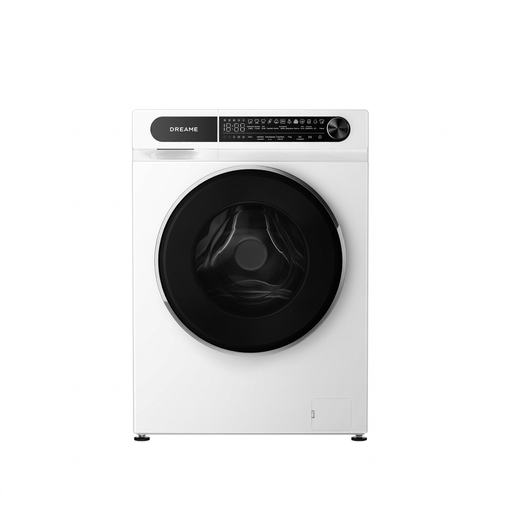 Image unavailable
For a studio flat, compare its stated 8 kg capacity with the size of your loads: UFC-Que Choisir says that 5 to 7 kg is generally enough for one person or a couple. Before choosing this model, check the installation plan for the space needed to open the door and accommodate the connections.
Measure the width, depth and height of the space, then allow room to open the door in front of a front-loader or the lid above a top-loader. Also check the delivery route, space for the hoses and the installation plan for the exact model.
UFC-Que Choisir says that 5 to 7 kg is generally enough for one person or a couple. Adjust this guide to suit your usual loads and check the load limits for the programmes you plan to use.
Only if its capacity and intended uses suit your everyday laundry. If you can’t install a standard machine, check how you’ll wash bulky items before choosing a mini model.
ADEME recommends checking energy and water use, noise levels and spin performance. Noise matters particularly if the machine is near your living area; spin performance is worth considering if you dry clothes indoors.