What should you check before choosing?
First, measure the route in and the space where the machine will go, allowing for the door or lid to open. Then compare only machines that will fit and can be used there.
| Factor |
What to check |
What I need |
| Dimensions and opening |
Measure the model’s overall width, height and depth. Allow room to open the lid on a top-loader or the door on a front-loader, as well as space for the connections. |
I need to be able to get the machine into the property, position it without blocking the way and load the laundry. According to the French National Consumer Institute, a top-loader is generally 40 to 45 cm wide but around 60 cm deep; a front-loader needs space in front of it. |
| Under-worktop installation |
Check the dimensions of the space, the manufacturer’s installation guidance and the clearance needed for the door. Don’t assume a machine will fit just because it’s a front-loader. |
My space is under a worktop, so I need a model that’s approved for this type of installation and has a door that I can still use. |
| Capacity |
Compare the capacity in kg with the amount of laundry you usually do and how often you wash. Check the dimensions of each machine you’re considering, too. |
I’d rather choose a capacity that suits my laundry than go for a large drum without thinking about how I’ll use it. ADEME recommends matching the capacity to your actual needs. |
| Noise and consumption |
On the energy label for the exact model, compare the energy class, kWh per 100 cycles, litres per cycle, the duration of the reference cycle and the noise level. |
In a room that’s also a living space, I want to compare spin noise and consumption across machines that fit my space. The European Commission says these figures are shown on washing machine energy labels. |
| Delivery and collection |
Check with the retailer what access arrangements apply, whether delivery to the room is included and what any installation service covers. If you’re replacing a machine, check how the old one can be collected. |
I want to know who will take the machine to its final position and how the old one will be collected. France’s DGCCRF reminds shoppers that, when buying a new appliance in France, the retailer must take back an equivalent used appliance free of charge under the “one-for-one” rule. |
| Another option |
If no machine can be installed and used in your home, consider the practicalities of a nearby launderette, including access, opening hours and travel. |
If I can’t install a machine at home, using a launderette from time to time is still an option, although I’ll need to travel there for each wash. |
A few well-known brands and models
These manufacturer examples show the differences in dimensions to look out for; they don’t guarantee that a particular model is available from any retailer.
Whirlpool
Whirlpool France’s specifications for the TDLR 6267 FR top-loader give a width of 40 cm, a depth of 60 cm and a capacity of 6 kg.
- Its width may work well if getting the machine through a narrow entrance is your main concern.
- You’ll need to leave space above it for loading and allow for its 60 cm depth.
Electrolux
Electrolux France lists slim front-loaders with depths generally ranging from 33 to 45 cm. The EW6S1064NA specifications give a depth of 411 mm and a capacity of 6 kg.
- This format is worth considering if depth is your main constraint.
- Slim models in this range are still generally 60 cm wide and need clearance in front of the door.
Candy
Candy France’s specifications for the ProWash 300 TCA463D3-S top-loader give a width of 405 mm, a depth of 600 mm and a capacity of 6 kg.
- Its width is another example of a top-loader worth considering for a narrow entrance.
- Its specifications show an energy class of C. Compare the label for the exact model with those of other machines you’re considering.
Front-loading washing machines available on Joybuy
These three front-loaders are options to consider for doing your laundry at home, provided their dimensions suit your studio flat. Check each machine’s full dimensions and installation requirements before choosing.
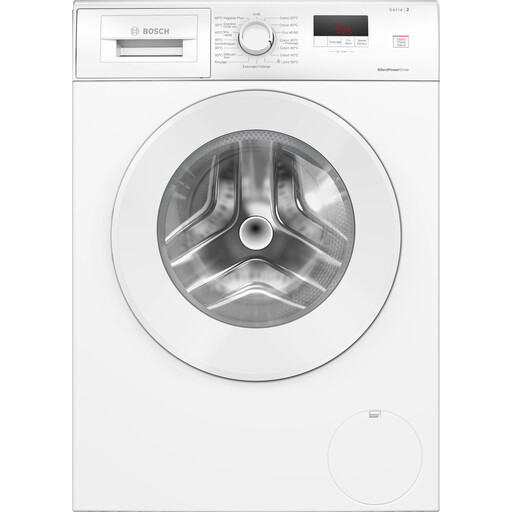 Image unavailable
Bosch WGE02407FR, 7 kg front-loader
A front-loader to consider if you have room in front of the door. The model name indicates a 7 kg capacity, a 1,400 rpm spin speed and an energy class of A. Check its overall depth and installation requirements if you’re thinking of fitting it under a worktop.
View on Joybuy
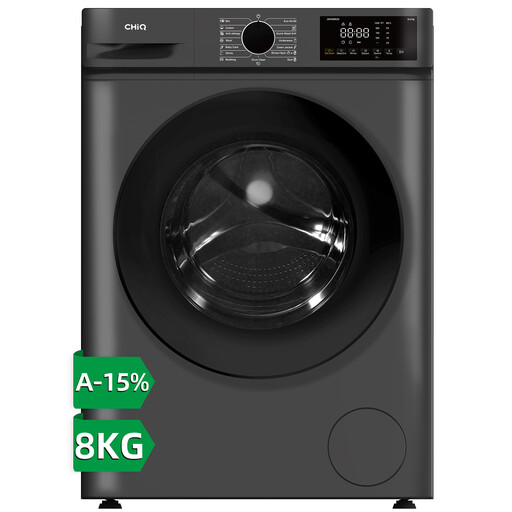 Image unavailable
CHiQ JW85883G, 8 kg dark grey front-loader
Compare its stated 8 kg capacity with the amount of laundry you usually do. The product name indicates a 530 mm drum and a 1,400 rpm spin speed. Before choosing it for a shallow space, check its overall width and depth, including the door and connections.
View on Joybuy
 Image unavailable
Electrolux EW7FI259160V, 9 kg front-loader
Compare its stated 9 kg capacity with the amount of laundry you actually do. The product name indicates a 1,600 rpm spin speed, along with SteamCare, SmartSelect and connected features. Check the space it takes up with the door open and its installation requirements before considering it for a studio flat.
View on Joybuy
Frequently asked questions
Will a 40 cm top-loader definitely fit in a narrow studio flat?
Not necessarily. Its width may solve the problem of getting it through a narrow entrance, but not issues with depth or opening the lid. The French National Consumer Institute says top-loaders are generally around 60 cm deep, so measure the space above the lid as well.
Can you install a slim front-loader under a worktop?
It’s possible if the front-loader is suitable for this type of installation, but “slim” on its own doesn’t tell you that. Check the manufacturer’s guidance, the dimensions of the space, room for the connections and clearance for the door. According to Electrolux France, its slim front-loaders generally have a reduced depth while remaining close to 60 cm wide.
Which figures should you compare on the energy label?
For machines that fit your space, compare the energy class, kWh per 100 cycles, litres per cycle, the duration of the reference cycle and the noise level. The European Commission says these figures appear on washing machine energy labels. ADEME also recommends choosing a capacity that suits your needs.
Will the retailer collect an old washing machine free of charge?
In France, the DGCCRF reminds shoppers that when a new appliance is sold, the retailer must take back an equivalent used appliance free of charge under the “one-for-one” rule. Before placing your order, check how to arrange collection with the retailer.
Does delivery to the room include installation?
Not necessarily. Check separately where the machine will be delivered and whether positioning and installation are included for the model you’ve chosen. France’s DGCCRF treats these as separate after-sales services and says any costs must be made clear before and at the time of purchase.


