What should you check before choosing?
Front-loading
Consider it: if the width, depth and door clearance all work in your studio flat.
Bear in mind: its stated noise level alone can’t predict how much vibration will travel through the floor.
Compact top-loading
Consider it: if the alcove is too narrow for the front-loader you had in mind.
Bear in mind: a narrower machine isn’t necessarily quieter during the spin cycle; check its capacity too.
Anti-vibration accessory
Consider it: for a working machine that’s already installed securely, after checking how it’s set up.
Bear in mind: Wpro’s claim that its mat reduces noise is a manufacturer claim, not a measurement of the disturbance in your home.
Once you’ve found an option that fits the space, compare the spin-cycle figures for the exact model and make sure you can meet its installation requirements.
| Priority |
What to check |
Think about your needs |
| Spin-cycle noise |
Compare the spin-cycle dB rating and airborne noise emission class on the label or product information for the exact model. The European Commission distinguishes these details from energy and water information. |
My washing machine will be near my living area, so I want to compare spin-cycle noise figures rather than rely on the word ‘quiet’ alone. |
| Stability |
Check that the floor is flat and stable and all four feet are firmly in contact with it, as recommended by UFC-Que Choisir. Leave enough space to prevent contact with furniture, and check that the washing is evenly distributed. |
I want to reduce shaking and impacts that can be felt around the home, not just the noise in the room. |
| Space required |
Measure the width, height and depth, and allow room for the door or lid to open. LG France lists a depth of 1,100 mm with the door open for the front-loading F84V35IXS; Electrolux France gives a width of 400 mm for the top-loading EW6T3465DA. |
A machine needs to do more than fit in the alcove: it must also open properly and be installed without touching the furniture. |
| Capacity |
Check the capacity of the specific model and compare it with the amount of washing you usually do. Electrolux France lists a 6 kg capacity for the EW6T3465DA; this figure doesn’t tell you how noisy it is. |
If I choose a top-loader to save space, I still want a capacity that suits my laundry loads without overfilling the drum. |
| Accessory |
Before using a mat or pads, check that the machine is stable and that the accessory suits its footprint and weight. Don’t rely on it to fix an unstable floor or incorrectly adjusted feet. |
My machine is already working, so I’d rather check how it’s installed before considering an accessory or a replacement. |
A few models from well-known brands
These models illustrate features worth checking. Their inclusion here is not a ranking or an indication of availability.
LG
The front-loading F84V35IXS is an example of a detailed product specification that lets you check both noise levels and the space required.
- LG France lists 73 dB(A) during the spin cycle, a noise class of B and dimensions of 600 × 850 × 565 mm. The depth with the door open is 1,100 mm.
- The airborne noise figure doesn’t measure vibrations travelling through the floor in your home.
Bosch
The front-loading WAJ28057FF gives you a chance to look at the stability features highlighted by its manufacturer.
- Bosch highlights a SilentPowerDrive motor and AntiVibration design on this model.
- These names don’t let you compare its noise level with another machine. Check the energy label for the exact model.
Electrolux
The top-loading EW6T3465DA is an example of a narrower machine for a tight alcove.
- Electrolux France lists dimensions of 890 × 400 × 600 mm and a capacity of 6 kg.
- Its width doesn’t mean it will be quieter during the spin cycle than a front-loader; check its noise figures separately.
Whirlpool
The brand provides an example of a top-loader with a published spin-cycle noise figure and sells an anti-vibration mat under the Wpro name.
- Whirlpool France listed 72 dB(A) during the spin cycle for the TDLRSX7232BSFR; Wpro describes its mat as designed to reduce noise and slipping.
- Whirlpool says this top-loader is no longer in its catalogue. Wpro’s description of the mat doesn’t guarantee a measurable reduction in disturbance in a block of flats.
Two top-loading washing machines for a narrow space
These two Joybuy options are top-loaders for when width is your main concern. Their design alone doesn’t mean they’ll disturb other occupants less than a front-loader. Compare the energy label for the exact variant and check how much space you’ll need to install it.
 Image unavailable
Candy TCA464TM4-S ProWash 500, 6 kg top-loader
Its top-loading design is worth considering if the width of your alcove limits your choice of front-loader. The product name indicates a 6 kg capacity and a spin speed of 1,400 rpm. Before choosing this model for a living area, check its dimensions and the spin-cycle noise figures on the energy label for this exact variant. You’ll also need a flat, stable floor.
View on Joybuy
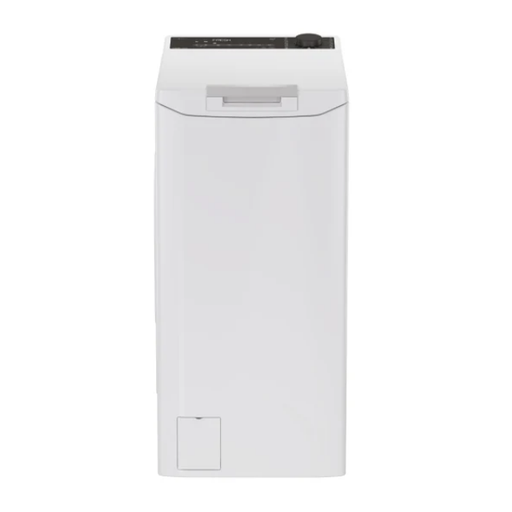 Image unavailable
Haier T Series 7 THASN276TM6-S, 7 kg top-loader
This top-loader is another option to measure up for a narrow alcove. Its name indicates a 7 kg capacity and a spin speed of 1,200 rpm. Check that there’s enough space for the lid to open and for the machine to be installed, then look up the spin-cycle noise figures for the exact variant. Neither its capacity nor its spin speed can predict how much vibration your neighbours will feel.
View on Joybuy
Frequently asked questions
Which figure should I compare to find a quieter washing machine during the spin cycle?
Compare the spin-cycle dB rating and airborne noise emission class for the exact model. The European Commission says washing machine energy labels include information on noise emissions; a marketing term such as ‘quiet’ isn’t a substitute for this figure.
Will a lower dB rating prevent neighbours from feeling vibrations?
No. The airborne noise figure alone doesn’t describe what travels through the floor. To reduce issues caused by the installation, follow UFC-Que Choisir’s recommendation: use a flat, stable floor and make sure all four feet are firmly in contact with it. Also check that the machine isn’t touching furniture and that the washing is evenly distributed.
Is an anti-vibration mat enough for a washing machine that shakes?
No. Wpro describes its mat as a way to reduce noise and slipping, but it doesn’t replace checks on the floor, feet and clearance around the machine. If the shaking is abnormal despite a correct installation, don’t assume an accessory will fix the cause.
Is a top-loader always better suited to a studio flat than a front-loader?
A top-loader is mainly useful when width is limited. Check its height, depth, lid clearance, capacity and spin-cycle noise too. Its compact design doesn’t prove that it will cause less disturbance than a properly installed front-loader.
Should I think about my neighbours when choosing when to run the spin cycle?
Yes, particularly if the machine is close to a neighbouring home. Service-Public.fr says noise from household appliances may be considered a nuisance if it amounts to an abnormal disturbance of the neighbourhood. Bear the potential disturbance in mind when setting the spin cycle, and check the rules that apply in your building.


