Renters or students short on space
In a narrow kitchen or small bathroom, the deciding factor may be depth, width or the space needed to open the drum door. First work out which measurement is actually preventing you from installing a machine.


For regular laundry in a small home, a slimline front-loader is usually the best choice when depth is limited, while a narrow top-loader suits spaces where width is the issue. A mini washing machine is better suited to very small loads or occasional use: its capacity and, depending on the model, compatibility requirements may limit how you can use it. Before choosing, measure the space needed to open the machine and reach the connections, then make sure its capacity suits the amount of laundry you do.
In a narrow kitchen or small bathroom, the deciding factor may be depth, width or the space needed to open the drum door. First work out which measurement is actually preventing you from installing a machine.
If you do your laundry regularly at home, compare the capacity with your usual loads before opting for a mini format. Slimline front-loaders and 6 kg top-loaders are two options, provided they fit the space and suit your connections.
UFC-Que Choisir lists studios and student rooms among the situations where a mini washing machine may be worth considering. For small loads, though, check the capacity and installation requirements of the specific model: some cannot be used on their own.
Start by identifying which dimension is preventing installation, then check the capacity, connections and practical features of models that will genuinely fit in your home.
Consider this: if depth is limited and there’s room to open the door in front of the machine.
Bear in mind: a shallower machine won’t solve a lack of width.
Consider this: if width is limited and the lid can open freely above the machine.
Bear in mind: the 40 cm-wide top-loaders listed by Electrolux France and Whirlpool France are also 60 cm deep.
Consider this: for very small loads or when a standard washing machine can’t be installed.
Bear in mind: its limited capacity may mean doing more washes; also check whether the model can operate independently.
| Factor | What to check | What you need |
|---|---|---|
| Space and opening | Measure the width, depth and height, then allow extra room for the hoses and for the door to open, or the lid to lift. | I need to be able to install the machine and load the laundry without blocking the way or the lid. |
| Capacity | Compare the kg of dry laundry with your usual loads and how often you’re happy to wash. UFC-Que Choisir points out that choosing the wrong capacity can mean doing more cycles or using more resources than necessary. | I want a capacity that suits my everyday laundry, rather than a small drum that means splitting every wash into smaller loads. |
| Installation | Check the water supply, drainage, power socket and floor stability. Follow the installation requirements in the manual for the model you choose. | Before ordering, I need a space where the connections can be made and the machine can be levelled. |
| Everyday use | When comparing models that will fit, look at comparable results for washing, rinsing and spinning, as well as cycle length, energy and water use, and noise. These are among the criteria assessed by UFC-Que Choisir in its washing machine comparison. | In a living space, noise and cycle length matter just as much to me as the stated capacity. |
A shallower front-loader may still be too wide for an alcove, while a narrow top-loader may stick out too far.
Measure all three dimensions of the space separately, then allow room for the hoses and for the machine to open.
A very small capacity means splitting laundry into smaller loads. According to LG France, the 2 kg TWINWash Mini FM27K5WH only works underneath a compatible LG washing machine or washer-dryer.
For everyday laundry, first compare capacities that will fit your space. If you’re considering a mini model, check that it will work in your set-up.
The size of the machine doesn’t guarantee that your water supply, drainage, socket and floor are suitable for installation.
Read the manual for your chosen model and check the space before delivery. Ask a professional to assess any installation that needs to be added or altered.
UFC-Que Choisir says that the wrong capacity can lead to more wash cycles or unnecessary water and electricity use.
Estimate the amount of dry laundry you usually have and how often you want to wash before comparing capacities in kg.
These models illustrate different space and installation requirements. They don’t necessarily represent the features of other models from each brand, or mean that these products are included in the Joybuy selection.
These two models make it easy to compare a slimline front-loader with a top-loader of the same stated capacity.
The TDLR6261BFR shows how a top-loader could work when width is your main constraint.
The TWINWash Mini FM27K5WH is an example of a mini model for small loads, with an important installation requirement.
These options include two top-loading washing machines and one front-loader. For a studio, compare each machine’s capacity with your laundry needs, and check its installation dimensions, opening clearance and connections before choosing.
 Image unavailable
This top-loader is worth considering if you can leave the lid clear. The product name lists a 6 kg capacity, a 1,400 tr/min spin speed, a B energy rating, 17 programmes, an Inverter motor and Wi-Fi. Measure the full space, including the clearance above and room for the hoses.
 Image unavailable
This top-loader needs clear access to the lid, and its 7 kg capacity should be compared with the amount of laundry you usually have. The product name lists a 1,200 tr/min spin speed, an A energy rating, steam, an Inverter motor and Wi-Fi. Check the total space required and the connections in your home.
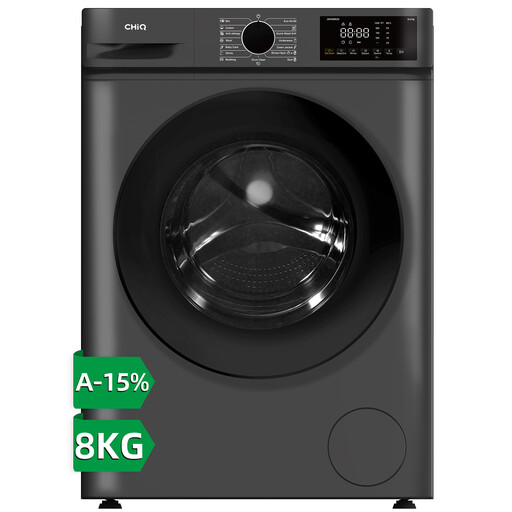 Image unavailable
Before considering this front-loader for a small home, check its width, overall depth and the space needed in front of the door. The product name lists an 8 kg capacity, a 1,400 tr/min spin speed, 16 programmes and a steam function. Compare its capacity with your usual loads, rather than choosing based on space alone.
Measure the available width, depth and height, along with the clearance needed in front of a front-loader or above a top-loader. Check access to the water supply, drainage and socket, then check the chosen model’s installation dimensions and levelling instructions.
Yes, if 6 kg suits your usual loads and the machine can be installed and connected properly. For example, Electrolux France lists the EW6S1064NA as having a 6 kg capacity and a depth of 411 mm. You’ll also need to leave space for the door to open.
No. It may save width without taking up less depth. Their manufacturers list the EW6T4613HA and TDLR6261BFR as 40 cm wide and 60 cm deep; both also need clearance above the lid.
For everyday laundry, first check whether its capacity suits your loads and how often you wash. UFC-Que Choisir presents mini washing machines as an option when it isn’t possible to install a standard model. According to LG France, the 2 kg TWINWash Mini FM27K5WH needs to be installed underneath a compatible LG appliance.
Check the manual for requirements relating to the power supply, water inlet, drainage and the machine’s stability. The Electrolux instructions consulted specify, among other things, an earthed socket and a flat, hard floor. Ask a professional to assess any set-up that needs to be added or altered.