What should you check before choosing?
First, measure the space and the clearance needed to open the machine. Then make sure its capacity suits the loads you actually do.
| Consideration |
What to check |
What I need |
| Overall size and opening clearance |
Measure the width, depth and height, including the connections. Allow room for the door or lid to open. A slim front-loader mainly reduces depth, while a top-loader mainly reduces width. |
I need to be able to install the machine without blocking the way or preventing it from opening. |
| Usable capacity |
Compare the kg of dry laundry with the load limits for the programmes you use. Que Choisir gives 5 to 7 kg as a general guideline for one or two people. The maximum capacity quoted applies to the cotton or eco 40-60 programme. |
For my regular laundry, I want a drum that avoids extra cycles without often being underfilled. |
| Using a mini washing machine |
Check the washing and spin capacities separately, as well as the drainage and connections. A listing found on ManoMano France specifies 3 kg for washing and 1 kg for spinning. These figures apply to the model listed, not to all mini washing machines. |
If I mainly wash small items or want to put the machine away after use, I could consider one for occasional use. For household laundry, I need to check how much it can actually handle. |
| Noise and energy use |
Compare the energy rating, kWh per 100 cycles, litres per cycle and the noise figures on the label. ADEME presents these as useful points of comparison between washing machines. |
If the machine is close to my living space, I want to know how noisy it is during the spin cycle as well as how much energy and water it uses. |
| Durability |
Check the durability index out of 10 that applies to washing machines in France. The French ministry responsible for ecology says it takes spare parts, maintenance and resistance to wear into account, among other factors. |
If two appliances fit my space and suit my laundry needs, I also want to compare how easy they are to maintain and how durable they are. |
Joybuy options for a studio flat
These two options suit different needs: a top-loading washing machine for regular laundry when width is limited, and a foldable mini machine to consider for occasional use or easy storage.
 Image unavailable
Candy TCA464TM4-S ProWash 500, 6 kg top-loader
A top-loader is worth considering if width is limited, as long as there’s room to open the lid. The product title lists a 6 kg capacity, 1 400 rpm spin speed, B energy rating, inverter motor, Wi-Fi and 17 programmes. Check the dimensions, connections and clearance above the machine before choosing where to put it.
View on Joybuy
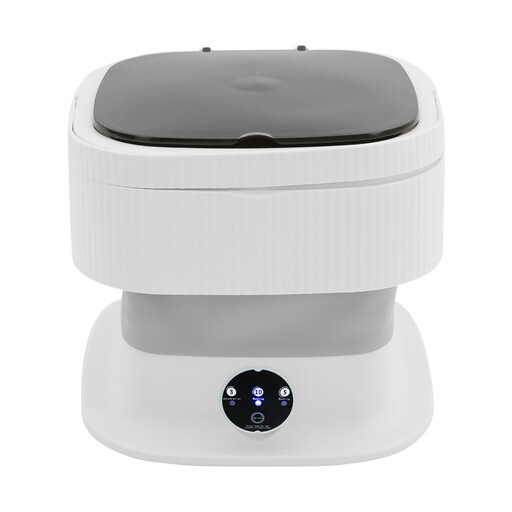 Image unavailable
10 L foldable portable mini washing machine
Its foldable design could suit you if you need to save space or want a machine for occasional use. The product title lists 2, 5 and 10-minute modes, a 40 W motor, 320 rpm, a draining basket and suction cups. 10 L refers to volume, not laundry capacity in kg. Check the washing and spin capacities, dimensions when unfolded and drainage requirements before considering it for your laundry.
View on Joybuy
Frequently asked questions
What capacity should one person choose for a studio flat?
Que Choisir generally recommends 5 to 7 kg for one person or a couple. Choose a capacity to suit how often you do laundry and the fabrics you wash. The kg figures refer to dry laundry, and the maximum load may be lower for some programmes.
Can a mini machine replace a full-size washing machine?
Not necessarily. A mini machine is best suited to occasional use if it can’t handle your usual laundry loads. A listing featured by ManoMano France gives a portable model a 3 kg washing capacity and a 1 kg spin capacity. Check both figures for the model you’re considering rather than guessing its laundry capacity from its size or volume in litres.
What should you compare on the energy label?
For washing machines covered by European energy labelling, ADEME recommends checking the energy rating, kWh per 100 cycles, litres of water per cycle and noise figures. Compare these with the capacity and type of machine you need.
What is a washing machine’s durability index for?
In France, the durability index out of 10 helps you compare factors such as parts availability, maintenance and resistance to wear. According to the French ministry responsible for ecology, it has been gradually replacing the repairability index for washing machines since 8 April 2025. Check it once you’ve confirmed that the models you’re comparing suit your space and laundry needs.


