One person in a studio flat or with a kitchenette
If space is limited in width or height and you shop often, a tabletop fridge is worth considering. Just make sure its compartments can hold the food you usually buy.


For one person, the 100–150 litres recommended by UFC-Que Choisir is a useful starting point. Adjust this to suit the space available, how often you shop and how much frozen food you need to store. A tabletop fridge can work well when space is tight, provided it has enough capacity. A fridge freezer takes up more room but gives you a separate freezer, while an integrated model needs to fit your cabinet and meet its installation requirements exactly.
If space is limited in width or height and you shop often, a tabletop fridge is worth considering. Just make sure its compartments can hold the food you usually buy.
If you regularly keep several frozen meals, compare the freezer capacity separately from the fridge capacity. A fridge freezer could suit your needs, as long as it fits comfortably in your kitchen.
If your fridge is concealed behind a cabinet door, measure the housing and check the door fixing, opening direction and ventilation instructions in the manual before choosing a model.
Start by measuring the available space, then work out how much room you need for fresh and frozen food. Next, compare the noise levels and energy consumption of the formats that fit.
| Factor | What to check | Think about your needs |
|---|---|---|
| Capacity and frozen food | Compare the fridge and freezer capacities separately. UFC-Que Choisir gives 100–150 litres as an average guide for one person, to be adjusted according to how often you shop and how much frozen food you eat. | I often do small shops, so a large capacity could take up space I don’t need. If I store several frozen meals, I also need to check the capacity of the dedicated compartment. |
| Space and installation | Measure the width, height and depth, then check how far the door swings open. For an integrated model, compare the housing dimensions, door fixing and ventilation requirements in the model’s manual. | My appliance needs to fit under a worktop or inside an existing cabinet without obstructing the door. |
| Noise and energy consumption | Compare the stated noise level in dB(A). Also check the energy rating and annual consumption in kWh, comparing appliances with similar capacities and formats. | In a room that doubles as a living space or bedroom, I want to be able to assess the stated noise level rather than assume a small appliance will be quiet. |
| Food storage | Check the temperature settings and the features of the freezer compartment. Anses recommends keeping food at between 0 and +4 °C in the coldest part of the fridge. | I want to be able to control the temperature for fresh food and know what the freezer compartment is designed for before storing frozen food in it. |
Two appliances with a similar total capacity can allocate space differently between fresh and frozen food. UFC-Que Choisir points out that a small freezer compartment may not be enough, depending on how much frozen food you eat.
Estimate how much you usually keep in each compartment, then compare their capacities separately. Use the 100–150-litre guide for one person as a starting point, not a fixed rule.
A similar height doesn’t guarantee that the housing, depth or cabinet-door fixing will be right. For example, Electrolux specifies a housing size of 880 x 560 x 550 mm for the LFB3AE88S, compared with 1780 x 560 x 550 mm for the ENS3LE18S.
Measure the cabinet’s three internal dimensions and check the installation manual for the model you’re considering, including the door and ventilation requirements.
In a studio flat, the appliance may run close to where you sleep or work. Its size alone won’t tell you how noisy it is.
Check the dB(A) level on the product information or label for models that already meet your space and storage needs.
These models illustrate different width and built-in installation requirements. Their dimensions are no substitute for measuring your kitchen.
Two tabletop models to consider when width is a key concern.
Integrated models in different sizes for kitchens with an existing housing.
An integrated model to consider if you need plenty of fresh-food storage and have the space for it.
This 92 l single-door fridge could suit a small kitchen if its capacity meets your needs. Check separately what you can store in its freezer compartment.
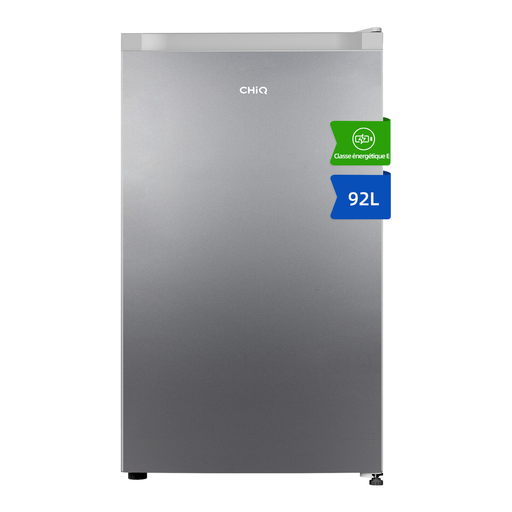 Image unavailable
Its stated capacity of 92 l could suit people who shop little and often, but it’s below the 100–150-litre guide for one person given by UFC-Que Choisir. The product name indicates a freezer compartment and an E energy rating. Check the freezer’s capacity and star rating against your frozen-food needs, as well as the full dimensions, noise level and annual energy consumption, before choosing.
UFC-Que Choisir gives 100–150 litres as an average guide for one person. Adjust this according to how often you shop, and compare the space for fresh and frozen food separately.
It may be enough for occasional use, but UFC-Que Choisir points out that a small freezer compartment may not be sufficient, depending on how much frozen food you eat. Check its capacity and star rating rather than relying on its presence alone.
Measure the internal height, width and depth of the housing, then check the cabinet-door fixing, door opening and ventilation requirements in the manual. For example, Electrolux France specifies a housing size of 880 x 560 x 550 mm for the LFB3AE88S and 1780 x 560 x 550 mm for the ENS3LE18S.
Anses recommends a temperature between 0 and +4 °C in the coldest part of the fridge. Check the setting and monitor the appliance’s temperature, especially when the amount of food inside changes.
Check the stated annual consumption in kWh and the energy rating, then take usable capacity and appliance type into account. An energy rating on its own won’t tell you how much space you need.