What should you look for?
Measure the space before comparing product details: an appealing noise level won’t make up for a door that can’t open or a capacity that doesn’t suit your shopping habits.
| What matters |
What to check |
Who is it for? |
| Noise disturbance |
Compare the stated dB levels and noise classes of similarly sized models; also check the installation instructions. |
If I sleep or work near the fridge, I want to limit sounds that might catch my attention in a quiet room. Around 33% of consumers rank this as a priority. |
| Space and installation |
Measure the width, depth and height, and check the door clearance; confirm the required clearances for the model you’re considering. |
With an alcove or narrow entrance, I need to be able to install and use the appliance without blocking its ventilation. This comes first for around 27% of consumers. |
| Capacity and freezing |
Check the capacity of the fridge and freezer compartments against your storage habits. |
If I keep meals to freeze, the space for frozen food matters as much as the room for fresh produce. Around 20% of consumers prioritise this factor. |
| Energy consumption |
Compare kWh/year and usable capacity between appliances designed for the same purpose, rather than looking at the energy rating alone. |
For an appliance that stays plugged in all the time, I want to check its energy consumption without giving up the capacity I need. This is the priority for around 20% of consumers. |
Fridges available on Joybuy
These models include two freestanding fridge-freezers for spaces where they can be installed, and one built-in model to consider only if you have a compatible kitchen unit. The stated noise level can help you compare them, but it doesn’t guarantee they’ll be inaudible near a bed.
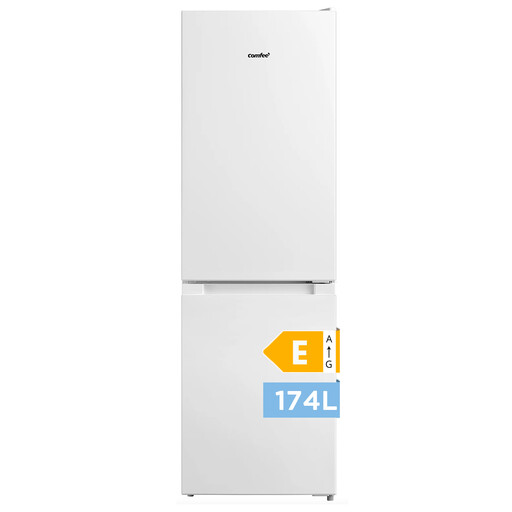 Image unavailable
Comfee' RCB169WH2(E), 174 L 70/30 fridge-freezer
Worth considering if you want a freestanding fridge-freezer and have enough room for an appliance that’s 150 cm tall. The product title lists a 39 dB noise level, a 4-star freezer, a reversible door, Low Frost and an energy rating of E. Compare the noise level without treating it as a guarantee of a good night’s sleep. Before deciding, also check the installation clearances and kWh/year.
View on Joybuy
 Image unavailable
Hisense RB3B250SAWC, 252 L built-in fridge-freezer
Consider this if your studio already has a suitable kitchen unit for a built-in fridge-freezer. The product title lists No Frost, an energy rating of C and an inverter compressor. Before buying, check that the housing, door fitting and ventilation meet the model’s requirements; also compare its stated noise level with those of the other appliances you’re considering.
View on Joybuy
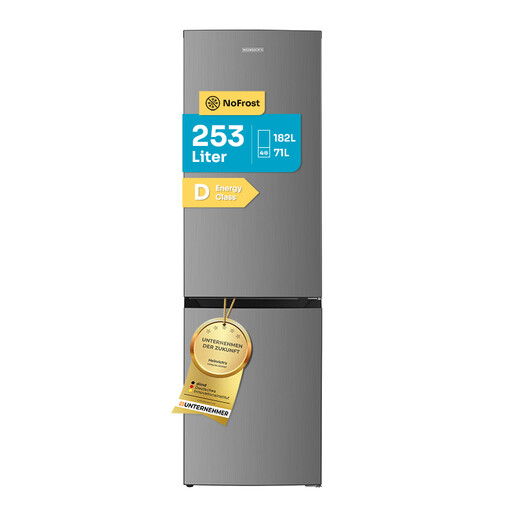 Image unavailable
Heinrich´s, 253 L fridge-freezer
Worth considering if you want a separate freezer compartment and have room for a fridge-freezer taller than a table-top model. The product title lists 182 L for the fridge and 71 L for the freezer, as well as No Frost and a 39 dB noise level. Before choosing it for a studio flat, check its full dimensions, required clearances and annual energy consumption. The 39 dB figure doesn’t indicate whether it will be disruptive near your bed.
View on Joybuy
Frequently asked questions
Will a fridge described as quiet be inaudible at night?
No. According to Que Choisir, the level shown on the label isn’t enough to tell whether the appliance will disturb your sleep. Compare the stated figures of similar models, while also bearing in mind the sounds they make during operation and how they’re installed in your room.
Can you place a fridge against a wall in a studio flat?
Only if the model’s instructions allow it. Bosch says some Perfect Fit appliances are suitable for this type of installation, but this feature doesn’t apply to other models. Check the required clearances and airflow for the appliance you choose.
When should you plug in a fridge after delivery?
Follow the instructions for the model you’ve received. In its installation guidance, Electrolux recommends waiting at least 4 hours before plugging the appliance in, to allow the oil to flow back into the compressor. Check the instructions for your particular appliance.
Is the energy rating enough to choose between two models?
No. When choosing a fridge for a studio flat, also compare kWh/year, usable capacity and whether there’s a freezer compartment, looking at appliances designed for the same purpose. ADEME points out that actual energy consumption varies depending, among other things, on the appliance’s size and how it’s used.


