Someone who lives alone and shops little and often
A table-top fridge can save space if you don’t store much between shopping trips. However, compare its usable capacity with Que Choisir’s average guide figure of 100 to 150 L for one person.


For one person, Que Choisir gives an average guide figure of 100 to 150 L of usable capacity. A table-top fridge of around 90 L may be suitable if you shop frequently and have limited storage needs. If you regularly keep frozen food, consider the capacity of a compact fridge-freezer instead. In a studio flat, also check the installation dimensions, door clearance and stated noise level before choosing.
A table-top fridge can save space if you don’t store much between shopping trips. However, compare its usable capacity with Que Choisir’s average guide figure of 100 to 150 L for one person.
If your fridge is near your bed or desk, compare the stated noise levels of the models you’re considering. Que Choisir classifies fridges below 40 dBA as the quietest.
Check the capacity of the freezer compartment, not just the total capacity. For example, BUT lists an 11 L compartment for the Frigelux R0TT94BE. Compare this with your shopping needs before opting for a small freezer.
Start with the space available and what you need to store between shopping trips. Then compare the installation and running requirements of the models that could work for you.
| Criteria | What to check | Depending on your needs |
|---|---|---|
| Size | Measure the overall width, height and depth. Check the delivery route, the space needed with the door open and the clearances specified in the instructions. For a built-in model, also check the housing unit and door-fixing requirements. | I want the appliance to fit in my kitchen without blocking the way or stopping a neighbouring cupboard from opening. |
| Usable capacity | Que Choisir gives 100 to 150 L as an average guide figure for one person. Compare the fridge capacity with your usual shopping: around 90 L leaves less room if you shop less often. | If I shop little and often several times a week, I may be able to manage with less capacity. If I shop less frequently, I need enough room to last between trips to the supermarket. |
| Freezing | Check the fridge capacity separately from the freezer compartment capacity. Look at the compartment’s capacity and the model’s food-storage guidance: simply having a freezer compartment doesn’t tell you how much you can store in it. | A few ice cubes or the occasional frozen item don’t need as much space as regular frozen-food shopping. |
| Noise | Compare the stated noise emissions in dB(A) on a like-for-like basis. According to Que Choisir, the quietest fridges are below 40 dBA. Also consider where you plan to place the appliance in relation to areas where you rest. | My bed or desk is close to the kitchen, so the stated noise level matters as much as the appliance’s size. |
| Energy | The energy label described by the European Commission shows details including the energy class, energy consumption, capacity and noise emissions. Compare the annual energy consumption of appliances with a similar type and capacity. | I want to take energy consumption into account without choosing an appliance that’s too small for my shopping. |
| Room temperature | Check the model’s climate class and the corresponding range of ambient temperatures. Make sure it’s suitable for the room where you plan to install the fridge. | My kitchen can be chilly or get very hot, so I need to choose a fridge that suits the actual conditions. |
This is below Que Choisir’s average guide figure of 100 to 150 L for one person. It leaves you with less room if you prepare meals in advance or shop less often.
Work out how much space your fresh food, drinks and meals take up over a typical week. Choose this smaller size only if your storage needs are genuinely limited.
The Frigelux R0TT94BE listed by BUT has an 11 L freezer compartment, out of a total capacity of 91 L. This can quickly limit the room available for frozen food.
If you buy frozen food regularly, compare the compartment’s capacity and food-storage guidance with those of a compact fridge-freezer.
A reversible door doesn’t, by itself, guarantee enough clearance to open it against a wall or cupboard. A built-in model must also fit the kitchen unit and meet its installation requirements.
Measure the space, delivery route and clearance needed with the door open. For a built-in model, also check the housing unit, hinges, door panel and ventilation requirements in the instructions.
The energy class doesn’t replace the annual energy consumption, usable capacity or noise level shown on the label described by the European Commission. The climate class answers a different question: what ambient temperatures the appliance is designed for.
Compare kWh/year for models of a similar size, then check that the climate class is suitable for the room.
FAR models show the range of capacities available for smaller homes. BUT lists two table-top fridges with capacities of 91 L and 128 L.
The R0TT94BE gives you an idea of what to expect from a table-top fridge with a small freezer compartment.
BUT lists the built-in CMLS68EW with a capacity of 135 L and a stated noise level of 39 dB.
Electro Dépôt lists a 102 L Valberg top fridge among its models for smaller spaces.
The model below is a small, single-door fridge with a freezer compartment, worth considering if you shop frequently and have limited storage needs. Check that its freezer compartment and installation requirements suit your needs.
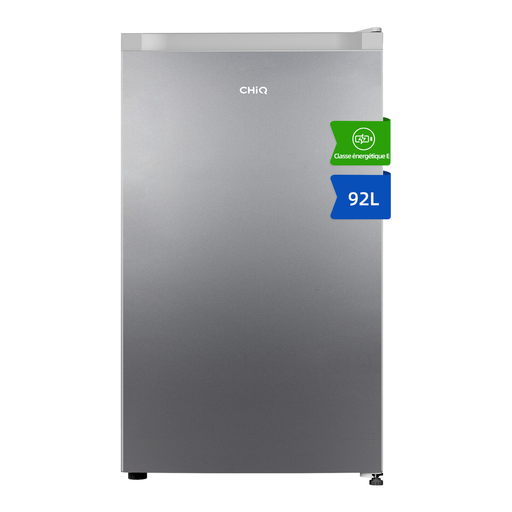 Image unavailable
Its 92 L capacity may suit you if you shop little and often and don’t store much food at a time. However, this is below Que Choisir’s average guide figure of 100 to 150 L for one person.
The model name indicates a freezer compartment, and the appliance has an energy class of E. If you plan to store frozen food or place the appliance near your bed, check the compartment’s capacity and the stated noise level. Also measure the space, taking the overall dimensions and door clearance into account.
Que Choisir gives 100 to 150 L as an average guide figure for one person. Around 90 L may be enough if you shop little and often and don’t store much. Work out how much room you need for fresh food before choosing this size.
The figure helps you compare models, but it doesn’t guarantee that the noise won’t bother you. Que Choisir classifies fridges below 40 dBA as the quietest. Check the stated noise level on the label and consider how close the fridge will be to where you sleep.
It shows the range of ambient temperatures the fridge is designed to operate in. Check that the model’s climate class covers the conditions in your kitchen, especially if it’s unheated or gets very hot.
Anses recommends keeping food between 0 and +4 °C in the coldest part of the fridge. Check the temperature and avoid overfilling the appliance so that cold air can circulate.
The ministries responsible for the ecological transition list several options for electrical appliances: a collection point, recycling centre, retailer or social and solidarity economy organisation. If you’re buying a new appliance, ask the retailer how to arrange the return and collection of your old one.