What should you check before choosing?
First decide where the appliance can go, then match its capacity and freezer space to your shopping habits before comparing noise levels and energy consumption.
| Consideration | What to check | Your needs |
|---|
| Space and installation |
Measure the height, width and depth; check the door swing and the clearances specified in the manual. For a built-in model, also check the housing unit and door fixing. |
I want to keep the walkway clear and be able to open the door without it hitting a cupboard. |
| Noise |
Compare the stated dB(A) levels of models suited to your space. Que Choisir’s benchmark is below 40 dB(A), but this alone doesn’t tell you how noisy it will seem in your home. |
My kitchen opens onto the room where I spend time or sleep, so the appliance’s operating noise matters to me. |
| Capacity and freezer space |
Que Choisir recommends an average of 100 to 150 L of usable capacity for one person. Check the fridge capacity and freezer compartment capacity separately, and look at the interior layout. |
I shop regularly and mainly store fresh food. If I regularly buy frozen food, I need to make sure the freezer has enough space. |
| Energy consumption |
Compare the energy label and annual consumption in kWh for appliances with a similar size and capacity. According to the European Your Europe portal, fridge energy labels run from A to G, with no « + » ratings since 2021. |
I want to compare appliances suited to the same needs, rather than choosing based on the letter on the energy label alone. |
Which branded models offer useful comparisons?
These models illustrate different installation and capacity requirements. Their inclusion here doesn’t mean they’re available to buy.
Bosch
The KTR15NWEB and KTL15NWEB table-top models let you compare two different capacity configurations in the same stated dimensions of 85 × 56 × 58 cm.
- According to Bosch’s product details, both have a noise level of 39 dB(A). The KTR15NWEB offers 134 L of fridge space and no freezer, while the KTL15NWEB offers 106 L with a freezer compartment.
- Your choice will therefore depend in part on how much room you need for fresh food and how much you’ll use the freezer compartment.
Beko
The TSE1234FSN table-top model is worth considering if you have limited width available.
- Beko states that this model is 54 cm wide.
- That alone doesn’t confirm it will fit your space. Check the other dimensions, door clearance and noise level of the version you’re considering too.
Electrolux
The EXB3AE82R is an example of an under-counter built-in fridge, worth considering if your kitchenette already has a suitable housing unit.
- Electrolux lists a total net capacity of 134 L, a noise level of 38 dB and a required installation niche height of 820 mm.
- Before installation, you’ll need to check the niche dimensions, door fixing and ventilation. It won’t automatically replace a freestanding appliance.
Which fridges should you look at on Joybuy?
These two options are designed for different installations: a built-in fridge-freezer and a compact single-door fridge. First check which one will fit your space.
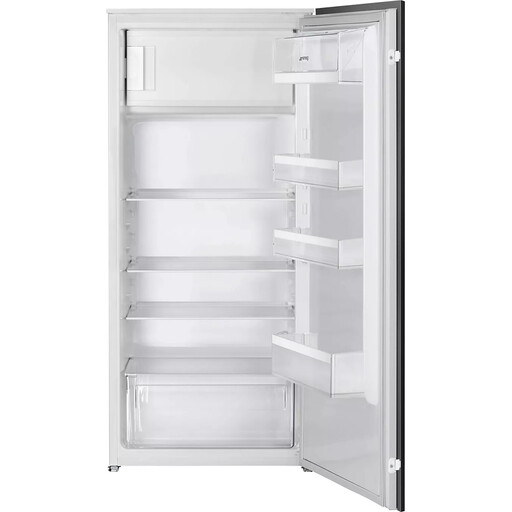 Image unavailable
SMEG S4C122E, 188 L built-in fridge-freezer
Worth considering for a kitchenette designed to house a built-in appliance. This single-door model has a freezer at the top and an E energy rating. Before choosing it, check that the installation niche, door fixing and ventilation meet its requirements.
View on Joybuy
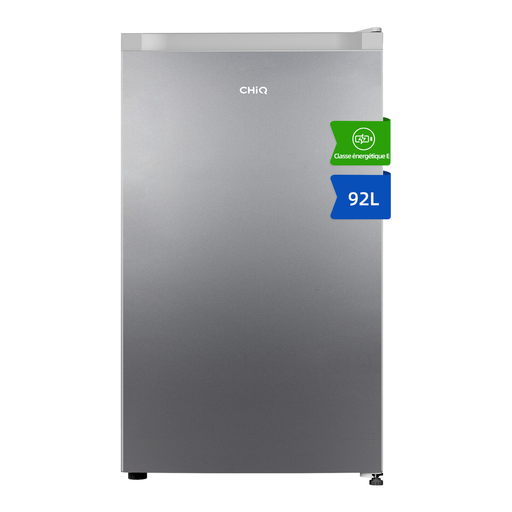 Image unavailable
CHiQ JR92DSE, 92 L single-door fridge
Its stated capacity of 92 L may suit frequent shopping and limited storage needs, although it’s below Que Choisir’s average recommendation of 100 to 150 L for one person. The model name indicates a small freezer compartment, and it has an E energy rating. For an open-plan kitchen, check the stated noise level, dimensions and installation clearances.
View on Joybuy
Frequently asked questions
What capacity should one person allow for in a studio flat?
Que Choisir recommends an average of 100 to 150 L of usable capacity for one person. Adjust this guide to how often you shop and how much fresh food you store, then check that the appliance’s dimensions suit your room.
What noise level should you look for in an open-plan kitchen?
Compare the stated dB(A) levels of models with enough capacity for your needs. Que Choisir’s benchmark for a quiet appliance is below 40 dB(A). In a living space, its location and installation in line with the manual are also important.
Is a table-top fridge with a small freezer compartment enough for frozen food?
It may be suitable if you only keep a few frozen items or ice cubes. If you regularly buy frozen food, check the freezer compartment’s capacity and consider a model with more space, while bearing in mind its overall size.
Can you replace a freestanding fridge with an under-counter built-in model?
Only after checking the housing unit and the built-in model’s requirements. For example, the Electrolux EXB3AE82R is specified for an 820 mm niche and a sliding door fixing system. Check the installation diagram and ventilation requirements too.
How do you compare the energy consumption of two small fridges?
Compare their annual consumption in kWh and energy labels, looking at models with similar capacities and dimensions. The European Your Europe portal says fridge energy labels run from A to G, and that the old ratings with a « + » are no longer used for these appliances, as of 2021.


