What should you check before choosing?
Que Choisir describes three formats designed to overcome different obstacles: a slimline front-loader if depth is limited, a top-loader if width is limited, and a mini washing machine for occasional use when a standard appliance cannot be installed. Whichever format you choose, check the model’s usable capacity and connections.
Slimline front-loader
Consider this if: you have around 60 cm of width, but the machine would stick out too far into the walkway. Que Choisir gives a depth of around 33 to 45 cm for slimline models.
The trade-off: you’ll need clearance in front of the appliance to open the door. Que Choisir gives a capacity of around 4 to 6 kg for this format.
Top-loading washing machine
Consider this if: the width of the space is the main obstacle. Que Choisir gives a width of around 40 to 46 cm for this type of machine.
The trade-off: the lid needs room to open, so a top-loader won’t fit beneath a fixed worktop.
Mini washing machine for occasional use
Consider this if: you can’t install a standard appliance and plan to wash small loads.
The trade-off: Que Choisir gives a capacity of 2 to 3 kg and weak spin performance; this format isn’t well suited to bulky items.
| What to consider |
What to check before buying |
Why it matters |
| Overall size and opening |
Measure the space, including skirting boards and connections, then check how much room you’ll need to open the door or lid of the exact model. |
If the machine blocks the walkway or its door won’t open, doing the laundry becomes impractical, even if the appliance fits into the space. Around 36% of consumers rank installation space as their most important need. |
| Usable capacity |
Compare the capacity in kg with the loads you wash, including bedding and towels. Que Choisir suggests 5 to 7 kg as a guide for one or two people. |
To wash my everyday laundry without splitting each load across several cycles, I need a drum that suits the textiles I wash. This is the main requirement for around 29% of consumers. |
| Connections |
Locate the water supply, waste outlet and socket, then check them against the model’s instructions. Have a professional assess the installation before any electrical work. |
A free space is no use to me if I can’t connect the appliance there in line with its instructions. For around 21% of consumers, checking that installation is possible comes before all other criteria. |
| Access and drying |
Try out how you’ll load the machine with a laundry basket, and compare spin information for models that provide it. |
If I often load the machine in a cramped space or dry laundry indoors, access to the drum and spin performance matter every day. Around 14% of consumers make this their main priority. |
Mini washing machines for occasional use on Joybuy
This foldable mini washing machine is an option for small loads when you need an extra appliance and can’t install a standard washing machine. Check how it can be used before deciding whether it’s right for your usual laundry.
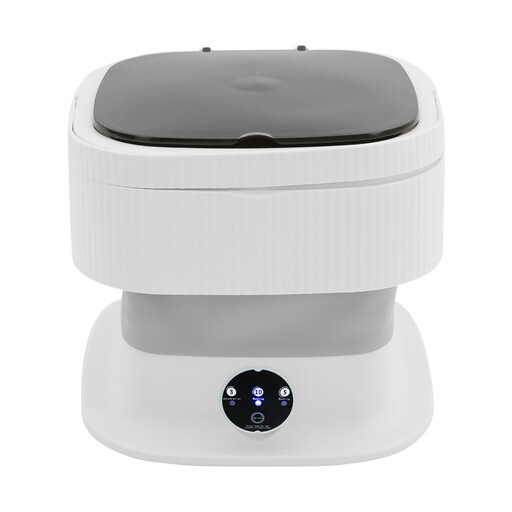 Image unavailable
10 L foldable mini washing machine with drain basket
Its foldable design may suit occasional use in a studio flat or student room, provided its dimensions and installation requirements work with the space you have.
The product title lists three wash times, 2/5/10 min, a 40 W motor, a drain basket and suction cups. The 10 L refers to volume, not laundry capacity in kg, so check the permitted load before buying.
Also check the dimensions when the appliance is open, its power supply and drainage, and its spin performance if you plan to dry laundry indoors.
View on Joybuy
Frequently asked questions
Is a slimline washing machine narrower than a standard front-loader?
Not necessarily. For the slimline models described by Que Choisir, it’s mainly the depth that’s reduced, to around 33 to 45 cm, while the width is generally close to 60 cm. If width is your main obstacle, consider a top-loader instead, but make sure there’s enough height to open the lid.
Can a mini washing machine be the main appliance in a studio flat?
It may be suitable for small loads, but it won’t automatically replace a main washing machine. Que Choisir gives a capacity of 2 to 3 kg for this category, with weak spin performance and difficulty washing bulky items. Also check whether the model you’re considering heats the water.
Do you need a hot water supply to install a washing machine?
Not for the front-loading and top-loading washing machines covered by Electrolux’s guidance: the brand says they’re designed for a cold water supply. For a different model, follow its own instructions rather than assuming it uses the same connections.
What should you check about a washing machine’s electrical connection in France?
Check that the electrical installation is suitable for the appliance before deciding where to put it. For installing or adapting a washing machine circuit, Legrand’s guide to applying NF C 15-100 specifies a dedicated circuit, a maximum 20 A circuit breaker, conductors of at least 2.5 mm² and Type A residual-current protection. In an existing home, ask a qualified professional to check the socket and circuit if you’re unsure or planning any work.


