Anyone without an obvious space for a washing machine
Whether you’re looking at a kitchen, bathroom or narrow alcove, check the machine’s width, depth and height, the space needed to open it and the connections required before choosing a style.


In a studio flat, start by choosing a washing machine that fits the space, can be opened properly and can be connected up. A top-loader is mainly suited to tight spaces where width is the issue, while a slim front-loader is designed for spaces with limited depth. A standard front-loader may also work if its full dimensions fit. Then compare the capacity you need for your laundry with the noise, water and energy figures for the exact model.
Whether you’re looking at a kitchen, bathroom or narrow alcove, check the machine’s width, depth and height, the space needed to open it and the connections required before choosing a style.
If the machine will be close to where you sleep or work, compare the stated noise level during the spin cycle for each model you’re considering. The EU energy label provides this figure.
If you mainly wash clothes for one or two people, match the drum capacity to the amount of laundry you actually build up between washes rather than automatically choosing the largest capacity.
The right style depends on which dimension is genuinely limited: width for some top-loaders, depth for some slim front-loaders. If there’s nowhere with the connections the machine needs, compare the cost and practicality of doing your washing elsewhere before ordering one.
Worth considering: when width is the main obstacle and there’s enough room to open the lid fully.
Bear in mind: a narrow width doesn’t necessarily mean a shallow machine. According to Whirlpool France, one of its 40 cm-wide models is also 60 cm deep.
Worth considering: when depth is limited, but there’s enough width and space in front of the door.
Bear in mind: ‘slim’ doesn’t mean one standard depth. Candy France gives a guide range of around 45 to 50 cm, while Electrolux France has a range that’s 41 cm deep.
Worth considering: if the space can accommodate the machine and leave enough room to open the door.
Bear in mind: it may take up more room. Candy France gives around 60 × 60 × 85 cm as a guide for a standard-size model.
| Factor | What to check | What matters to shoppers |
|---|---|---|
| Size and access | Measure the width, depth and height, as well as the space needed to open the machine; compare these with the dimensions of the exact model. | In a narrow alcove, I want to be able to install the machine without blocking the walkway or the door. Around 37% of shoppers prioritise having enough space. |
| Connections | Check where the water supply, waste outlet and electricity supply are, then consult the model’s manual. | If the space doesn’t have suitable connections, I need to know what work is required before ordering. Around 27% of shoppers put this first. |
| Noise during the spin cycle | Compare the stated noise levels during the spin cycle using the same energy label, and check the installation instructions. | When the machine is close to my bed or a shared wall, my main concern is keeping noise to a minimum. Around 18% of shoppers prioritise noise. |
| Capacity and usage | Match the stated capacity in kilograms to your usual laundry load. Also check water per cycle, energy per 100 cycles and the durability index, where available. | For regular small loads, I prefer a suitable capacity and usage figures I can compare. Around 18% of shoppers put this need first. |
ADEME recommends choosing a capacity that suits your actual needs and checking the energy label for water, energy, spin performance and noise. The European Commission explains that the label also shows energy per 100 cycles, water per cycle, cycle duration and noise emissions. Compare these figures for models that can actually be installed in your home.
A narrow top-loader can still be deep, while a slim front-loader still needs space in front of its door. The style name alone won’t tell you whether it will fit your space.
Measure the width, depth and height separately, along with the opening and access space, then compare them with the specifications for the exact model.
A large drum won’t necessarily suit someone who does small loads regularly. ADEME says that a 7 kg capacity is enough most of the time, but this isn’t a rule for every household.
Estimate how much laundry you actually build up between washes before comparing capacities.
A claim about a range won’t tell you the noise level during the spin cycle for every model. If your washing machine will be in a living space, compare the stated noise level for each model.
Check the noise figure on the energy label or product specifications for your chosen model, and follow its installation instructions.
Even if a machine fits in the space, it may still need a water supply, waste outlet or electricity supply to be installed.
Check the manual for your chosen model and get any necessary changes assessed before buying.
Top-loading models to consider if you have limited width.
Slim front-loaders to consider when depth is the main constraint.
A slim front-loading range to consider if there’s room to open the door.
These two machines suit different spaces: a top-loader if width is an issue, and a 7 kg front-loader if your home can accommodate its dimensions and leave room to open the door.
 Image unavailable
A top-loader is worth considering if width is your main constraint, provided there’s enough headroom to open the lid.
Stated capacity: 6 kg; maximum spin speed: 1 400 tr/min; energy rating B. Compare its noise level during the spin cycle and its full dimensions with those of the other models you’re considering.
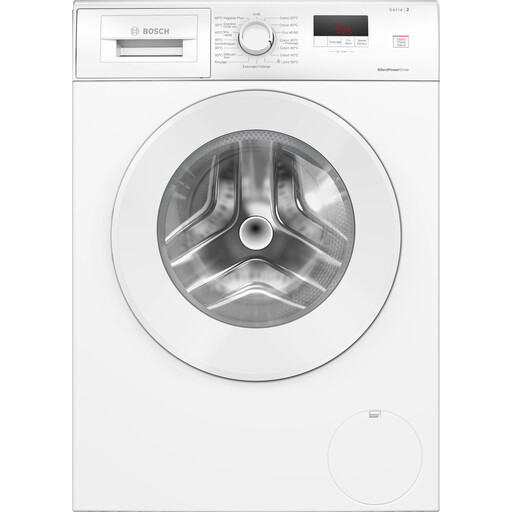 Image unavailable
This front-loader is worth considering if you have a deep enough space and a clear area in front of the door.
Stated capacity: 7 kg; maximum spin speed: 1 400 tr/min; energy rating A. Check its full dimensions and connection instructions before choosing it for a studio flat.
Compare the capacity and, on the EU energy label, the energy rating, energy per 100 cycles, water per cycle, cycle duration, spin performance and noise. ADEME recommends checking water, energy, spin performance and noise in particular. However, treat the machine’s dimensions and whether it can be installed as your first checks.
No. Width alone tells you nothing about the depth or the space needed to open the lid. According to Whirlpool France, the TDLR6247FR/N top-loader is 40 cm wide, but it’s also 60 cm deep and 90 cm high. Compare all the dimensions of the model you’re considering with your available space.
No. A slim front-loader is mainly designed to reduce depth, but it still needs space in front of the door. Also check its width and height, the access space and room for the connections using the specifications for the exact model.
Find the manual for the exact washing machine model and check its instructions against the space you have in mind. Check the door opening, water supply, waste outlet and electricity supply. If any changes are needed, get them assessed before buying.