What should you check before choosing?
Start with your usual shopping, then rule out any formats that won’t fit the space or allow the door to open. Next, compare the noise levels and energy consumption of models that meet your storage needs.
| Criteria | What to check | Depending on your needs |
|---|
| Fresh food capacity |
Compare the fridge’s usable capacity with the space taken up by your usual shopping. If the appliance has a freezer compartment, distinguish the fridge capacity from the total capacity. |
I shop little and often: a table-top model may be enough. If I shop less frequently, I check that all my fresh food will fit without filling the fridge to the brim. |
| Freezer space |
Check whether there’s a freezer compartment, how much space it offers and its specifications. Don’t infer its capacity from the total capacity alone. |
If I regularly buy frozen food, I compare the space available for it rather than choosing a model just because it has a small freezer compartment. |
| Installation |
Measure the height, width and depth, and check how far the door swings open. Consult the manual for ventilation requirements. For an integrated model, also check the housing unit and door-front fixing. |
My kitchenette is narrow or already fitted: I need to be able to install the appliance, open its door and leave the required clearance. |
| Noise and electricity |
Compare the stated noise level and annual energy consumption in kWh across models with a suitable format and capacity for the same use. Don’t rely on the energy rating alone. |
I sleep near the kitchenette, so the stated noise level matters when I’m choosing. I also check the energy consumption of an appliance that, as ADEME points out, runs continuously. |
| Food storage |
Leave enough space for air to circulate and check the temperature in the coldest area. ANSES recommends keeping this area at 4 °C. |
After shopping, I want to be able to put perishable food in the cold zone without overfilling the fridge. |
A few brands and models to consider
These examples show a range of configurations. Check the dimensions and specifications of the exact model you’re considering.
Beko
Beko offers table-top fridges designed for smaller spaces, including models with and without a freezer compartment.
- Beko lists the TSE1264FMGN as 54 cm wide.
- The TSE1504FN is a table-top fridge without a freezer, so check that it suits your frozen food shopping habits.
Liebherr
The KTe500 is an example of a table-top fridge with dimensions and capacity specified by Liebherr.
- Liebherr lists the KTe500 as 85 × 50 × 60,7 cm, with a total capacity of 110 litres and a noise level of 35 dB.
- These external dimensions don’t replace the need to check ventilation and door clearance in the space where you plan to put it.
Electrolux
The LFB3DE12S is an example of an integrated fridge for a kitchen with a suitable housing unit.
- Electrolux specifies an appliance height of 1 218 mm and a housing unit measuring 1 225 mm high and 560 mm wide for this model.
- Check all housing unit dimensions, ventilation requirements and door fixing details before choosing this appliance.
Fridges to compare on Joybuy
These models offer two options for a studio flat: prioritise fresh food storage in a small appliance, or make room for a freezer compartment too. Compare their capacity with your shopping needs before checking whether they’ll fit in your kitchen.
 Image unavailable
CHiQ JR227LSE, 227 L fridge freezer, silver
Worth considering if you need space for both fresh and frozen food: the model name lists 153 L for refrigeration and 74 L for freezing, with a 4-star freezer compartment.
It also lists a width of 54 cm, a reversible door, Low Frost technology and an E energy rating. The total capacity of 227 L may be more than you need if you shop little and often. Check the height, door clearance and ventilation before choosing where to put it.
View on Joybuy
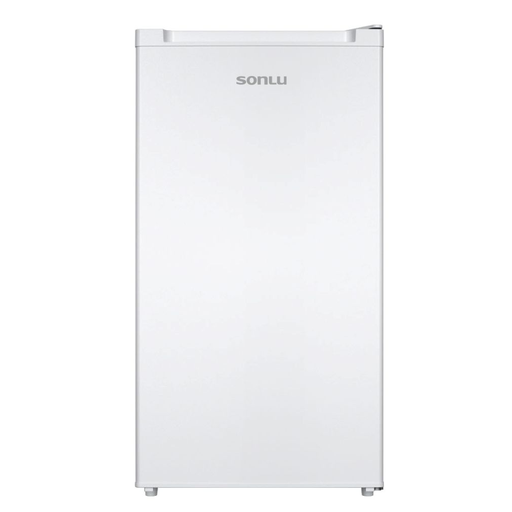 Image unavailable
Sonlu CS-100L, 82 L single-door fridge
If you shop frequently, compare its 82 L capacity with the amount of fresh food you usually store.
The model name lists an E energy rating. Check its dimensions and interior layout before deciding where to put it or whether it will suit your frozen food storage needs.
View on Joybuy
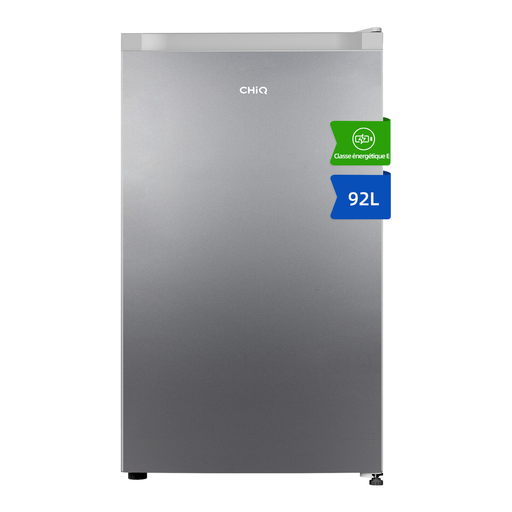 Image unavailable
CHiQ JR92DSE, 92 L fridge with freezer compartment
This format may suit a small kitchen if 92 L is enough for your shopping and you’d like a freezer compartment.
The model name lists a footprint of 0,22 m² and an E energy rating. Before planning to store frozen food, check the compartment’s capacity and specifications. Also check the full dimensions and installation clearances.
View on Joybuy
Frequently asked questions
What capacity do you need if you live alone in a studio flat?
Start with the amount you shop for between trips to the shops, then check the fridge’s usable capacity. If you buy frozen food, look separately at how much space is set aside for it: the total capacity doesn’t tell you how well the fridge will meet both needs.
What temperature should you keep perishable food at?
ANSES recommends keeping an eye on the temperature in the coldest area of the fridge and maintaining it at 4 °C. Use the manual to find this area, store perishable food there and avoid overfilling the appliance so air can circulate.
Will an integrated fridge fit in any kitchen unit?
No. The housing unit dimensions, ventilation and door fitting must all match the model. For the LFB3DE12S, Electrolux specifies a housing unit 1 225 mm high and 560 mm wide, among other requirements. Check all installation details before choosing.
How should you compare noise and energy use in a studio flat?
Compare the stated noise level and annual energy consumption in kWh across appliances with a capacity that suits your shopping habits. If you sleep near the kitchenette, factor in the noise level. Don’t compare different capacities on energy rating alone.
What should you do with an old fridge in France?
In France, a used fridge comes under the electrical and electronic equipment waste scheme described by the ministry responsible for ecological transition. Before your new appliance is delivered, ask the retailer or your local authority which collection or take-back options are available at your address.


