Someone living in a studio flat without frozen-food storage
If your kitchen is narrow or open-plan, check that a compact appliance has enough room for your fresh food, fits the space available and is quiet enough for you.


For a studio flat, an under-counter fridge may be enough if you don’t need to freeze food. If you shop less frequently and buy frozen food, consider a fridge freezer with a separate freezer compartment instead. First, measure the space and the delivery route, then check the clearances specified in the manual. An integrated model must also fit the cabinet space and door-fitting system.
If your kitchen is narrow or open-plan, check that a compact appliance has enough room for your fresh food, fits the space available and is quiet enough for you.
If you need to store several days’ worth of fresh food as well as frozen food, compare the fridge and freezer capacities separately, while also considering how much space the appliance will take up in your kitchen.
When replacing an integrated appliance, check that the new model is compatible with the internal dimensions of the cabinet space, the door fixing and the ventilation requirements before comparing its capacity.
First rule out any appliances that can’t be installed, then work out how much space you need for fresh food and, separately, for frozen food. Noise levels and the energy label can then help you choose between models that meet your needs.
| Feature | What to check | Who it matters to |
|---|---|---|
| Space and installation | Measure the height, width and depth, as well as the delivery route and door clearance. For an integrated model, also check the cabinet space, door fixing and clearances specified in the manual. | In a small kitchen, I need to be able to get the appliance in and install it without blocking a door or ventilation. Around 36% of consumers put these installation constraints first. |
| Fridge capacity | Compare the usable capacity of the fridge compartment alone. Que Choisir suggests an average guide of 100 to 150 l for one person, plus 50 l for each additional person. Adjust this to suit your shopping habits. | If I shop less frequently, I need enough space to keep fresh food until my next shop. This is the top priority for around 29% of consumers. |
| Freezer capacity | Check whether there is a freezer and its separate usable capacity. A large total capacity on its own doesn’t tell you how much space there is for frozen food. | If I regularly store frozen food between shops, an appliance without a suitable freezer compartment won’t meet my needs. Around 21% of consumers put freezer space first. |
| Noise and energy use | Compare the stated noise level in dB(A), then check the energy class and annual consumption in kWh on the energy label for the models you’re considering. | In a living area, I pay attention to noise. I also want to compare the energy use of appliances that fit my kitchen. For around 14% of consumers, this everyday comfort is the main consideration. |
An under-counter fridge may have enough room for fresh food but no freezer. On the other hand, households that shop less frequently may find there isn’t enough room for frozen food, even if the total capacity seems sufficient.
Compare the usable capacity of each compartment separately, based on the food you usually store.
The depth, door clearance or delivery route could prevent installation. Ventilation requirements also depend on the appliance and how it is fitted.
Measure everything and check the manual before ordering. Bosch recommends at least 200 cm² of ventilation space behind and beneath the fridge in its installation advice; always follow the requirements for the model you choose.
Appliances of a similar height may need different cabinet spaces or door-fixing systems. The height of the door panel alone isn’t enough to confirm compatibility.
Measure the inside of the cabinet space, identify the existing door-fitting system and check these details against the new appliance’s manual.
Frost-free cooling or a particular energy class can’t make up for a lack of food storage space or an appliance that can’t be installed.
First shortlist models that fit the available space and offer the capacity you need. Then compare their cooling systems, noise levels and energy label details.
These ranges include useful formats to compare, but you should check capacity and installation requirements for the specific model, not assume they apply across a whole brand.
Bosch offers under-counter fridges, freestanding fridge freezers and integrated fridge freezers.
Liebherr offers fridge freezers with a separate freezer compartment, worth considering if frozen food is an important part of your decision.
Whirlpool offers both freestanding and integrated fridge freezers. Make sure you know which type you need before comparing their capacities.
Beko lists fridge freezers with fan-assisted cooling, a feature to consider once you’ve worked out the format and capacity you need.
These models include freestanding fridge freezers for storing fresh and frozen food, including one format worth considering for a small kitchen, as well as integrated models designed for a compatible cabinet space. Compare their capacities and installation requirements before choosing.
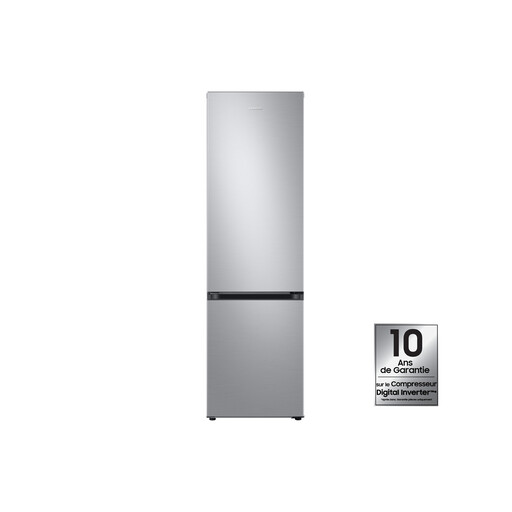 Image unavailable
Worth considering if you shop less frequently and also want to store frozen food. It has a stated energy class of C. At 203 cm tall, check the available space, delivery route and clearances specified in the manual.
 Image unavailable
For a fitted kitchen, consider this model only if it’s compatible with your cabinet space and door fixing. It is listed with No Frost and an energy class of C. Check the internal dimensions and ventilation requirements before buying.
 Image unavailable
Consider this freestanding fridge freezer if you need space for both fresh and frozen food. It has an energy class of E. At 185.3 cm tall and 65.8 cm deep, it’s important to check the available space, delivery route and clearances specified in the manual.
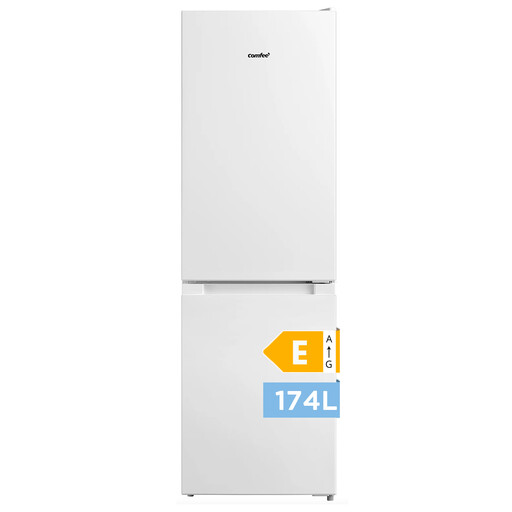 Image unavailable
Worth considering for a small kitchen if you also want a freezer, provided its capacity suits how much frozen food you buy. The model name lists a height of 150 cm, a noise level of 39 dB, Low Frost and an energy class of E. Also compare its annual energy consumption on the label.
 Image unavailable
If you’re replacing an appliance in a fitted kitchen, first check the cabinet space and sliding door-fitting system. This white model is listed with TwinTech No Frost and an energy class of E. Check the manual for ventilation clearances too.
Que Choisir suggests an average guide of 100 to 150 l of usable fridge space for one person, plus 50 l for each additional person. Use this as a starting point and adjust it to how often you shop. If you store frozen food, compare the freezer capacity separately.
Yes, if it has enough capacity for your fresh food and you don’t need a freezer. For example, Bosch states that the KTR15NWEB has 134 l of fridge space and no freezer compartment. Also measure the space and check the ventilation requirements for your chosen model.
No. The new fridge freezer must be compatible with the cabinet space, door-fitting system and installation requirements. For example, Bosch’s product specifications for the KIV875SE0 state that it has sliding hinges and measures 1,772 × 541 × 548 mm. These dimensions alone don’t confirm that it will fit your kitchen unit.
Compare their energy classes and annual consumption in kWh once you’ve confirmed that their capacities and features suit your needs. ADEME describes the energy label as a useful guide when choosing an appliance, but it doesn’t replace checking the dimensions, noise level and compartments.