If space is very limited
If your fridge needs to fit under a worktop or into a narrow corner, check its full dimensions, how the door opens and the ventilation requirements in its manual before deciding on capacity.


For your first studio flat, start by choosing a fridge that fits the available space, whose door can open properly and that meets the clearance requirements in its manual. A table-top fridge takes up less space; a fridge-freezer is better suited to regular frozen-food storage if you have room for it; and a single-door fridge with a freezer compartment is more suitable if you only need to freeze food occasionally. Then compare models by their capacities, stated noise levels and annual energy consumption.
If your fridge needs to fit under a worktop or into a narrow corner, check its full dimensions, how the door opens and the ventilation requirements in its manual before deciding on capacity.
If you buy small amounts at a time and mainly eat fresh food, a lower-capacity appliance may suit you. Just check whether you really need a freezer compartment.
If you shop less often or regularly store frozen food, compare the fridge and freezer capacities separately rather than relying on the total capacity alone.
When choosing a fridge for a studio flat, start with the space available and your shopping habits: the format determines how much room you’ll have for fresh and frozen food.
Consider this if: you need a low-level appliance and shop frequently.
Bear in mind: capacity is limited and, depending on the model, there may be no freezer.
Consider this if: you regularly store frozen food and want separate spaces for fresh and frozen items.
Bear in mind: check the dimensions particularly carefully in a studio flat.
Consider this if: you mainly store fresh food and only freeze things occasionally.
Bear in mind: the built-in compartment may not be big enough for regular frozen-food storage.
| Feature | What to check | Who should consider it? |
|---|---|---|
| Size and space | Full dimensions and door swing; clearances specified in the model’s manual. | When every centimetre counts, I want to be sure I can install the appliance and open the door without it getting in the way of the furniture. Around 36% of consumers put this compatibility first. |
| Capacity and freezing | Separate usable capacities for fresh and frozen food; type of freezer compartment. | If I shop less often or store frozen food, I need a capacity that suits my needs rather than a small appliance chosen for its size alone. Around 29% of consumers put storage ahead of everything else. |
| Noise | Stated noise level in dB(A) and where the appliance will go in the room. | If it’s near my bed or desk, I want to take the stated noise level into account before choosing. A quiet room is the priority for around 21% of consumers. |
| Energy consumption | Annual consumption in kWh and associated capacities, comparing appliances with similar features. | As the appliance runs continuously, I want to compare the stated energy consumption without overlooking the capacity I need. Around 14% of consumers put this feature first. |
A fridge may fit in the space you’ve set aside, but its door might not open far enough or the installation might not meet the manufacturer’s instructions.
Measure the route into your studio flat and the door swing too, then check the manual for the exact model to find out how much clearance it needs.
If you regularly store frozen food, the freezer compartment in a single-door fridge may be too small for your shopping habits.
Work out how much you usually store, then compare the type and capacity of the compartment with those of a fridge-freezer.
The energy rating alone doesn’t tell you how much space there is for your food, the stated noise level or the annual energy consumption.
The European Commission says that fridge labels include information such as energy consumption, capacity and noise emissions. Compare these details across models that meet similar storage needs.
A brand to consider for freestanding table-top fridges designed for compact spaces.
A brand to consider if you’re choosing between a low-level appliance and a fridge-freezer with separate compartments.
A brand to consider for a single-door fridge with a freezer compartment, particularly if you’re planning a built-in installation.
These models include fridge-freezers with separate spaces for fresh and frozen food, as well as a 92 L single-door fridge for more modest storage needs. Before deciding whether a model is right for your studio flat, check its installation dimensions.
 Image unavailable
Worth considering if you want separate capacities for fresh and frozen food and have checked all the dimensions of the available space.
Stated capacity: 153 L for the fridge and 74 L for the freezer. 54 cm wide, with a reversible door, adjustable feet, Low Frost and an E energy rating.
Before buying, check the model’s height, depth, door opening, ventilation requirements and annual energy consumption.
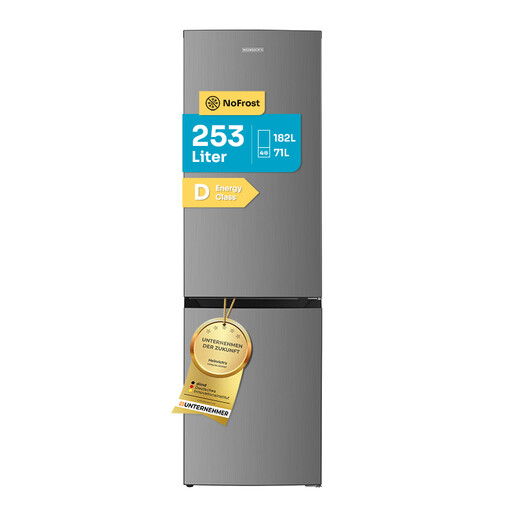 Image unavailable
Worth considering if you shop less often and need space for both fresh and frozen food, provided the dimensions are right for your space.
Stated capacity: 182 L for the fridge and 71 L for the freezer. Stated noise level of 39 dB, reversible door hinge and No Frost system.
Measure the full space and check the manual for installation requirements. Remember to compare annual energy consumption too.
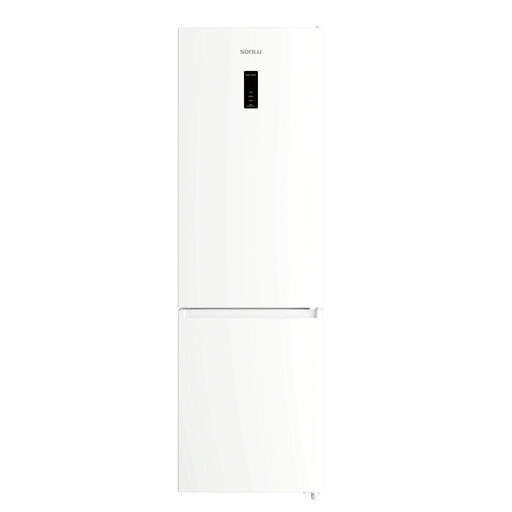 Image unavailable
Only consider this model if your storage needs justify the capacity and you have enough room for it in your studio flat.
Stated capacity: 252 L for the fridge and 103 L for the freezer. 60 cm wide, with a reversible door and an E energy rating.
Check the other dimensions, delivery access, ventilation requirements, stated noise level and annual energy consumption.
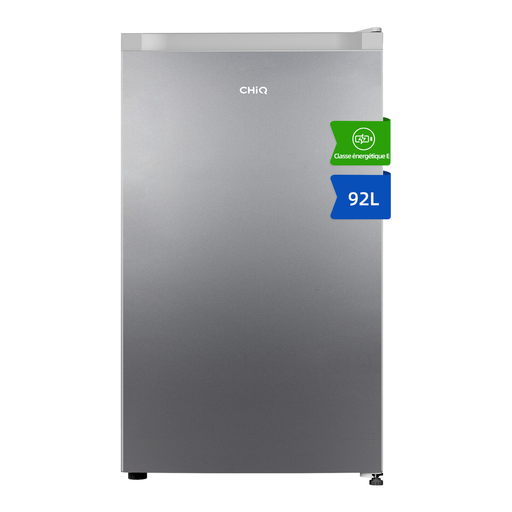 Image unavailable
Worth considering if you shop frequently and are happy with a 92 L capacity and a small freezer compartment.
Single-door fridge with a compact freezer compartment; E energy rating.
Check that the compartment capacity, full dimensions, stated noise level and annual energy consumption suit your needs.
Que Choisir gives 100 to 150 L of usable capacity as a general guide for one person. Use this as a starting point and adjust it to how often you shop. If you eat frozen food, compare the space for it separately.
Yes, if you shop frequently, need to save space and don’t need a separate freezer. Que Choisir recommends this format for studio flats; still, check the capacity and whether the model you’re considering has a freezer compartment.
Follow the clearance requirements in the manual for the model you want to install. Liebherr highlights the need for good ventilation where the appliance is installed, so measure the space with these requirements in mind, not just the appliance dimensions.
Compare the efficiency rating, annual energy consumption in kWh, storage capacities and stated noise level. The European Commission provides this information for fridges and freezers; start by comparing appliances with similar capacities and features that meet the same needs.