Renters without a dedicated water supply
A mini dishwasher with a water tank avoids the need to connect to a fixed water supply. However, you’ll need to fill the tank for every cycle and position the drain hose according to the instructions.


In a studio flat without a dedicated water supply, a mini dishwasher with a water tank could be a good choice if your dishes fit in its basket and you have somewhere to drain the wastewater. If you have the connections and floor space, consider comparing 45 cm models for larger loads too. A mini model that connects to the water supply keeps the worktop-friendly format without the need to fill a tank by hand.
The right size depends mainly on the space you have, access to water and how much washing-up you need to do.
A mini dishwasher with a water tank avoids the need to connect to a fixed water supply. However, you’ll need to fill the tank for every cycle and position the drain hose according to the instructions.
If you have space on the floor, it’s worth comparing a 45 cm model with a worktop appliance when small loads no longer suit your usual washing-up. Check the depth and installation requirements too.
Noise matters more when your kitchen shares your living space. Check each model’s noise level in dB and its noise class rather than assuming that a smaller appliance will be quieter.
First, decide where the appliance can go and how water will be supplied and drained. Then compare the basket and the energy label details to find a model that suits the way you’ll use it.
Consider this if: there’s no fixed water supply available and your dishes fit in a small basket.
The trade-off: you’ll need to fill the tank by hand and arrange for the water to drain after each cycle.
Consider this if: you want a worktop appliance without having to fill its tank for every cycle, and you have a compatible water connection.
The trade-off: you’ll need to check both the water connection and how the drain hose is secured.
Consider this if: you have a suitable space and connections, but the basket in a mini model would be too small.
The trade-off: you’ll need to set aside floor space; an integrated model also requires a compatible kitchen unit.
| Factor | What to check | What I need |
|---|---|---|
| Size | Measure the width, depth and height, then allow space to open the door. For a worktop appliance, check that the surface you plan to use is suitable too. | I want to keep enough worktop space for preparing meals, without blocking a cupboard or walkway. |
| Water supply and drainage | Check whether the model has a tank or what type of water inlet connection it needs. In either case, find out where the drain hose should go and how it should be secured, as shown in the instructions. | Without a dedicated water supply, I can fill a tank, but I’ll need a suitable place to drain the wastewater. |
| Usable capacity | Compare the number of place settings, the basket layout and the maximum plate diameter. Picture a load that includes your bowls, utensils or small pans too. | If dishes for two people build up, I’d rather check what fits in one load than rely on the number of place settings alone. |
| Noise and cycles | Check the dB level, noise class and Eco programme duration. ADEME notes that the energy label also shows water use in litres per reference cycle and energy use in kWh per 100 reference cycles. | In a one-room living space, noise during a wash matters to me just as much as the space the appliance takes up. |
| Installation and maintenance | Check where the socket, water supply and drain are, as well as the access you’ll need to maintain the appliance. Promotelec states that a dishwasher socket should be on a dedicated circuit. | I want to be able to install and use the appliance in my existing kitchen without finding out after buying it that a kitchen unit or connection needs adapting. |
A tank supplies water for the wash, but wastewater still leaves through a hose. Daan Tech’s connection guide says that the drain hose for its Bob model must be connected.
Before buying, locate the drain and check the instructions to see how to position and secure the hose in your home.
The stated capacity alone doesn’t tell you how much room there is for your plates, pans and utensils.
Measure your largest plate and compare the basket layout with the dishes you get through after a typical meal.
According to Bosch’s product details, the freestanding SPS2HKI55E measures 845 × 450 × 600 mm. Its depth matters just as much as its width when you’re finding a place for it.
Measure the space in all three dimensions and check the water supply, drainage and electrical circuit before settling on a fixed model.
You may also need work done to adapt a kitchen unit or connections before the appliance can be used.
A figure per cycle doesn’t tell you how many cycles your washing-up will need. ADEME explains that the water and energy figures on the label relate to reference cycles.
Compare litres per cycle, kWh per 100 cycles, capacity and Eco programme duration, then consider how often you’d need to fill each basket.
These examples show a range of different set-ups; they don’t necessarily represent every model from each brand.
The brand’s range includes Bob, a compact dishwasher designed to sit on a worktop.
The range includes slimline appliances for kitchens with a suitable installation space.
The brand offers a range of 45 cm dishwashers, including freestanding and integrated models.
These worktop appliances let you compare different capacities and ways of supplying water for a small kitchen. Check the dimensions, drainage and connections for the model you choose. This list isn’t a substitute for comparing 45 cm appliances if you have floor space available.
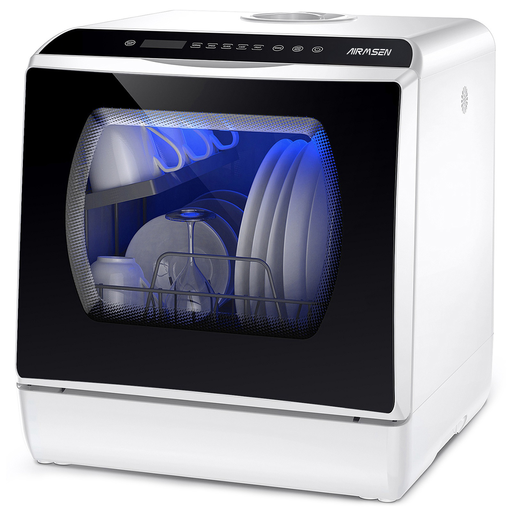 Image unavailable
The stated tank capacity could suit you if you don’t have a dedicated water supply. You’ll also need somewhere to drain the wastewater.
The title states that it has a 5 L tank and 5 + 1 wash cycles. If you have an open-plan kitchen, check the noise level before choosing.
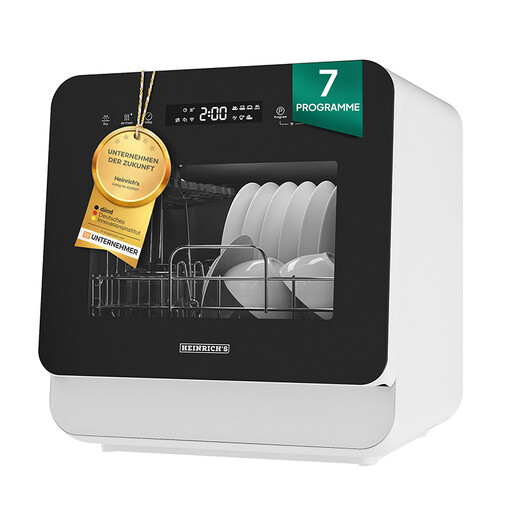 Image unavailable
This worktop size is worth considering for small loads; check whether its stated capacity of 3 place settings suits your plates and utensils.
The title states that it has 7 programmes and a noise level of 56.3 dB. Check the overall dimensions, as well as the water supply and drainage set-up at the intended location.
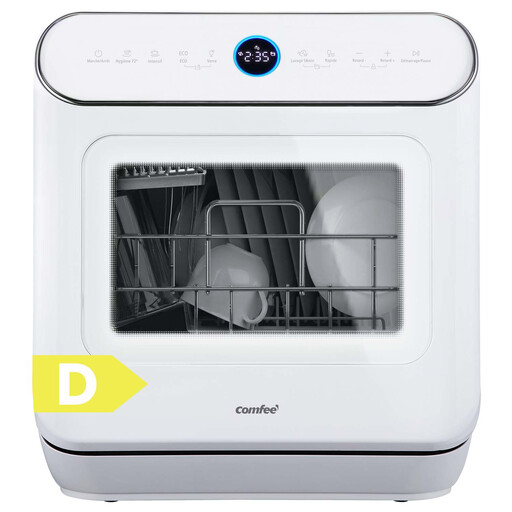 Image unavailable
The stated manual-fill design could suit you if you don’t want a permanent connection to the water supply.
The title states that it has 7 programmes and a 24-hour delay start. Check the basket capacity, how it’s filled and where the water drains before deciding where to put it.
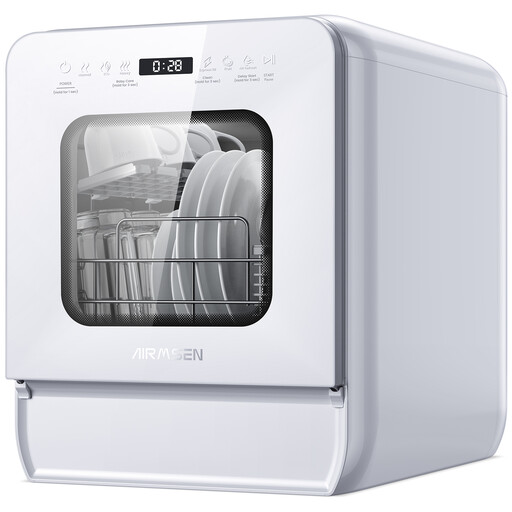 Image unavailable
Its stated width of 37 cm is worth checking against the space left on your worktop, allowing for the door to open and for drainage too.
The title states that it has a 5 L tank and 9 programmes. The depth is given as 50 cm in the title and 51 cm in the description, so confirm the overall dimensions before buying.
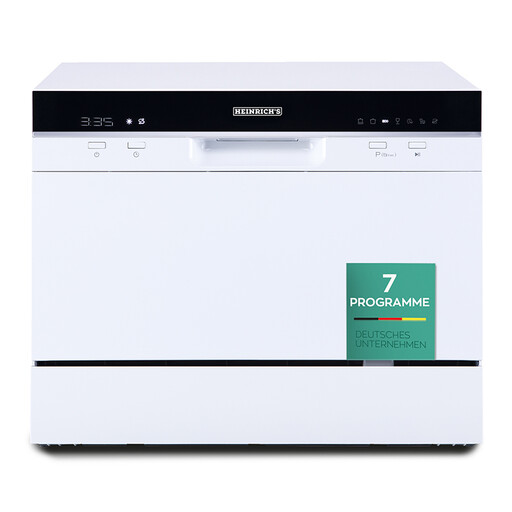 Image unavailable
Its stated capacity of 6 place settings could suit a small kitchen with room for a tabletop appliance, but where a 3-place-setting basket would be too small.
The 47 dB figure appears in the product title and isn’t an independent measurement. Check the overall dimensions and make sure the water supply and drainage are compatible.
Yes, if the model is designed to be filled using its tank. Daan Tech says Bob can use its tank instead of a standard water supply; however, its guide still requires a hose to drain wastewater. Check the drainage set-up for the model you choose.
It could suit a couple who often wash small loads, as long as their plates and utensils really do fit in the basket. If pans or dishes from several meals mean you need extra cycles, compare a larger-capacity appliance if you have the space and connections for one.
Measure the available width, height and depth, as well as the space needed to open the door. Then check the water supply, drainage and electricity supply. Promotelec states that a dishwasher socket should be on a dedicated circuit.
Compare their noise levels in dB and their noise classes, then check the energy label for water use in litres per reference cycle and energy use in kWh per 100 reference cycles, as explained by ADEME. Consider the basket capacity too: a small appliance may need several loads to wash your usual dishes.