Students setting up their first kitchen cupboard
You’re looking for a size that’s easy to store, but you’re not yet sure how often you’ll eat this spread.


For your first student kitchen cupboard, a jar in a suitable size is a practical choice if you haven’t found a squeeze-bottle spread that meets your needs. Don’t assume a bottle will reduce waste: check its closure and how the spread is dispensed, then compare the ingredients, allergens and sugars per 100 g for the specific product you’re considering.
You’re looking for a size that’s easy to store, but you’re not yet sure how often you’ll eat this spread.
You want to avoid getting spread on the lid, worktop or utensils. If you’re considering a squeeze bottle, check its closure and how the product is dispensed before choosing it.
You compare the sugars, ingredients and allergens in each product, whatever the packaging.
When shopping for your move, first choose a size that suits how you’ll use the spread and where you’ll store it. Then check the packaging and ingredients of the specific product you’re thinking of buying.
| What to consider | What to check | Who it matters to |
|---|---|---|
| Serving and storage | Check the type of packaging and how it closes. If you choose a jar, have a clean utensil ready. | When I move in, I want to store the container easily and serve the spread without making a mess; around 40% of consumers put serving and storage first. |
| Size | Compare the quantities shown and choose a size that suits how often you’ll eat it and how much space you have. | I’d rather start with an amount I can use than a large, bulky jar; around 30% of consumers prioritise a suitable size. |
| Ingredients | Check the sugars per 100 g, the ingredients list and allergens. Look at the Nutri-Score if one is shown. | If I’m comparing recipes, I want to know the sugars and allergens in the exact product; for around 30% of consumers, ingredients are the priority. |
A convenient opening doesn’t prove that you’ll use more of the product or avoid waste.
Before choosing a product, check its size, closure and storage instructions. Compare it with a jar that’s the right size for your needs.
According to Santé publique France, producers display the Nutri-Score voluntarily. Its absence therefore tells you nothing about the ingredients in a spread.
If it’s shown on the product, read it alongside the nutritional information, ingredients and allergens for that specific product.
A 750 g or 1 kg jar takes up more room than a smaller size and may not suit you if you’re still unsure how often you’ll eat it.
For your first purchase, think about how often you’re likely to use it and how much storage space you have.
Carrefour’s listings for Nocciolata and Jardin BiO étic products both mention hazelnuts and milk, despite their different recipe features.
Check the ingredients, allergens and nutritional values separately on the label of the product you buy.
Carrefour and Auchan stock this hazelnut and cocoa spread in a range of sizes.
This organic cocoa and hazelnut spread is available in a 250 g jar in the Carrefour range reviewed.
Carrefour’s listing describes an organic hazelnut and chocolate spread, sold in a 300 g glass jar.
Carrefour stocks hazelnut and hazelnut-cocoa spreads under these own brands, with different sizes available depending on the product.
Auchan stocks this hazelnut and cocoa spread in 400 g and 750 g sizes.
These three Nutella products let you compare sizes for your first kitchen cupboard. They’re not a selection of squeeze bottles: choose based on how much you think you’ll use, and check the label on each product.
 Image unavailable
The 1 kg size could suit you if you eat it regularly and have room to store the jar. It won’t give you the option of dispensing straight from a squeeze bottle.
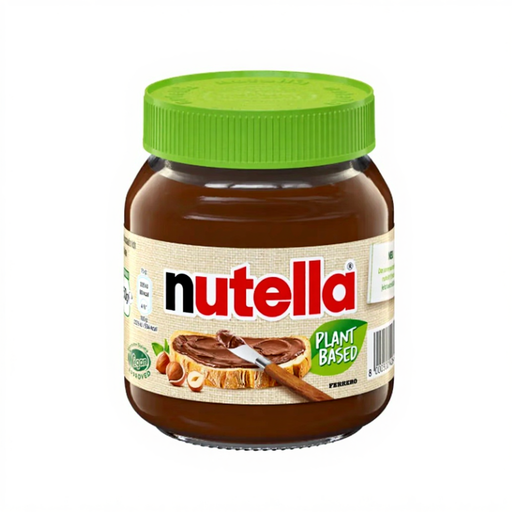 Image unavailable
The 350 g size lets you start with a smaller amount if you’re not sure how often you’ll use it. The name Plant Based doesn’t replace the need to check the ingredients, allergens and nutritional information for the exact product.
 Image unavailable
This 750 g size could suit you if you expect to use it regularly but don’t want to choose the 1 kg size. Check that it fits your storage space, and read the label for the ingredients in this specific product.
No. A spread isn’t a drink or a liquid preparation for a drink covered by the charge described in Article 1613 ter of the French General Tax Code, published by Légifrance. You can still compare the sugars per 100 g in different recipes, regardless of this tax.
No. Santé publique France says that producers display the Nutri-Score voluntarily. If it’s not shown on a product, check its nutritional information and ingredients list rather than drawing a conclusion from its absence.
The per-100 g figure gives you a consistent basis for comparison when serving sizes differ. The Auchan listing for Nutella 1 kg shows 56,3 g of sugars per 100 g; use the listing for each other product to make your comparison.
Check the ingredients list and allergen information on the label of the exact product. Carrefour’s listings for Nocciolata and Jardin BiO étic both mention hazelnuts and milk, with different information about soya.
Follow the instructions on the label of the product you buy. The Auchan listing for Nutella 1 kg says to store it in a dry place, away from heat and outside the fridge; don’t automatically apply these instructions to a different recipe.