
Livraison le jour même ou le lendemain

Qualité garantie

Débloquez vos offres de bienvenue: Livraison GRATUITE | Jusqu'à -80 % | 30 jours d'essai gratuits à JoyPlus
Téléchargez l'application
A strong multi-purpose glue can repair an object, bond two materials together, or fix something in place without drilling. But relying solely on the promise of "extra-strong" can lead to a few nasty surprises. An instant glue isn't necessarily suitable for a flexible surface, while a fixing adhesive designed for a wall won't necessarily work for a small, precision repair.
Before you buy, check the material compatibility, the conditions of use and the drying time. These few criteria will help you choose a universal glue, a waterproof glue or a fixing adhesive that's genuinely right for your project.
A glue can hold two pieces in place after a few seconds without having reached its maximum strength. Depending on the formula, full curing can take several hours, or even 24 hours. If you handle the object too soon, you risk weakening the bond, even though the adhesive looks dry.
Claims like "universal" or "multi-material" don't mean every surface is compatible. PE, PP and PTFE are often excluded from instant glues and fixing adhesives. Silicone, flexible PVC and acrylic glass can also require a special formula.
Moisture, temperature fluctuations, vibrations and UV rays can all affect an adhesive's performance. A glue intended for indoor use may lose effectiveness in a bathroom, on a patio or near a heat source. For outdoor use, look for specific details about resistance to water, weather and extreme temperatures.
Start by identifying the two surfaces you need to bond: wood, metal, ceramic, glass, stone, rubber, fabric or plastic. A wood glue is designed for very specific joins, whereas a contact adhesive can work on laminate, leather or rubber.
For plastics, always check the list of excluded materials. If the surface is shiny, porous or hard to identify, do a test on an inconspicuous area.
A waterproof glue can be suitable for a damp room or outdoor use, but that doesn't necessarily mean it will withstand permanent immersion. For wood, the resistance classes are a good guide: D2 glues handle occasional indoor humidity, while D3 glues to EN 204 are designed for greater exposure to moisture.
For heat, refer to the maximum temperature stated by the manufacturer. According to its product sheet, a Pattex high-temperature contact adhesive resists up to 120 °C. The UHU and Pattex polymer adhesives shown below also specify precise temperature ranges: compare them with the real conditions of your project.
Always prepare the surfaces: they must be clean, dry, dust-free and degreased, unless the manufacturer states otherwise.
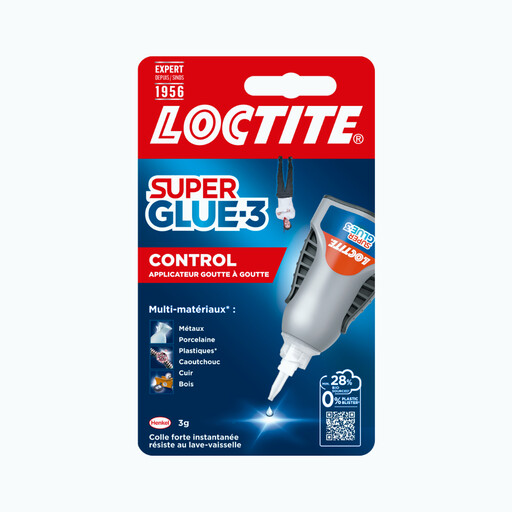
Why this choice suits this profile: Its 3 g bottle and control button are especially handy for small household repairs, picture frames, decorative items, shoes and craft projects.
The controlled flow limits excess glue and reminds you that an instant formula is mainly for small surfaces, not large wall fixings.
Transparent adhesive, compatible with many materials and water-resistant according to the product sheet. Exclusions: PE, PP and PTFE.
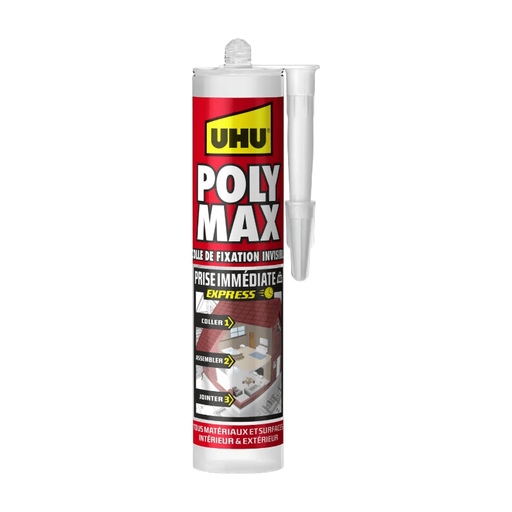
Why this choice suits this profile: Its MSP polymer technology and cartridge format are well suited to renovation projects where bonding, sealing and visual discretion matter.
The sheet specifies compatible substrates, exclusions — PE, PP, PTFE and bitumen — and application conditions, between 5 °C and 40 °C.
Solvent-free formula, transparent, elastic, water and UV resistant, with a stated operating range of -40 °C to +100 °C.
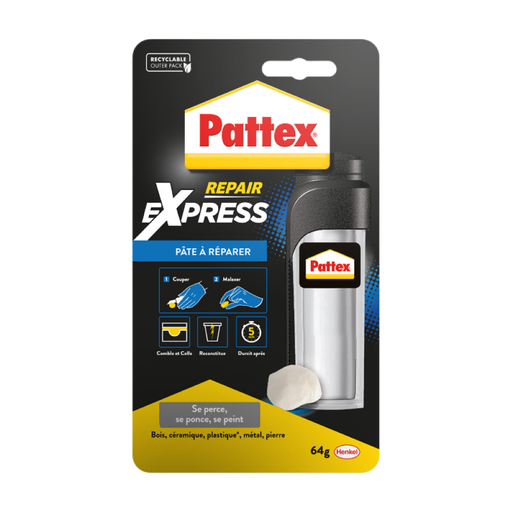
Why this choice suits this profile: This repair paste is aimed at those who switch between repairs, filling and rebuilding on wood, metal, ceramic, stone or cement.
Its mouldable texture isn't just for gluing: it also lets you fill holes and rebuild small missing parts. PE, PP and PTFE plastics remain excluded.
Stated set time of 5 minutes, final strength after 24 hours, with the ability to sand and paint once the paste has hardened.
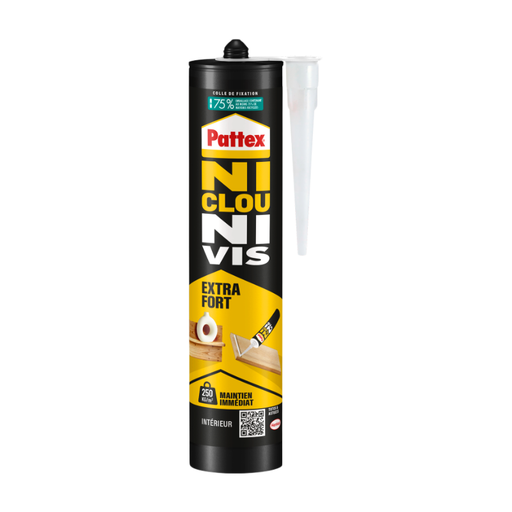
Why this choice suits this profile: This glue is suitable for fixing skirting boards, shelves, hooks or battens to a wall or ceiling, when at least one of the surfaces is porous.
The sheet clearly limits its use to indoors and porous materials. This makes it impossible to confuse with a glue suitable for a constantly damp or low-adhesion surface.
Solvent-free formula, no-drill application and stated final strength after 24 hours.
We've put together a comprehensive, real-time updated selection of products that meet these demanding criteria, while complying with European safety regulations.
For wall fixing, go for a fixing adhesive in a cartridge. Check the porosity of the surface, the weight of the object and any potential exposure to moisture. A no-nails-no-screws glue doesn't automatically replace a mechanical fixing when it comes to heavy loads or unstable surfaces.
Some instant glues claim water resistance once cured. That doesn't mean they are suitable for prolonged immersion. Check the product's instructions and let the bond reach its final strength before washing it.
For a wood bond, look at the resistance class, particularly D2 or D3 to EN 204. A D3 glue is suitable for damper conditions than a D2, but neither should be chosen for permanent immersion without a specific indication.