To serve strong instant coffee in a canteen, start with a product described as ‘intense’, ‘strong’ or ‘espresso’, then taste it at the dose you’ll actually use. Next, compare formats by the number of cups stated on the pack: the yield will change if you use more coffee per cup. As Carte Noire explains, taste intensity alone doesn’t tell you how stimulating the coffee will be.
Who is this guide for?
Those looking for a really strong cup
If a bold flavour is your main priority, check the intensity stated for the specific product, then try it in the cups used at your canteen. Carte Noire points out that intensity describes flavour, not directly how stimulating the coffee is.
Managers of busy catering services
Format and dosage matter when cup after cup is being served. Auchan states that a 200 g jar of intensity 6 makes 100 cups; Carrefour states that a 150 g NESCAFÉ Spécial Filtre refill makes 75 cups. Compare these yields with the dose your canteen will use.
Buyers who want to offer a choice
You could offer a separate option alongside a strong coffee, such as a decaffeinated variety, if diners ask for one. Keep the details of each product to hand for staff: Anses says that the effects of caffeine vary from person to person.
Which criteria should you prioritise?
For a workplace canteen, first decide what sort of flavour you’re looking for. Then choose a pack size that suits the pace of service and the options you want to offer diners.
| Criteria |
What to check |
Who it’s for |
| Strong flavour |
Look for ‘intense’, ‘strong’ or ‘espresso’ on the exact product, then taste the coffee at your service dosage. Intensity scales aren’t necessarily comparable between brands. |
I want a bold-tasting cup, without treating intensity as a measure of caffeine; around 50% of consumers put this flavour profile first. |
| Format and yield |
Check the net weight, the stated number of cups and the dosage that figure is based on. Choose between a jar, refill or individual portions to suit your service. |
When cups are served regularly, I need to be able to plan replenishment; yield would be the priority for around 30% of consumers. |
| Choice for diners |
Check the product name and ingredients for each variety, and consider whether a separate decaffeinated option would be useful based on local demand. |
If not everyone wants the same coffee, I want to be able to identify each option clearly; around 20% of consumers would put this choice first. |
Mistakes to avoid before ordering
-
Assuming ‘intense’ means more caffeine
A strong-tasting cup doesn’t, on its own, tell you how much caffeine it contains. Carte Noire explicitly distinguishes flavour intensity from the stimulating effect.
Treat intensity as a guide to flavour and check the information for the specific product separately.
-
Assuming the stated yield is a guaranteed number of cups
Auchan states that its 200 g jar of intense coffee makes 100 cups, while Carrefour states that a 150 g NESCAFÉ refill makes 75. Using a larger dose will reduce the number of cups you get from either format.
Try the amount of coffee you plan to use in your cups before basing replenishment plans on the stated yield.
-
Choosing a brand without checking the specific variety
The same retailer may offer several intensity levels and pack sizes. The brand name alone won’t tell you whether a particular instant coffee will have the flavour profile you’re looking for.
Check the full product name, format, ingredients and intensity information for the specific variety you’re ordering.
-
Opening a large pack without planning how to store it
A shared container will be opened and handled throughout service. The product information for a freeze-dried instant coffee sold by Auchan recommends storing it in a dry place at room temperature.
Follow the instructions for the product you receive and use a clean, resealable container that’s protected from moisture.
Instant coffee brands to compare
NESCAFÉ
The range lets you compare varieties described as intense with Spécial Filtre L’Original, which NESCAFÉ presents as more balanced.
- NESCAFÉ describes Espresso Intenso as having rich, intense notes.
- Don’t apply this description to Spécial Filtre L’Original or the whole range.
Auchan
Auchan’s range includes instant coffees at different intensity levels, including a 200 g jar of freeze-dried coffee with intensity 6, stated to make 100 cups.
- The weight, intensity and stated yield give you a basis for assessing the intensity 6 variety.
- The range also includes an intensity 8 variety: check the details for that specific product before choosing it.
Carrefour Extra
Carrefour’s range includes Café Soluble Gold in a 100 g jar.
- The 100 g format gives you a pack size to compare.
- The name Gold isn’t enough to describe its flavour as extra strong: check the product details.
E.Leclerc / Plantation
E.Leclerc offers Plantation instant coffee in 100 g and 200 g jars, as well as sticks.
- These formats let you compare serving from a jar with individual portions.
- Check the flavour profile of the variety you’re considering before choosing it for really strong cups.
Jacobs
Professional supplier DRH Market lists Jacobs Pur Krönung instant coffee in a 100 g pack.
- This product can be included when comparing instant coffee pack sizes.
- Being listed in a professional catalogue doesn’t prove that it has an extra-strong flavour profile; check what to expect from this variety.
Carte Noire
Carte Noire Café Soluble Classique is stocked in French instant coffee ranges.
- The brand explains that flavour intensity isn’t a direct measure of how stimulating the coffee is.
- Don’t assume its instant coffee tastes like one of the brand’s coffee capsules or ground coffee; check the exact product.
A product on Joybuy
This 30 g pack of black instant coffee can be used to test a dose in the canteen’s cups before planning for regular service.
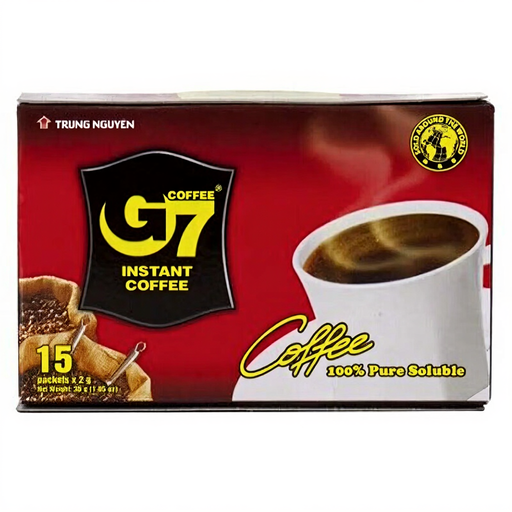 Image unavailable
Trung Nguyen G7 Pure Black, 30 g instant coffee
A way to try black instant coffee at the dose planned for the canteen. The product description calls its flavour powerful and robust: see how this profile tastes in the cups used for service.
Format: 30 g. Work out how many cups you get at your chosen dose before planning quantities for serving a group.
View on Joybuy
Frequently asked questions
Does ‘intense’ instant coffee always contain more caffeine?
No: intensity describes the flavour profile, not directly the caffeine content. Carte Noire also distinguishes intensity from the stimulating effect. Check the information for the specific product rather than using a flavour scale to estimate its caffeine content.
How can I estimate how many cups I’ll get from a jar?
Start with the stated yield for the product, then try the dose you’ll actually use in the canteen. Auchan says its 200 g jar of intense coffee makes 100 cups; if you use more coffee in each cup, the jar will make fewer.
How should I store instant coffee at the service station?
Seal the container and follow the instructions on the product you receive. The product information for a freeze-dried instant coffee sold at Auchan recommends storing it in a dry place at room temperature; check the instructions for your specific product.
What information should I keep about the coffee served in the canteen?
Keep the packaging or product information for the coffee you actually receive so you can identify the product being served. The DGCCRF notes that pre-packed food labelling includes details such as the product name, ingredients, nutritional information, net quantity and a date appropriate to the product.
Is there a place for decaffeinated coffee alongside a strong coffee?
It can be useful if diners would like another option. Anses says that the effects of caffeine vary from person to person; clearly label the decaffeinated coffee and check its own product information rather than assuming its composition from its flavour intensity.


