
Livraison le jour même ou le lendemain

Qualité garantie

Débloquez vos offres de bienvenue: Livraison GRATUITE | Jusqu'à -80 % | 30 jours d'essai gratuits à JoyPlus
Téléchargez l'application
Mounting a shelf, a baseboard, or a heavy frame without pulling out the drill? It's an appealing promise. The market is flooded with "extra-strong" construction adhesives, but the results are often disappointing: an object that falls, a damaged wall, and wasted money. To help you avoid these setbacks, our editors are here to separate fact from fiction. Follow our guide to choose the right adhesive and sidestep the most common pitfalls.
Before grabbing the first tube you see labelled "extra strong," it's crucial to understand why so many adhesive applications fail.
For a successful and long-lasting bond, three points must be checked before any purchase.
For mounting objects with significant weight, construction mastic is the premier solution. Unlike liquid glues like Super Glue, its thick texture fills minor surface irregularities, creating a bond that is both strong and durable. Formulas based on hybrid polymers (MS Polymer) or acrylics are the top performers today. They combine adhesive force, flexibility, and long-term resistance: the winning combination for a heavy-duty adhesive worthy of the name.
This is THE decisive factor, yet it's the one most often overlooked.
Before you buy, inspect your wall and the object you need to mount. A wooden baseboard on a plasterboard wall? An adhesive for porous surfaces will do the job. A mirror on a tiled wall? You'll need a formula for sealed surfaces.
The resistance value shown on the packaging (often in kg/cm?) is a figure obtained under ideal laboratory conditions. In the real world, the equation is more complex. For a bond that lasts, take into account:
Rather than an exhaustive list, here are targeted options based on common use cases.
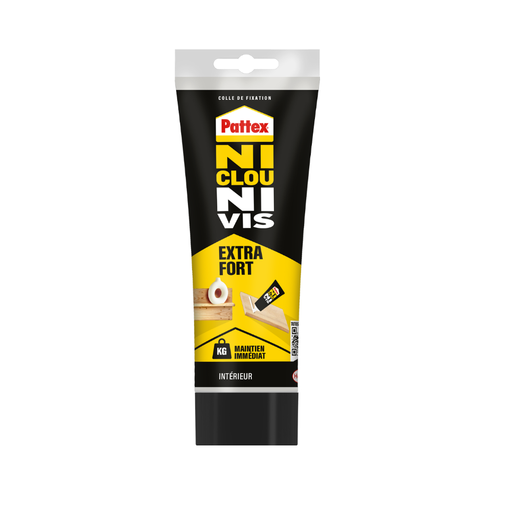
Why this choice? Ideal for common tasks like gluing a wooden baseboard or a small frame. Its tube format, which requires no caulk gun, makes application simple and direct. It's the perfect solution for small interior jobs.
It avoids the trap of using an oversized product: no need for a large cartridge for a one-off job. Its formula is optimised for the porous surfaces typical of home interiors (plaster, wood), ensuring a reliable bond.
Ultra-simple application without a gun; solvent-free formula, ideal for indoor use.
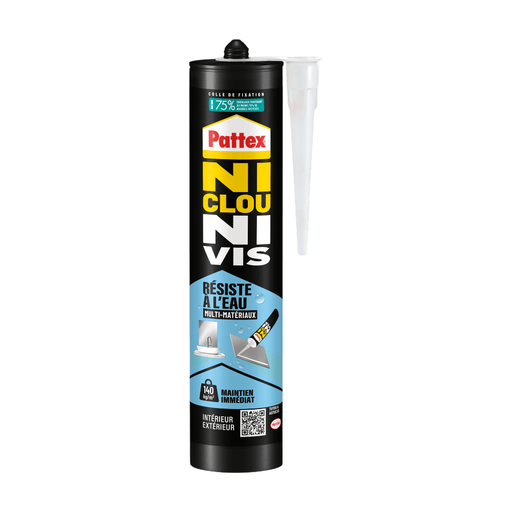
Why this choice? Its versatility is its greatest strength. Mounting a mailbox, a shelf in the shower, or an outdoor fixture? Its resistance to water, UV, and temperature makes it a reliable all-rounder on most materials.
Unlike a standard interior adhesive, this mastic isn't afraid of moisture. Say goodbye to premature peeling outdoors or in wet rooms. It even adheres to temporarily damp surfaces.
Flextec technology is resistant to water and UV; repositionable for 10 minutes for a perfect fit.
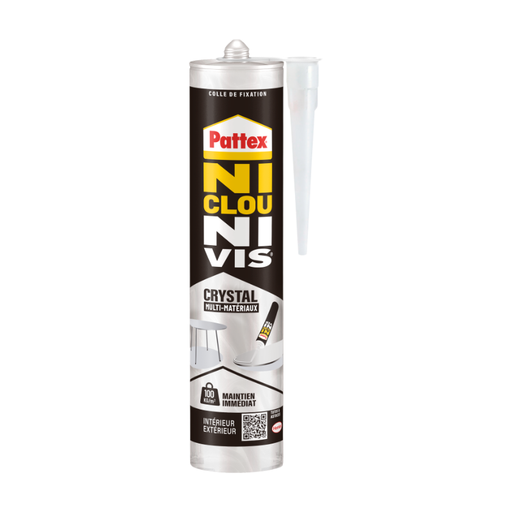
Why this choice? Essential when the adhesive needs to be invisible. Perfect for mounting glass, a mirror, or transparent plastics, it provides a clean, professional finish with no white residue.
It solves the problem of adhesive seams that yellow or remain visible, ruining the final result. Its transparency is designed to last, without degrading over time or with UV exposure.
100% transparent finish; Flextec polymer technology resists UV and moisture.
Discover our complete selection of glues and adhesives, all tested and approved by our experts against strict criteria.
The full curing time, or "core polymerisation," depends on the adhesive, the thickness of the application, the temperature, and the humidity. For most construction mastics, maximum strength is reached after 24 to 48 hours. It is imperative not to put any load on the object before this time. The "initial grab" is only meant to hold it in position without you having to.
Yes, provided you choose the right heavy-duty adhesive and follow the instructions to the letter. This involves properly preparing the surfaces (clean, dry, degreased), applying the right amount of adhesive, and, most importantly, respecting the curing time. For very heavy objects (over 20 kg / 45 lbs) or those subject to strong vibrations, mechanical fastening (screws and anchors) remains essential for safety.
Removing a cured construction mastic is always tricky. The best method is to saw through the adhesive bead with a thin, strong blade (utility knife, piano wire, or cheese wire) by sliding it between the object and the wall. The residue can then be carefully scraped off. On a fragile wall like plasterboard, the risk of tearing off the paper facing is real, so patience and a delicate touch are required.