
Livraison le jour même ou le lendemain

Qualité garantie

Débloquez vos offres de bienvenue: Livraison GRATUITE | Jusqu'à -80 % | 30 jours d'essai gratuits à JoyPlus
Téléchargez l'application
A well-organised home isn’t just about how much furniture you have. The choice of containers, their dimensions and where you place them all have a direct impact on how easy it is to keep things tidy day to day. Whether you live in a flat or a house, storage and organisation solutions need to suit the room, the items you’re storing and how often you use them.
Before you buy cube-shaped wall shelves, storage baskets or collapsible boxes, it’s worth avoiding a few common pitfalls.
A box that’s too deep can stop a cupboard door from opening fully. A shelf that’s too wide can get in the way in a hallway. So measure the width, height and depth of the space, leaving a few centimetres of clearance so you can easily handle the containers.
For fabric storage cubes, also check the internal dimensions of the furniture. A 30 × 30 × 30 cm size fits many standard cubbyholes, but not every bookcase or wardrobe.
A decorative shelf designed for picture frames or small plants isn’t the same as storage intended for books. Wall-mounted products must be fixed with wall plugs and screws suitable for the wall type: plasterboard, brick, concrete or wood.
Always stick to the maximum load stated by the manufacturer. This usually applies to static use and correct installation. A wall shelf should never be used as a step or overloaded.
Non-woven fabric feels soft and discreet, but it doesn’t resist moisture as well as a plastic box. In a cellar, garage or utility room, stackable PP storage boxes with lids are often a better choice. In a dry bedroom or living room, fabric baskets and cubes add a warmer touch.
Modularity makes organising a cupboard simpler and lets you adapt the setup over time. A set of identical containers makes it easier to sort clothes, accessories, toys or documents without having lots of different sizes.
Collapsible boxes are especially handy when your storage needs change with the seasons. You put them together when you need them and fold them flat again when they’re empty.
A lid protects the contents from dust, but adds an extra step every time you need something. Open baskets are more practical for everyday items. For clothes storage, cubes with handles let you pull out one category without having to move the others.
Also think about labelling the contents. This simple step stops boxes from becoming mere transit zones where things get moved around without ever being properly sorted.
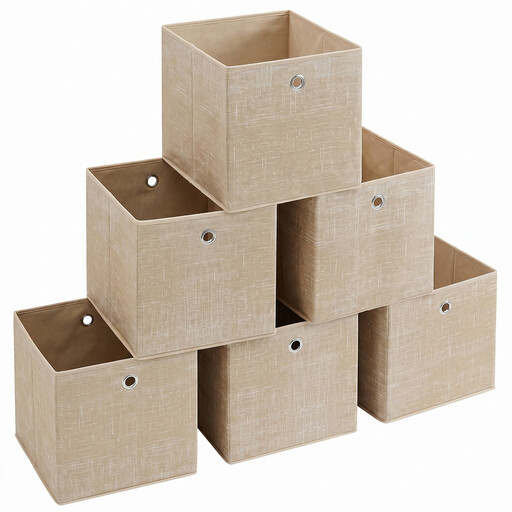
Why this choice suits this profile: This set of six 30 × 30 × 30 cm cubes lets you start organising a cupboard, bookcase or bedroom efficiently without having lots of different sizes.
The standard size makes it easy to compare with cubbyhole furniture. The boxes fold flat when not in use.
Six units, carry handles and a stated static load of up to 5 kg per box.
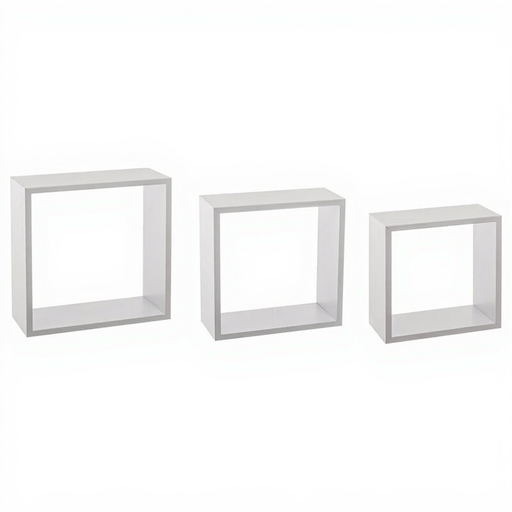
Why this choice suits this profile: This set is for those who want to incorporate decorative storage into the living room, hallway, home office or bedroom.
The three pieces are independent, so you can arrange them on the wall to suit your space, unlike a single fixed unit.
Three sizes: 24, 27 and 30 cm, with a depth of 12 cm and a white finish.

Why this choice suits this profile: The clear plastic and clip-on lids are ideal for seasonal storage, the garage, balcony, car boot or items you rarely use.
The lid limits dust exposure, while the transparency means you don’t have to open every box to find what you need.
Size: 50.4 × 37.6 × 28.8 cm, reinforced 2.5 mm PP plastic, integrated handles and stackable design.
We’ve put together a full, real-time updated selection of products that meet these strict criteria as well as European safety regulations.
Start by grouping items by use, then measure the vertical space available. Fabric cubes and stackable boxes help you make the most of the height. Keep easily accessible areas for items you use every week and the higher sections for seasonal storage.
Yes, as long as you use them in a dry, well-ventilated room. They work well for jumpers, accessories, bed linen and folded clothes. However, avoid placing them in a damp space and don’t overload them, so they keep their shape.
Stick to the stated load, avoid sharp objects and wipe surfaces with a slightly damp cloth. For plastic boxes, keep them away from high heat and prolonged sunlight. For woven paper baskets or fabric cubes, limit contact with water as much as possible.