
Livraison le jour même ou le lendemain

Qualité garantie

Débloquez vos offres de bienvenue: Livraison GRATUITE | Jusqu'à -80 % | 30 jours d'essai gratuits à JoyPlus
Téléchargez l'application
Finding the perfect storage box with a lid holds the promise of transforming a cluttered space into a peaceful haven. The problem? The market is saturated with models that look great in photos but prove disappointing, or even unusable, in day-to-day life. As a section editor and home product specialist, my mission is to decode fact from fiction for you and guide you towards a storage solution that is truly durable and functional, cutting through the marketing noise.
Before you pull out your credit card, be vigilant! Here are the most common design flaws that turn a good idea into a purchase you'll 100% regret.
To make an informed choice, forget the marketing and focus on the technical details that guarantee the quality and longevity of your storage solution.
The type of plastic is the first indicator of a box's sturdiness. Polypropylene (PP) is the gold standard, and for good reason. It is renowned for its resistance to impact, bending, and chemicals. Unlike more rigid and brittle plastics, PP has a flexibility that allows it to handle loads without cracking. For clothing storage, fabric boxes with a frame are an excellent alternative: they are gentle on delicate textiles and are often foldable for maximum space-saving.
A good storage bin with a lid must close securely, with sturdy clips that lock it without force. For stable stacking, the equation is simple: the lid must have raised edges or deep grooves that fit perfectly with the base of the box on top. Reinforced corners and a non-slip textured bottom are the details that reveal a well-thought-out design for home storage that is both optimised and safe.
Litre capacity is often misleading. Two 50-litre boxes can have radically different shapes. The first thing you should do before buying a set of storage boxes? Measure what you want to store in them (files, duvets, tools) and compare those numbers to the internal dimensions of the box. It's the only way to avoid the frustration of discovering that your items don't fit, even though the volume seemed perfect on paper. A detail that makes all the difference for a truly effective closet organiser.
Rather than an endless list, here is a selection of products that meet specific needs, all vetted against the criteria we've just covered.
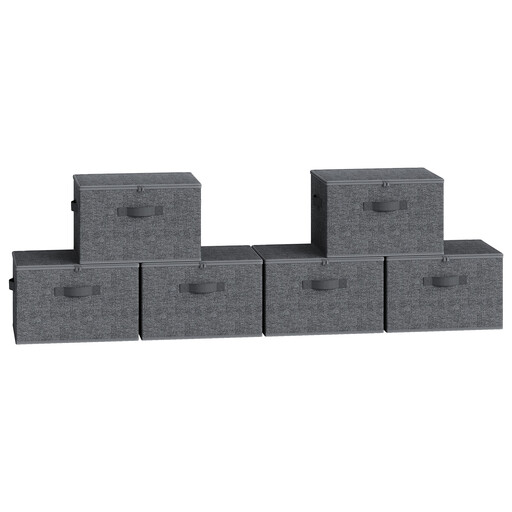
Why we chose it? Perfect for off-season clothing, bed linens, or baby items. Its fabric material is gentle on delicate fibres, and its foldable design allows it to be stored flat when empty. A real space-saving advantage.
This model swaps potentially brittle plastic for a durable non-woven fabric. Its zipped lid ensures a tight seal against dust, far more effective than a simple loose-fitting lid.
The set of 6 allows you to create a harmonious storage system. The reinforced handles are a real plus, making them easy to move even when full.

Why we chose it? This is the solution designed for tough conditions (garage, cellar) and heavy items. Its entire structure is engineered to bear weight and last over time.
This model tackles the problems of fragility and precarious stacking head-on. Its 2.5 mm thickened body, reinforcing ribs, and non-slip bottom give it stability and robustness that are head and shoulders above the rest.
Its design guarantees perfectly stable and secure stacking, ideal for utilising the full height of a room. The transparent plastic lets you identify the contents at a glance.
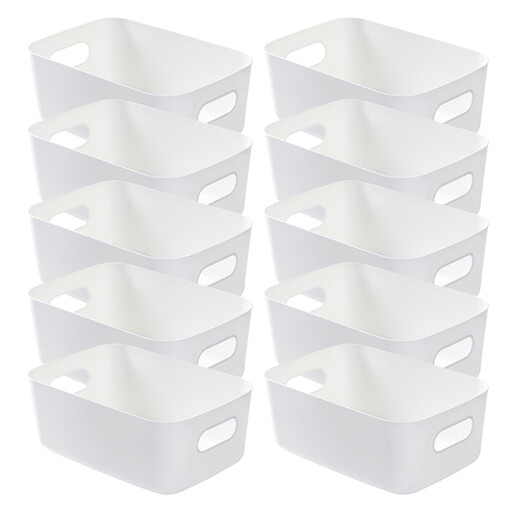
Why we chose it? Perfect for taming the chaos of small items on a desk, or in a bathroom or kitchen drawer. Its compact size is a valuable asset for students or small apartments.
With small items, dust is public enemy number one. The simple but well-fitting lid accomplishes this mission perfectly. The set format is ideal for creating a visually coherent organisation system.
The set of 10 offers excellent value, perfect for outfitting several areas at once. Its minimalist and versatile design fits into any decor.
Explore our full selection of products that meet our charter for quality and durability.
It couldn't be simpler! A damp cloth and a little mild soap (like Castile soap) are all you need for most PP plastic boxes. Avoid abrasive sponges, which would scratch the surface. For a stubborn stain, a paste made of baking soda and water works wonders. Let the box air dry completely before closing it to prevent any trace of moisture or mould.
Polypropylene (PP), which you can identify by the #5 recycling logo, is the champion in this category. It is robust, flexible, and resistant to both heat and chemicals. In contrast, other plastics like polystyrene (PS) are much more brittle, and PET is mainly reserved for bottles. For a storage solution that lasts, PP is undoubtedly the sensible choice.
That's a very bad idea. The interlocking systems (grooves, rims) are designed for a specific model. Mixing brands and sizes is a guarantee for an unstable and dangerous stack. For safe and optimised storage, the golden rule is to invest in an identical set of storage boxes.