
Livraison le jour même ou le lendemain

Qualité garantie

Débloquez vos offres de bienvenue: Livraison GRATUITE | Jusqu'à -80 % | 30 jours d'essai gratuits à JoyPlus
Téléchargez l'application
A well-organised home isn’t just about how much furniture you have. Choosing the right storage boxes is just as important for making the most of a shelf, decluttering a wardrobe, or protecting accessories stored on a balcony. But you need to pick the right size: a box that’s too small, too flimsy, or ill-suited to the space will soon end up at the back of a cupboard.
A 30-litre box might look spacious on paper, but its shape determines what it can actually hold. A tall model will more easily accommodate jumpers or bulky toys, while a low box will slide under a bed or into a wardrobe.
Always check the external dimensions, not just the capacity in litres. Also measure the depth of your shelves, the width of your doors, and the space available between pieces of furniture.
A collapsible storage box made of fabric or reinforced cardboard works well for clothes, lightweight linen, and accessories. It folds flat when not in use, but it isn’t designed to hold tools, particularly heavy books, or sharp objects.
For that kind of use, a plastic storage box with reinforced sides and a snap-on lid will be more suitable. You must still respect the maximum load stated by the manufacturer.
A lid keeps dust out, but it doesn’t automatically make a box waterproof. For a balcony, patio, or garden, look for specific mentions like weather resistance, UV protection, or waterproof construction. Fabric boxes and open baskets, on the other hand, are generally intended for indoor use only.
For clothes storage, a box of around 30 litres can hold jumpers, household linen, or seasonal clothing, as long as you don’t fill it to the brim. For toys, cushions, and garden accessories, a large-capacity storage box of 160 to 420 litres will be more suitable.
Leave a little room so you can close the lid without forcing it. A slightly smaller container that’s easy to move and open will often be more practical than a box packed to the maximum.
Also check for handles, the rigidity of the sides, and how easy it is to open. For a stackable storage box, the lid should stay stable and the base shouldn’t slide easily.
Never place a child inside a chest or box, even if the container seems large enough. For a garden chest, set it on a flat surface and follow the assembly instructions carefully. Keep small assembly parts out of reach of children.
Outdoors, UV and frost protection can slow down plastic degradation, but regular maintenance is still needed. Also avoid leaving damp items inside a closed container for a long period.
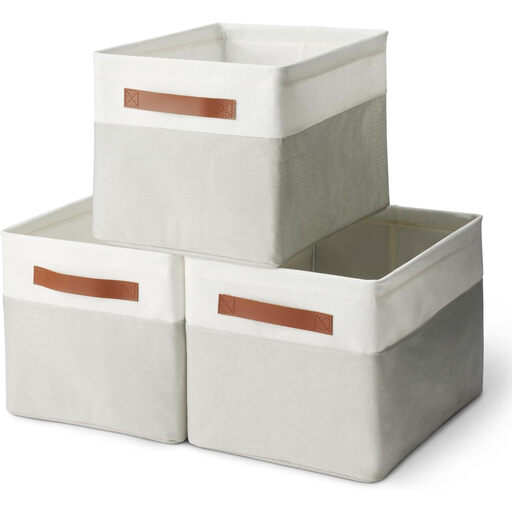
Why this suits this profile: This set of three collapsible bins provides a solid foundation for organising a wardrobe, a child’s bedroom, or a home office. Each bin measures approximately 38.1 × 27.9 × 25.4 cm and features integrated handles.
The size and number of bins are clearly stated, so you can plan the space needed. However, the lightweight structure shouldn’t be overloaded.
Pack of three bins, integrated handles, collapsible storage, and easy cleaning with a damp cloth.
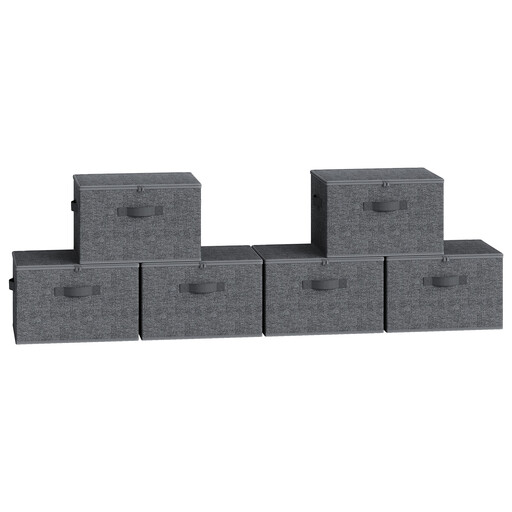
Why this suits this profile: This set is ideal for anyone wanting to create a coordinated look in a wardrobe, cupboard, or student bedroom with matching, easy-to-handle containers.
The zipped lids limit dust exposure. The stated static load is 3 kg per box – stick to that limit.
Six boxes measuring 40 × 30 × 25 cm, three handles per box, and flat folding when not in use.
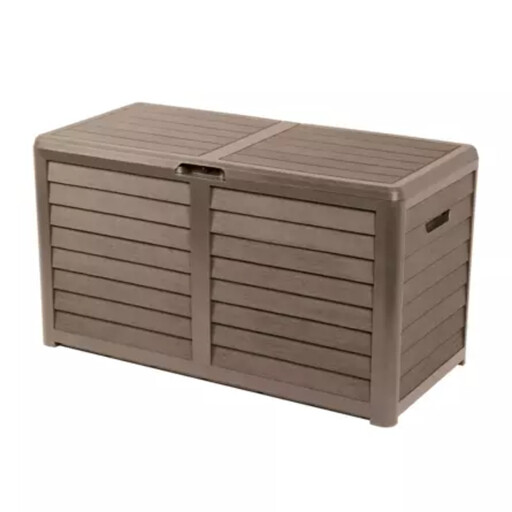
Why this suits this profile: This outdoor chest is ideal for storing cushions, pool accessories, or small garden tools on a patio or in another outdoor space.
The chest is described as UV- and frost-resistant, with permanent ventilation at the handles. However, it shouldn’t be used as a seat or step.
420-litre capacity, tool-free assembly, lockable lid (padlock not included), and UV protection.
We’ve put together a comprehensive, real-time updated selection of products that meet these exacting criteria, while also taking European safety regulations into account.
Choose a storage box with a lid, wide enough so you don’t squash the textiles. A collapsible model with a zip closure works well in a wardrobe or under-bed storage. For a cellar or garage, plastic with a snap-on lid will offer better protection against dust and repeated handling.
Use containers with compatible dimensions, put the heaviest ones at the bottom, and respect the stated maximum load. Flat lids and non-slip bases make stacking more stable. Avoid placing a heavy box on a fabric model designed for lightweight items.
The lifespan depends on the material, the load it carries, sun exposure, and how often it’s handled. Clean the boxes according to the manufacturer’s recommendations, avoid high temperatures, and replace any container that shows cracks, warping, or weakened handles.