
Livraison le jour même ou le lendemain

Qualité garantie

Débloquez vos offres de bienvenue: Livraison GRATUITE | Jusqu'à -80 % | 30 jours d'essai gratuits à JoyPlus
Téléchargez l'application
Storage boxes are a quick way to free up space, but a poorly sized model can soon create new problems. A box that’s too deep becomes hard to reach at the back of a cupboard; a flimsy lid buckles under the weight; and a fabric that’s too soft loses its shape after just a few uses.
So before you pick a set of storage boxes, it’s worth looking beyond the promises of “large capacity” or “universal storage”. The stated volume, the material and the opening system all need to match how you’ll actually use them – whether that’s for clothes, toys, documents or bathroom accessories.
The dimensions given usually include the walls, the lid and sometimes the internal structure. A 30-litre box doesn’t necessarily give you 30 litres of genuinely usable space. For storing clothes, check the available height in particular, and make sure you can fold items without forcing the lid shut.
A stackable box with a lid protects your belongings well, but it becomes impractical if you have to move several containers to reach the one at the bottom. For items you use every week, choose a box with handles or a front-opening design – it’ll be much easier to handle.
Fabric storage cubes fit neatly on shelves in a bedroom or living room, but they aren’t designed for damp environments. In a bathroom, kitchen or garage, plastic is generally easier to clean. Woven paper models also need to be kept away from moisture and heavy loads.
Measure the available space, taking into account the cupboard opening, the depth of the shelves and the height between levels. For cubes, the 30 × 30 × 30 cm size is very common, but check that your cubbyhole leaves a few millimetres of clearance.
For a box to slide under the bed, choose a low, elongated model. In a wardrobe, containers of a similar width make alignment easier. A set of storage boxes in varied sizes can also adapt to small accessories as well as seasonal items.
Always check the stated static load. A capacity of 5 kg per box, for example, doesn’t mean the container can be used as a step stool or a seat.
A clip-on lid protects the contents and can be useful in a garage or cellar. A zip closure on three sides makes it easier to access clothes stored on a shelf. For stackable boxes, look for a non-slip base and a lid that’s flat enough to stabilise the level above.
Integrated handles should be wide enough for a comfortable grip, especially when the box contains books or dense laundry. Also check any warnings about heat, flames, prolonged sun exposure and overloading.
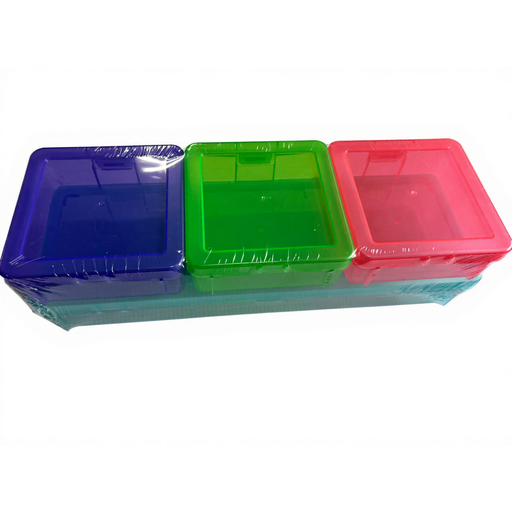
Why this choice suits this profile: A set of four containers lets you start sorting remote controls, magazines, supplies or accessories without buying a large quantity of boxes all at once.
The multi-pack format stops you buying oversized boxes before you’ve worked out your needs. Their uniform design also makes it easier to organise by category.
Four pieces to separate everyday items, with a discreet look that suits the living room, bedroom or home office.
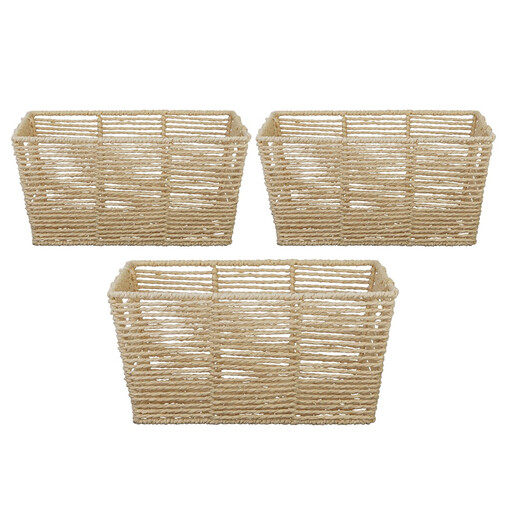
Why this choice suits this profile: These baskets blend easily into a well-decorated home, especially in a living room, hallway or home office where storage remains on display.
The metal frame helps the basket keep its shape, but it must stay indoors, in a dry place, in line with the care instructions.
Woven paper, metal frame and reusable design for storing household or personal items.

Why this choice suits this profile: Families and those storing seasonal clothes, baby items or garage equipment can identify the contents without opening each box.
The stated 2.5 mm body, reinforcing ribs, clip-on lid and non-slip base address the common problems of boxes that lack stability.
Transparent PP plastic, integrated handles, stackable design and dimensions of 50.4 × 37.6 × 28.8 cm per box.
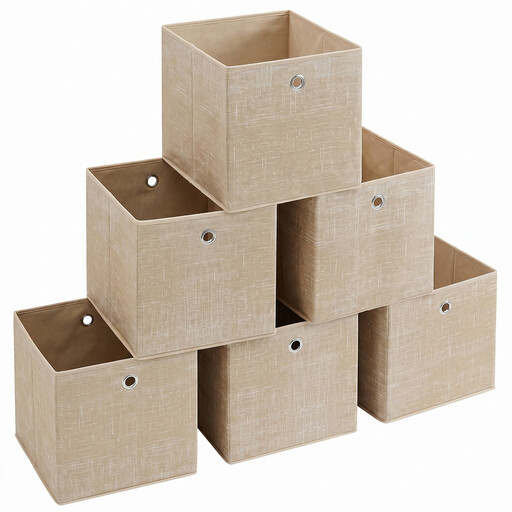
Why this choice suits this profile: Renters, students and families with modular shelving units can store jumpers, toys or laundry without changing their furniture.
These boxes fold flat when not in use and come with an insert base. This stops you storing rigid containers that remain unused.
Set of six 30 × 30 × 30 cm cubes, handles and a stated static load of 5 kg per box.
We’ve put together a comprehensive, real-time updated list of products that fully meet these strict selection criteria and European safety regulations.
Start by grouping items by use, then measure the shelves. Place things you rarely use up high and keep everyday categories within easy reach. A label on each box will save you from opening several containers to find one item.
Yes, as long as they are clean, dry and correctly sized. They let you quickly spot seasonal clothing. However, avoid exposing them to strong heat or prolonged sunlight, and respect the recommended load when stacking.
They are generally fine for laundry, accessories, lightweight toys and light documents. For tools, books or dense items, check the stated static load and opt for a reinforced structure or a PP box.