
Livraison le jour même ou le lendemain

Qualité garantie

Débloquez vos offres de bienvenue: Livraison GRATUITE | Jusqu'à -80 % | 30 jours d'essai gratuits à JoyPlus
Téléchargez l'application
Between overflowing cupboards, out-of-season clothing and food that is difficult to organise, storage boxes can quickly make everyday life easier. The key is to choose a size suited to the space available and how you intend to use it. A box that is too flexible, an awkward lid or poorly judged dimensions can turn a promising purchase into an accessory you never use.
Here are the main points to check before buying your storage boxes, along with a selection of models suited to different needs.
A capacity given in litres is not enough to determine whether a box will fit on a shelf or in a drawer. Two models with the same capacity can have very different proportions. Always measure the width, depth and height available, taking skirting boards, doors and drawer runners into account.
For a box intended for a cupboard, also check whether the lid adds a few centimetres to the height. In a bedroom, under-bed storage boxes should be compared with the actual space available beneath the bed frame.
Foldable storage boxes are particularly practical in smaller homes, student bedrooms or for seasonal storage. However, they are not designed to support every type of load. They are generally better suited to clothing, household linen and accessories than to books or heavy objects.
Check for reinforcement, the rigidity of the base and the maximum load specified by the manufacturer. For textile models, also avoid sharp objects that could deform or tear the structure.
A box placed high up or at the back of a cupboard should be easy to remove. Storage bins with handles reduce the amount of handling required, provided their handles are sufficiently strong and securely attached. For clothing, a wide-opening lid or a zip that opens along several sides may be more practical than a completely removable lid.
Before ordering, take the internal measurements of your furniture. For a cupboard organiser, allow a few centimetres of clearance so that you can remove the bin without it rubbing against the sides.
For example, 8.5-litre cube boxes are designed to fit into many square cube storage units. However, check their exact dimensions against those of your furniture.
Non-woven fabric is lightweight and can generally be cleaned with a damp cloth. It is suitable for laundry, toys and accessories, but should be kept away from heat sources and persistent moisture. Baskets made from recycled materials can have a place in a living room, provided you respect their maximum load and care instructions.
For kitchen storage, glass or food-contact plastic containers require particular care. Check the manufacturer’s instructions regarding the dishwasher, freezer, oven and microwave. The term “airtight” does not automatically mean that the container can withstand all temperatures.
Food storage boxes should be clean and completely dry before being closed. For dry foods, airtight food containers can help limit splashes and odours, depending on the lid design. For liquid preparations, check that the product is described as watertight or leak-proof, then transport it upright whenever recommended.
Borosilicate glass is used for some food containers, but each use — freezing, reheating or washing — should be confirmed in the product details. Do not assume compatibility based on a simple illustration or a generic marketing claim.
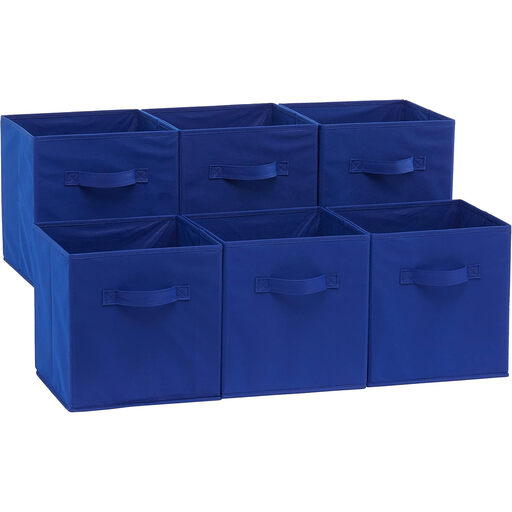
Why this choice suits this profile : This pack of six boxes helps you start sorting your belongings by category in a living room, bedroom or home office, without needing multiple sizes. Each bin has a stated capacity of 8.5 litres and measures 26.7 × 26.7 × 27.9 cm.
Its clearly stated dimensions let you check whether it will fit a cube storage unit before buying. The handles make the bin easy to remove.
Pack of 6, lightweight structure, integrated handles and care with a damp cloth.

Why this choice suits this profile : With four capacities — 0.25, 0.6, 1 and 2 litres — this set helps you organise your kitchen with sizes suited to small portions, leftovers and dry ingredients.
The range of sizes means you do not need to use a large container for a small quantity. The airtight lids must be dried before closing, in line with the instructions provided.
12 containers, BPA-free plastic according to the product details, four capacities and airtight lids.

Why this choice suits this profile : The eight capacities, from 150 ml to 1 040 ml, are suitable for meal preparation, individual portions and carrying lunch.
The range of capacities helps prevent overfilling and makes it easier to choose the right container. Check the specific instructions before placing it in the oven, microwave or freezer.
Borosilicate glass stated in the product details, set of 8 sizes and removable lids.
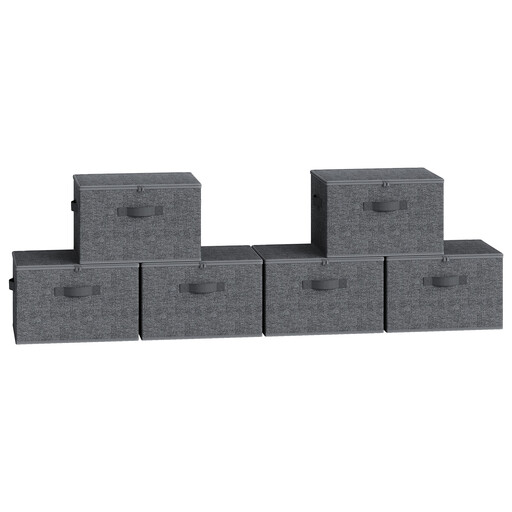
Why this choice suits this profile : With a stated capacity of 30 litres per box, zipped lids and three handles, this set is suitable for dressing rooms, shelves and under-bed storage.
The zipped lid protects textiles from dust and the handles make the box easy to move. The stated static load is 3 kg per box.
40 × 30 × 25 cm size, folds flat, with a lid and three handles per box.
Start by grouping items according to their use, then measure each area of the furniture. Place the items you use most often at eye level and reserve the higher shelves for seasonal belongings. Labelling the boxes means you will not have to open them one by one.
Yes, provided they have a sufficiently reinforced base, a suitable lid and a maximum load compatible with their contents. They are particularly suitable for out-of-season clothing, linen and accessories. Avoid overloading them to preserve their shape and handles.
Wash the container before its first use and allow the lid to dry completely before closing it. Follow the manufacturer’s instructions regarding the dishwasher, freezer and reheating. If there is a crack, deformation or damaged seal, replace the container.