
Livraison le jour même ou le lendemain

Qualité garantie

Débloquez vos offres de bienvenue: Livraison GRATUITE | Jusqu'à -80 % | 30 jours d'essai gratuits à JoyPlus
Téléchargez l'application
A well-organised home isn’t just about how much furniture you have. The choice of storage boxes directly affects the space you use, how easily you can access your belongings, and how well they’re protected day to day. Seasonal clothes, toys, blankets, accessories and travel items don’t all belong in the same type of container.
Before you buy, three common mistakes keep cropping up:
The idea, then, is to compare the size, structure and conditions of use, rather than relying solely on appearance or the number of litres stated.
For an under-bed storage box, measure the height available between the floor and the bed base. Also remember to check the width and depth, taking into account the bed legs and any skirting boards.
A model that is 15 to 18 cm high may suit many beds, but only measuring your own furniture can confirm this. For a cupboard, also note the internal width and the height available between two shelves. A 160 L storage box can hold a significant volume, provided you have a space large enough to accommodate it.
Fabric, plastic and structures with rigid panels don’t all meet the same needs:
A zip closure, a lid or a transparent window can limit exposure to dust. However, none of these features guarantees complete waterproofing unless that is clearly stated in the specifications.
Check the stated maximum load and how rigid the base is. For books, shoes or tools, it’s better to choose a reinforced structure. For lightweight clothes, a foldable storage basket can be perfectly adequate.
Handles make it easier to carry from one room to another. A storage crate on wheels is even more practical when it needs to be moved regularly. However, do check that the wheels are suitable for your floor type and that the lid stays securely closed.
Foldable models are particularly useful in a small home or for students: once stored away, they take up very little space. However, they are less suitable for heavy or sharp objects.
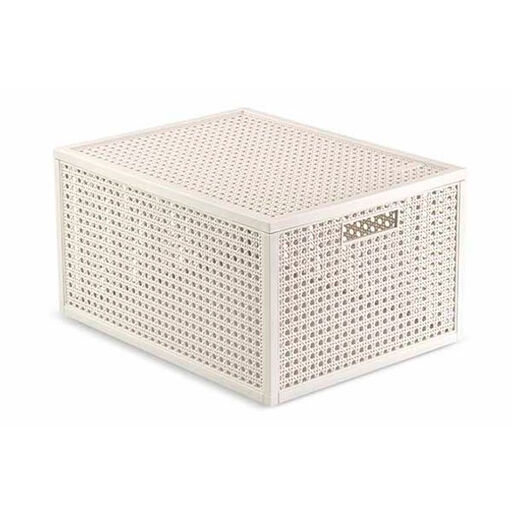
Why this choice suits this profile: Its size of 41.6 × 30 × 7.1 cm fits small shelves, cubbyholes and compartment furniture. It can hold accessories, magazines, lightweight toys or small amounts of laundry.
Its dimensions are stated precisely, so you can check compatibility with your furniture before buying. However, don’t choose it for heavy items: the stated maximum load for this small size is 3 kg, evenly distributed.
Made from recycled materials, a low profile and easy to clean with a damp cloth. Its textile structure allows air to circulate.
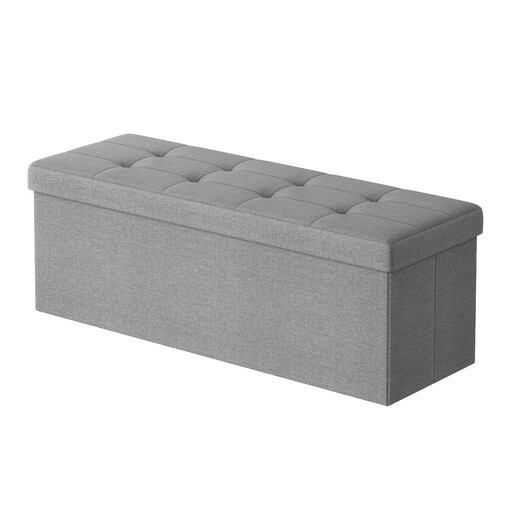
Why this choice suits this profile: This chest, measuring 38 × 110 × 38 cm, fits at the foot of a bed, in a living room or in a hallway. Its linen-look finish and quilted design mean you can leave it on display.
It combines a stated volume of 131 L with precise external dimensions. The lid must be fully closed before using it as a seat, in line with the manufacturer’s instructions.
MDF panels, metal reinforcements on the lid, a slot-together base assembly and convenient folding for storage.
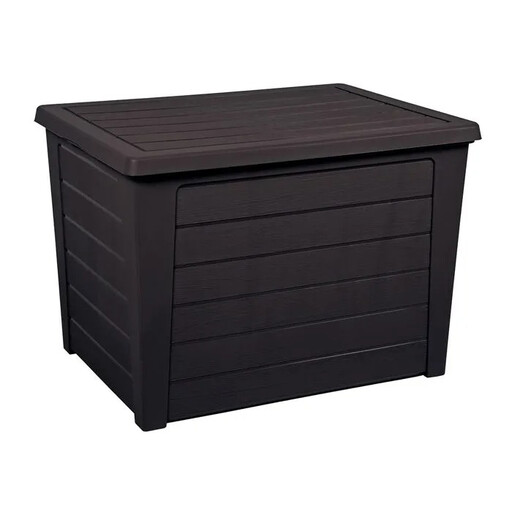
Why this choice suits this profile: Its 160 L capacity and dimensions of 72.5 × 54.5 × 51.5 cm allow you to store cushions, toys, garden tools or bulky accessories.
This isn’t a simple fabric box: its recyclable plastic construction is stated to be water-resistant, weather-resistant and UV-resistant. However, you should not sit or climb on it.
Suitable for both indoor and outdoor use, a wood-effect finish, made in France and simple to assemble.
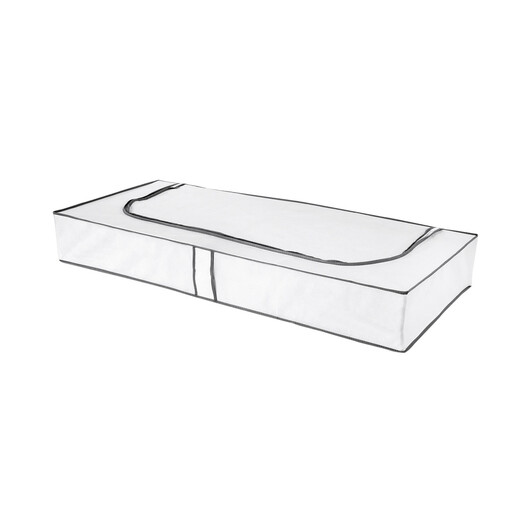
Why this choice suits this profile: With its size of 108 × 45 × 15 cm, this cover slides under the bed to hold duvets, throws and seasonal clothes.
Its height is clearly stated and its non-woven polypropylene textile is designed to limit dust. However, avoid sharp objects and overfilling.
A low profile, easy access by sliding it out, and simple cleaning with a damp cloth.
We’ve put together a comprehensive list, updated in real time, of products that meet these strict selection criteria as well as European safety regulations.
How long a box lasts depends mainly on the load it carries, the humidity and how often it’s handled. To keep your storage boxes in good condition:
An empty foldable box can be flattened for storage. However, avoid compressing it if that might distort its structure.
Start by measuring the available space, then choose a low model with a closure or lid. A height of 15 cm may suit many beds, but you should check the actual dimensions of your bed base and the space between it and the floor. For seasonal clothes, a cover or box with a window lets you quickly see what’s inside.
Yes, provided you have enough floor space, in a garage or on a terrace. This size allows you to group bulky items together, but it becomes heavy once filled. It’s therefore best reserved for infrequent storage.
Choose a compartmentalised model and, where necessary, keep medicines in their original packaging. Also check the storage conditions. A travel organiser is for arranging your products, but it does not replace your pharmacist’s advice or the information on the leaflet. Keep it out of reach of children.