
Livraison le jour même ou le lendemain

Qualité garantie

Débloquez vos offres de bienvenue: Livraison GRATUITE | Jusqu'à -80 % | 30 jours d'essai gratuits à JoyPlus
Téléchargez l'application
In a small flat, a student bedroom or a family home, storage boxes help you quickly clear surfaces and group items by category. But you need to choose a model that’s genuinely practical: a box that looks great in a photo can quickly become bulky or awkward to use day to day.
Measure the width, depth and height you have available, then leave a few centimetres of clearance so you can handle the box without difficulty. For under-bed storage boxes, height is often the deciding factor. Low models with handles or castors are easier to pull out.
Also check the maximum static load. This usually refers to the weight the box can support when it’s stationary. A product rated for 5 kg shouldn’t be used to store heavy books beyond that limit, even if its structure looks sturdy.
Non-woven fabric is lightweight and foldable. It’s suitable for jumpers, household linen and accessories, provided it’s used in a dry place. Cardboard panels improve stability, but they must not be washed or exposed to moisture.
Woven paper baskets with a metal frame offer a more decorative look in a living room or on a shelf. However, they need dry cleaning and are less water-resistant than a plastic box.
Storage boxes with a lid or zip closure offer better protection for textiles against dust. For frequent use, go for reinforced handles and an opening that stays easy to access in the room concerned.
A set of cube baskets will naturally fit into a bookcase or a shelving unit, while a narrow shoe cabinet is better suited to a hallway. In every case, make sure the product’s dimensions match your furniture.
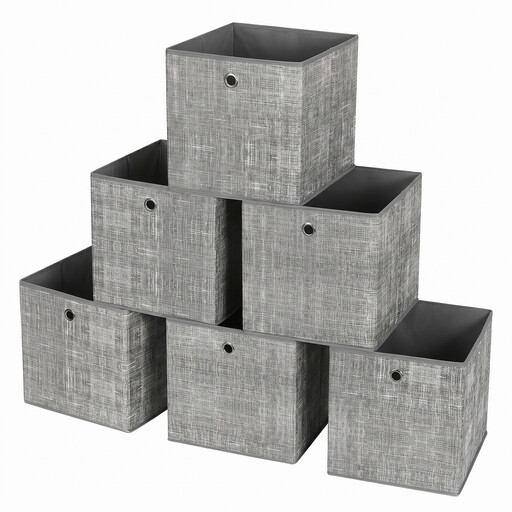
Why this choice suits this profile: This set of six 30 × 30 × 30 cm boxes is a great starting point for storing clothes and everyday items without juggling multiple sizes. It works in compartments that are at least 30.5 cm wide.
The bottom panels and cardboard provide a more consistent structure than a simple soft bag. Each box also supports a stated static load of 5 kg.
80 g/m² non-woven fabric, eyelet handles and foldable when the boxes are not in use.
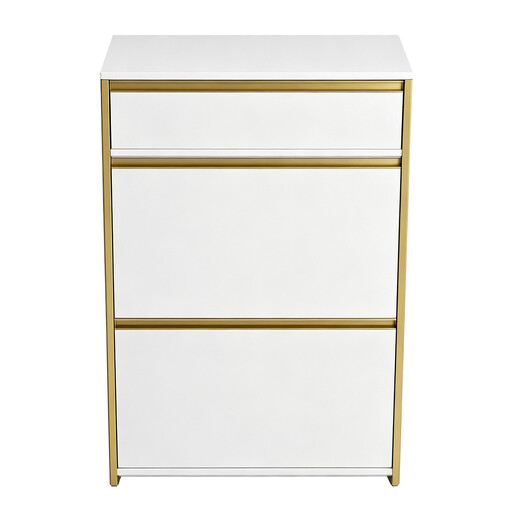
Why this choice suits this profile: With dimensions of 60.5 × 24.5 × 105 cm, this narrow shoe cabinet fits neatly into a hallway or corridor. It can also hold accessories, books or a few decorative items.
Its adjustable shelves let you tailor the space for shoes or boxes, rather than being stuck with standard compartments. The anti-tip device must be fixed to the wall as per the instructions.
Four shelves, two hinged doors, one drawer and a top surface in particle board and metal.
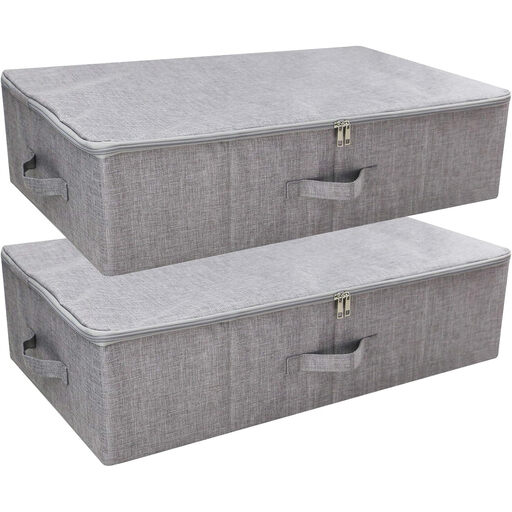
Why this choice suits this profile: With dimensions of 70 × 43 × 18 cm per box, this set is designed for storing clothes, accessories and seasonal items under the bed.
The zipped cover limits exposure to dust. The low profile lets you make use of the space under a bed, but you must measure the ground clearance before buying.
Two matching boxes, a foldable design and a light grey colour for discreet storage.
We’ve put together a comprehensive, real-time selection of products that meet these strict criteria, while also complying with European safety regulations.
Choose a model whose height is less than the available space, with a zip closure or a lid. Dimensions of 70 × 43 × 18 cm work for many uses, but measuring the space under your bed is essential. Avoid over-compressing textiles so you don’t distort the box.
Not always. Non-woven fabric reinforced with cardboard should generally be cleaned with a slightly damp cloth, then air-dried. Woven paper baskets should be dry-dusted and kept away from moisture.
Respect the stated load, distribute the weight evenly across the base and avoid placing the boxes in a damp area. For foldable models, remove the panels before storing them and don’t put heavy objects on top. Labelling each box also makes organising your home easier and prevents unnecessary handling.