
Livraison le jour même ou le lendemain

Qualité garantie

Débloquez vos offres de bienvenue: Livraison GRATUITE | Jusqu'à -80 % | 30 jours d'essai gratuits à JoyPlus
Téléchargez l'application
Between the shoes piling up in the hallway, the seasonal clothes that are hard to stow away, and the meals you need to take on the go, a well-organised home often comes down to a few carefully chosen accessories. But not all storage boxes and food containers are suited to the same purpose. A bin that is too bulky can take up more space than it saves, while a poorly sealed box risks emptying its contents at the bottom of a bag.
Here are the criteria to consider before placing your order, along with a selection designed for different needs.
An 84-litre box may look spacious on paper. However, its external dimensions, shape and opening size determine how easy it actually is to use. For a cupboard, measure the available width, depth and height, remembering to account for the space needed for hinges, handles and skirting boards.
For under-bed storage, it is the height that makes all the difference. A container that is 18 cm tall, such as certain models measuring 70 × 43 × 18 cm, can slide under many beds. But you still need to measure the clearance before you buy.
Stackable shoe boxes and storage baskets help you make better use of the height in a wardrobe. Their stability, however, depends on the rigidity of the structure, the contact surface area and the weight placed on top. Without reinforcement, a collapsible box is best suited to clothes and lightweight accessories.
Also think about how you will access the contents. A front-opening design is particularly handy in a column of boxes, whereas a top lid works better for storage you rarely need to get into.
For a compartmentalised lunch box, the seal depends on the quality of the lid, the gasket and the closure system. Having several compartments is not enough to stop food from mixing together.
An insulated food jar keeps its temperature thanks to vacuum insulation. How long it stays hot or cold depends on the contents, their temperature when filled and how often you open it. Always follow the manufacturer's recommendations, especially for transport and cleaning.
Before ordering, note the dimensions available in your furniture and compare them with the product's measurements. For shoes, measure the length and height of your largest pair, especially if you have high-top trainers or hiking boots.
For clothes, go for:
Woven paper storage baskets with a metal frame fit neatly on open shelving. However, they should be kept away from moisture and not be overloaded.
Polypropylene, very common in storage boxes, is lightweight and easy to clean. A transparent door lets you see the contents without having to open every box. For food containers, borosilicate glass offers a non-porous surface and good visibility. It is heavier, though, and can break if dropped.
Stainless steel 304 or 316 is used in many jars and lunch boxes. Just seeing the material listed is not enough to know what it can be used for: some products are not suitable for the oven, microwave or dishwasher. For plastic parts, check the information about food contact and temperature limits.
For a meal taken to the office, school or on a trip, look for:
A stainless steel lunch box generally withstands knocks better than a glass container. However, it should not go in the microwave if it contains metal parts. A Tritan water bottle can be handy for sport and commuting, as long as you follow the manufacturer's advice on washing and use.
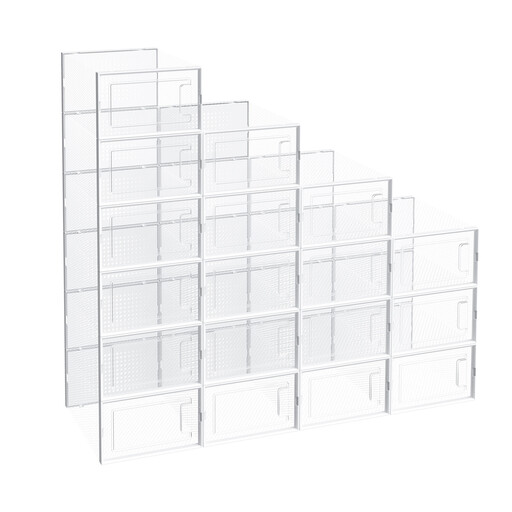
Why this choice suits this profile: With its 18 transparent boxes, this set lets you create a uniform organisation system in the hallway or dressing room, while keeping your shoes accessible from the front.
The dimensions of 35 × 25.2 × 19 cm are clearly stated, so you can easily check that the whole set will fit in your intended cupboard. The ventilation holes help prevent shoes from being sealed in for too long.
A stackable structure, transparent doors, an ABS frame and PP boxes. Compatibility is stated up to UK size 11, but you should confirm this based on the shape of your shoes.

Why this choice suits this profile: Its 1.5-litre capacity is ideal for those who carry soup, a family-sized meal or several portions for a day at work or a day out.
The wide opening makes filling and cleaning easy. The leak-proof lid is designed for transport, but the manufacturer advises against turning the jar upside down.
316 stainless steel, vacuum insulation and a stated heat retention time of 4 to 6 hours, depending on usage conditions.

Why this choice suits this profile: Its five compartments are ideal for meal prep, separate portions and picnics. A design made for those who regularly take several different foods with them.
The four clips hold the lid securely in place. However, the manufacturer states that the box should not be used in the oven or microwave and recommends hand washing only.
A 316L stainless steel construction, clear separation of foods and a PP lid with four fasteners.
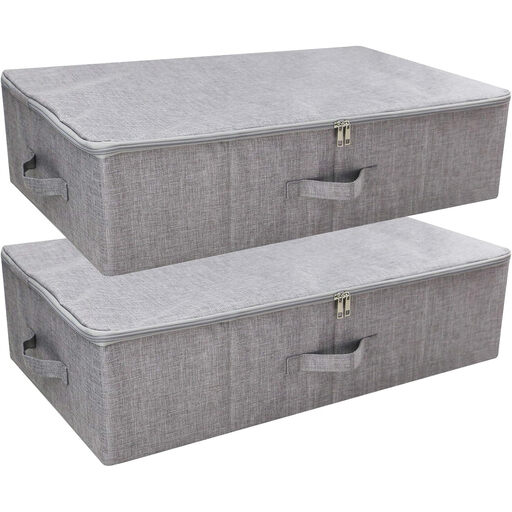
Why this choice suits this profile: This pack of two boxes is ideal for sorting clothes, accessories or household linen, especially in a flat or student bedroom.
The dimensions of 70 × 43 × 18 cm per box are clearly stated so you can check they will fit under your bed. The zipped cover protects the contents from dust.
A rectangular format, collapsible storage and two units to keep categories separate. Cleaning with a damp cloth is recommended.
We have put together a comprehensive list, updated in real time, of products that meet these strict selection criteria and European safety regulations.
Start by measuring the available space before comparing capacities. Allow a few extra centimetres for opening and handling. For shoes, also measure your largest pair; for linen, estimate the volume once the items are folded.
It depends on the model and the manufacturer's instructions. Borosilicate glass is often used for food containers, but the lid, clips and removable parts may withstand different temperatures. Always check the manual before reheating the contents.
Clean the gasket and lid after each use, then dry all parts thoroughly before closing the container. Avoid abrasive products. For an insulated jar, preheating or pre-cooling can help maintain the stated temperature for longer. Regularly inspect the container for any cracks, warping or closures that no longer work properly.