
Livraison le jour même ou le lendemain

Qualité garantie

Débloquez vos offres de bienvenue: Livraison GRATUITE | Jusqu'à -80 % | 30 jours d'essai gratuits à JoyPlus
Téléchargez l'application
Achieving a clear, well-organised living space is a goal many of us share. The solution seems obvious: a storage box. Yet, with a dizzying array of options, it's all too easy to end up with a model that cracks at the first bump or a lid that refuses to cooperate. As Head of Product Recommendations at Joybuy, my mission is to demystify this market for you and help you make a smart choice, steering clear of marketing gimmicks.
Before you start, watch out for these three hidden flaws that too often render storage boxes unusable in the long run:
To avoid buyer's remorse, you need to rely on objective technical criteria. Here are the key points to inspect to ensure you're investing in a home storage solution that is both practical and built to last.
The term "plastic" covers a wide range of materials. For a plastic storage box, two materials stand out:
A good storage box with a lid should help you maximise your space. To do this, take a close look at:
A good storage system should adapt to your needs, not the other way around. Opting for a set of storage boxes from the same range but in various sizes is often a winning strategy. This allows you to create a cohesive system to optimise space in your cupboards, on your shelves, or even in your car's boot. In terms of finish, transparent boxes are unbeatable for identifying contents at a glance, while opaque models provide a more understated look and protect light-sensitive items.
The one-size-fits-all box doesn't exist. The right choice depends primarily on your use case. Here are a few recommended options, matched with user profiles.

Why we chose it: Perfect for storing duvets, off-season clothing, or Christmas decorations in the cellar, garage, or attic. Its large capacity and sturdiness make it an ally for long-term storage.
Its secret? A structure made of 2.5 mm thick polypropylene (PP), reinforced with ribs. This counters the problem of brittle plastic. Its clip-on lid and flat surface ensure stable stacking, avoiding the headache of warped lids.
Its reinforced structure supports heavy loads and allows for secure stacking. Its transparency is a bonus for finding your belongings without unpacking everything.
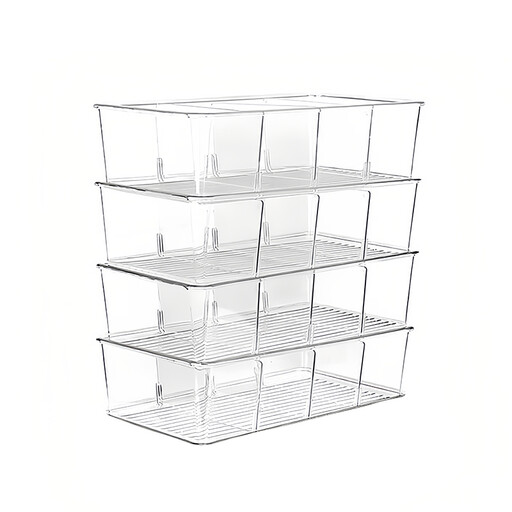
Why we chose it: Ideal for organising kitchen drawers, a desk, or a bathroom cabinet. This organiser is designed for sorting small everyday items: tea bags, makeup, supplies...
Here, there's no heavy storage, so the risk of cracking is eliminated. Its main appeal lies in its transparent PET material for perfect visibility, and its compartments that put an end to chaos inside the box.
Meticulous organisation of small items thanks to the compartments. The set of four allows you to create a cohesive and modular storage system.
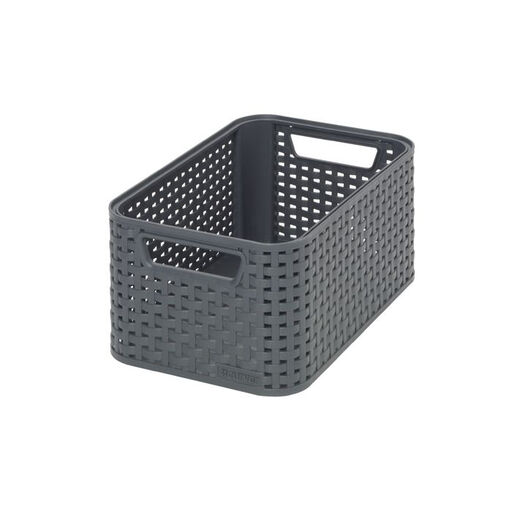
Why we chose it: For those who want a storage bin that's meant to be seen. With its woven rattan look, it elegantly fits into a living room, bedroom, or bathroom to hold magazines, throws, or beauty products.
Since this is an open basket, the problem of a warped lid is solved. Its polypropylene (PP) construction makes it sturdy and easy to clean, unlike natural fibre baskets, which are often more fragile and difficult to maintain.
The perfect blend of style and practicality. Its rattan-look texture is a real decorative plus, while its plastic design ensures longevity and ease of maintenance.
Discover our full selection of products that meet our criteria for quality and durability.
Polypropylene (PP) is more flexible and resistant to impacts and temperature changes. It's the ideal choice for long-term storage in unheated areas (cellar, garage). Polyethylene terephthalate (PET), which is more rigid and transparent, is perfect for organising everyday items you want to identify at a glance, in a kitchen or on a desk.
For stable stacking, use boxes from the same range that are designed to be stacked. The golden rule: always place the heaviest boxes at the bottom. Never exceed the manufacturer's recommended height and ensure each box is perfectly stable and aligned before adding another. Flat lids with interlocking rims are essential.
Absolutely not. It is imperative to only use boxes certified for food use. Look for the "food safe" label or the international symbol (a glass and fork). Standard storage boxes can release harmful chemicals or dyes when they come into contact with food.