
Livraison le jour même ou le lendemain

Qualité garantie

Débloquez vos offres de bienvenue: Livraison GRATUITE | Jusqu'à -80 % | 30 jours d'essai gratuits à JoyPlus
Téléchargez l'application
Clutter is taking over, and you're dreaming of a miracle solution: the storage box. The problem: the market is flooded with models that look identical but often hide deal-breaking flaws. Before you click 'buy', a quick overview of the common pitfalls is essential to avoid turning a great deal into a major headache.
Do these scenarios sound familiar?
Fortunately, these disappointments are not inevitable. You just need to know a few key technical criteria to make an informed and, most importantly, durable choice.
For a home organisation system that lasts, price and colour aren't enough. Three technical details make all the difference between a gimmicky product and a long-term investment.
The generic term "plastic storage box" actually hides a wide range of qualities. The material to look for is almost always polypropylene (PP). It offers the best compromise between rigidity, impact resistance, and tolerance to temperature changes.
Be aware, not all PP is created equal. Two points to scrutinise:
The "stackable" label is everywhere, but stability is rarely a given. Reliable stacking depends on the design of the box with lid / base combination.
The external dimensions (L x W x H) are often misleading. To judge the real capacity, you need to inspect the internal geometry.
Because every need is unique, here is our selection of products that meet specific uses, all evaluated according to the quality criteria we've just detailed.
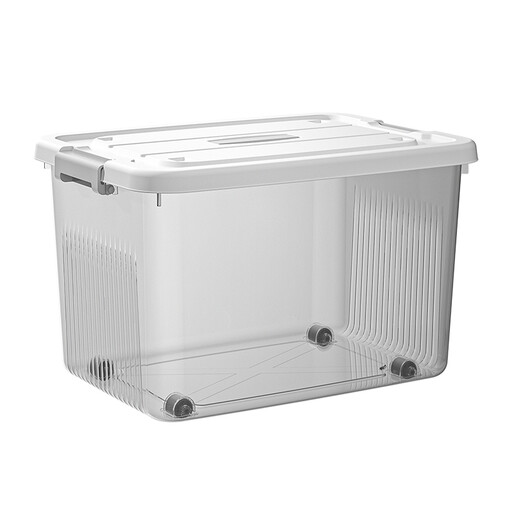
Best for: Perfect for storing heavy items (tools, archives) or for long-term storage in the basement, garage, or attic. This set of storage boxes is built for performance.
Its 2.5 mm thick PP structure, covered with reinforcing ribs, knocks out the brittle plastic syndrome. The non-slip bottom and flat lid ensure stable stacking—goodbye to the "Leaning Tower of Pisa" effect.
Its transparency allows you to identify the contents at a glance, without having to unstack everything. A real plus, complemented by integrated handles that make handling easy, even when fully loaded.
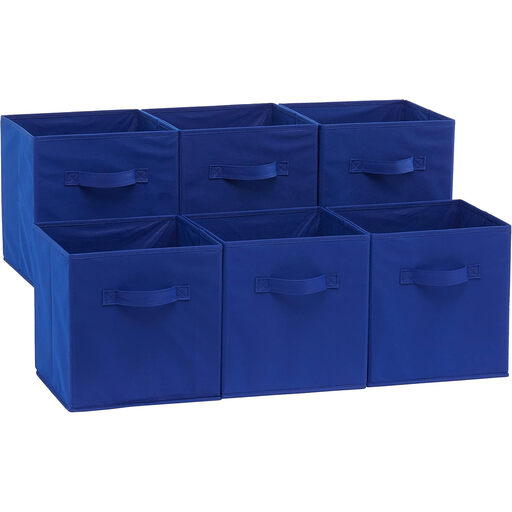
Best for: Ideal for compartmentalising shelves in a wardrobe, office, or playroom. This type of storage cube is lightweight, flexible, and folds flat when not in use—a real bonus for small spaces.
It cleverly sidesteps the wasted volume trap. Its cubic shape and straight fabric walls guarantee 100% usable internal volume, without the space squandered by the tapered walls of plastic boxes.
Modularity. Sold as a set, it allows you to create a category-based organisation system (toys, accessories, stationery...). The handles make them easy to pull out from shelves. It's the most accessible and flexible organisation solution.
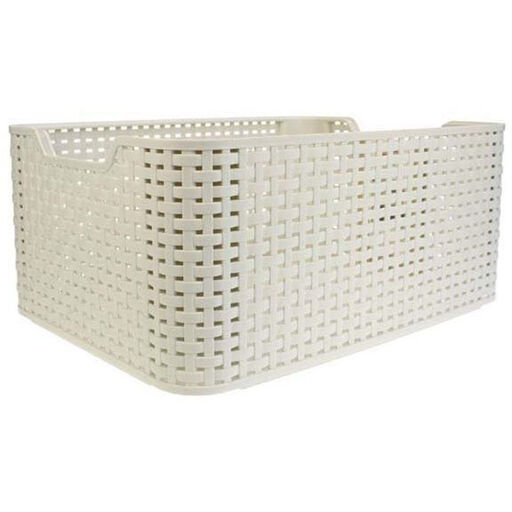
Best for: For those who refuse to sacrifice style for practicality. This storage basket is designed to be seen and fits perfectly in a living room, bathroom, or bedroom.
It shatters the notion that "plastic box" means "ugly." Its woven rattan-style finish adds a warm touch, while retaining the advantages of plastic: lightweight, durable, and easy to clean with a simple wipe.
Its versatility. Its open design and large handles make it ultra-practical for holding throws, magazines, towels, or beauty products, all while keeping the contents within easy reach.
Discover our full selection of editor-approved products, all meeting our quality criteria and safety standards.
Polypropylene (PP) is the champion in this category for its fatigue resistance (it doesn't break when bent), good chemical resistance, and temperature tolerance. Other plastics like polystyrene (PS) are much more brittle, while polyethylene (PE) is more flexible. For boxes that are both rigid and durable, PP remains the safest choice.
The golden rule: always place the heaviest boxes at the bottom. Make sure each lid is securely closed, clean, and dry. Firmly nest the base of the top box into the designated notches on the lid of the one below. Finally, avoid stacks that are too high, especially if they are not braced against a wall.
Absolutely not. For food contact, it is imperative to use boxes that are labelled "food-safe" or guaranteed BPA-free (Bisphenol A). Standard storage boxes (for the garage, DIY, etc.) are not designed for this purpose and can leach chemicals into food. Always check the manufacturer's specifications before any use.