
Livraison le jour même ou le lendemain

Qualité garantie

Débloquez vos offres de bienvenue: Livraison GRATUITE | Jusqu'à -80 % | 30 jours d'essai gratuits à JoyPlus
Téléchargez l'application
A tidy home makes for a clear mind. Yet, the quest for the perfect storage box often turns into a real headache. An impulse buy all too often ends in disappointment: warping lids, wobbly stacks, or materials unsuitable for their intended use.
As a Product Expert for Joybuy, my mission is to help you navigate the options and make an informed choice. This guide breaks down the key points to check and the mistakes to avoid, ensuring your investment is both worthwhile and long-lasting.
The market is flooded with solutions that seem practical at first but reveal their weaknesses with use. Here are the three most common disappointments.
To avoid these issues, a few technical details can make all the difference.
The choice of material is crucial and depends entirely on what you plan to store.
A well-designed storage box should adapt to your space, not the other way around.
Rather than an overwhelming list, we've selected solutions that meet specific needs, applying the quality criteria we've just discussed.
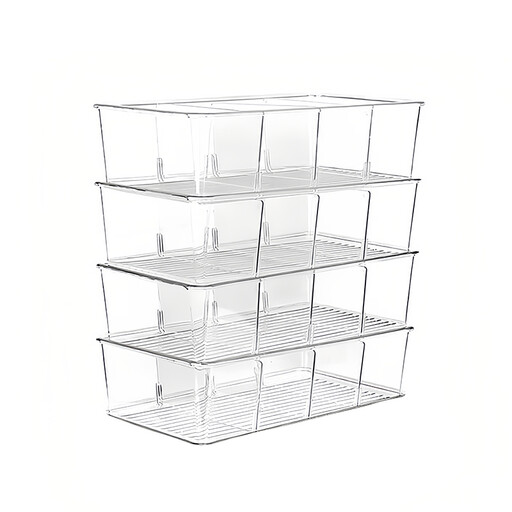
Why we chose it: Ideal for organising small everyday items: tea bags, coffee pods, makeup, office supplies... Its open-top design ensures immediate access.
The PET material ensures excellent rigidity and crystal-clear transparency, a far cry from the "cheap plastic" look that warps. Designed as an organiser, its lidless design immediately eliminates the problem of a poor seal.
Its modularity allows you to create a custom configuration in a drawer or on a shelf. The transparency ensures you can see the contents instantly.

Why we chose it: Perfect for meal prep enthusiasts or for storing leftovers. This container goes from the fridge to the oven and then straight to the table, radically simplifying meal management.
Its borosilicate glass body withstands temperatures up to 400°C without ever warping. The 4-clip locking system, combined with a silicone seal, ensures a 100% airtight closure, bypassing the faulty lid pitfall.
Its versatility (oven, microwave, freezer, dishwasher) and its food-safe properties. Glass is a perfectly inert material that preserves the integrity and taste of food.

Why we chose it: Designed for heavy-duty storage: out-of-season clothing, archives, children's toys, or DIY equipment. Its large capacity and robustness are its strongest selling points.
Its structure, made of 2.5 mm thick reinforced PP with ribs, counteracts the risk of warping. The lid is specifically designed to interlock with the base, guaranteeing a stable and secure stack.
An excellent load capacity and a design optimised for vertical space. The integrated handles make it much easier to carry, even when fully loaded.
We have put together a complete selection of products that meet our quality criteria and current safety standards.
It all depends on the plastic. For food use, it is imperative that the box is labelled "food safe" or displays the international symbol (a glass and fork). Plastics like PP (polypropylene) and PET are often suitable; however, it is safer to choose products explicitly certified as BPA-free. For absolute peace of mind, especially with fatty or acidic foods, a glass food storage container remains the safest and most inert option.
For a stable and secure stack, it's best to choose boxes from the same product line. Their dimensions are often designed to be modular. The golden rule: always place the heaviest items in the bottom boxes and respect the maximum load capacity indicated by the manufacturer to avoid any long-term deformation.
The main difference lies in their chemical composition and, consequently, their durability. Borosilicate glass incorporates boron trioxide, which gives it a very low coefficient of thermal expansion. In practical terms, it can withstand abrupt temperature changes (thermal shock) without cracking, unlike ordinary soda-lime glass. This is why it is preferred for ovenware and laboratory equipment. It is also lighter and more resistant to mechanical impact than standard glass.