
Livraison le jour même ou le lendemain

Qualité garantie

Débloquez vos offres de bienvenue: Livraison GRATUITE | Jusqu'à -80 % | 30 jours d'essai gratuits à JoyPlus
Téléchargez l'application
A storage box can transform a cluttered cupboard into a perfectly organised space. But you need to choose a model that suits your needs. Dimensions quoted without accounting for the lid, materials that are too flimsy, wobbly stacking… some purchases can quickly disappoint after just a few weeks.
This guide helps you compare the criteria that really matter for storing clothes, toys, documents or everyday items, whether you live in a small flat, a family house or a student bedroom.
A large storage box might look good on paper, but it quickly becomes difficult to move once it's full. For clothes and household linen, pay close attention to the external dimensions, the shape and whether it has handles. A deep model works well for seasonal storage, but is less practical on a low shelf or under a bed.
A stackable storage box needs a sufficiently flat lid and a stable base. Without grooves, rims or a non-slip base, containers can slide when you remove a box from the middle of the stack. Also respect the maximum load, especially in a cupboard or cellar.
Fabric gives a warmer feel, while a plastic storage box is easy to clean. However, cardboard and fabric don't cope well with moisture. For a cellar, garage or balcony, it's best to choose rigid plastic and avoid prolonged exposure to sunlight or a heat source.
Measure the space before ordering: shelf width, available height and cupboard depth. For wardrobe storage, allow a few centimetres of clearance so you can easily grab the box. Under a bed, a low model with a lid is more practical than a tall box.
Also think about the opening system. A clip-on lid is suitable for long-term storage, while an open box or a storage basket gives quick access to toys, towels and everyday accessories.
Polypropylene, usually marked with the abbreviation PP, is very common for plastic boxes. It can be cleaned with a damp cloth and stands up well to normal household use. Some reinforced models have thick walls, ribs and integrated handles. These details make them easier to carry, but you still need to respect the recommended load.
Non-woven fabric or cardboard models are fine for clothes, papers and small items, provided you use them in a dry room. A foldable storage box can be flattened when not in use – a real advantage in homes where every square centimetre counts.
A clear storage box lets you see what's inside at a glance, without having to open every container. It's especially handy for stationery, toys, shoes and accessories. To protect seasonal clothes from dust, choose a storage box with a lid or a model with a closure.
However, avoid putting heavy items in a box designed for textiles. For documents, choose a size that fits files and keep the boxes away from damp.
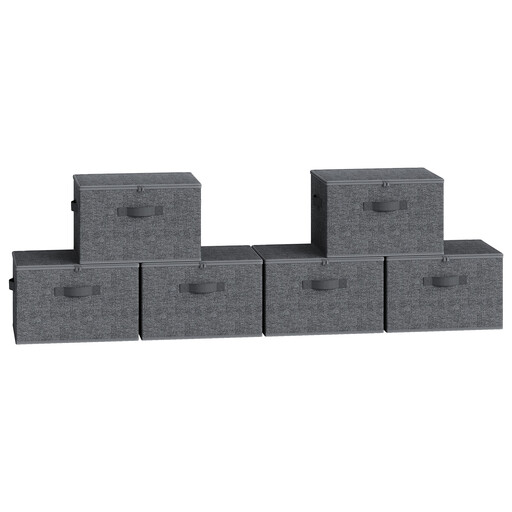
Why this choice suits this profile: this set is ideal for organising a wardrobe, a student bedroom or a family shelf. Each box offers a stated volume of 30 L and measures 40 × 30 × 25 cm.
The zip-up lids on three sides limit dust exposure, while the boxes fold flat when not in use.
Six units, three handles per box and a stated maximum static load of 3 kg per unit.

Why this choice suits this profile: this model is designed for those who want a visual, uniform organisation system in a wardrobe, utility room or garage.
The walls, stated at 2.5 mm, the reinforcing ribs and the non-slip base reduce the risk of warping and sliding.
Press-on lid, integrated handles and dimensions of 50.4 × 37.6 × 28.8 cm.
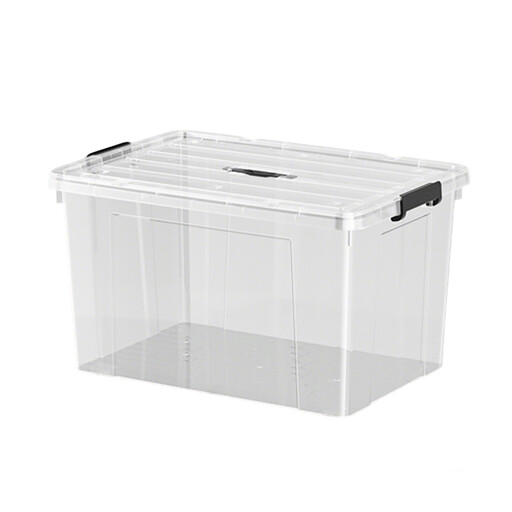
Why this choice suits this profile: with its size of 51 × 39 × 35 cm, this set offers a capacity suited to bulky clothes, toys and regularly used accessories.
The transparency prevents endless searching and the press-on lid protects the contents from dust in storage spaces.
Reinforced PP structure, side handles and a design built for stacking.
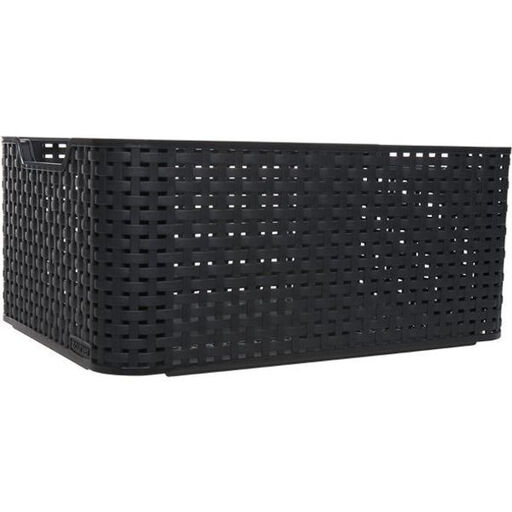
Why this choice suits this profile: this open basket is perfectly suited to everyday use in a bathroom, bedroom, office or living room.
Its open design means you don't have to fiddle with a lid several times a day, while the handles make it easy to move around.
Rattan-effect polypropylene, wipe-clean with a damp cloth and a stated maximum load of 8 kg, evenly distributed.
We've put together a comprehensive, real-time updated selection of products that meet these demanding criteria and European safety standards.
Choose a closed model, with a lid or zip closure, to limit dust build-up. For jumpers and linen, pay particular attention to the volume, room ventilation and maximum load capacity. A foldable box saves space when empty.
They make it easy to identify the contents, but plastic doesn't automatically protect against damp. In a cellar, place the boxes on a shelf and avoid direct contact with the floor. Check the condition of the lid and contents regularly.
Start by measuring the available space and sorting items by category. A set of storage boxes can be useful for keeping uniform dimensions, but only buy the number that actually fits on your shelves. Leave enough clearance to open, grab and move each container.