
Livraison le jour même ou le lendemain

Qualité garantie

Débloquez vos offres de bienvenue: Livraison GRATUITE | Jusqu'à -80 % | 30 jours d'essai gratuits à JoyPlus
Téléchargez l'application
A storage box can quickly free up space in a bedroom, living room or garage. But a poorly thought-out purchase often ends up at the back of a cupboard: a lid that's hard to close, flimsy handles, fabric that loses its shape, or dimensions that don't fit your shelving.
To organise your home effectively, it's best not to rely on looks alone. Here are the criteria to consider, the common mistakes to avoid, and a selection of models suited to different uses.
A large-capacity storage bin can turn out to be impractical if it's too shallow, too deep, or awkward to get hold of. For folded clothes, toys or laundry, measure the space you have available and compare it with the product's external dimensions.
Also think about access. A box placed on a high shelf needs to be light enough and have handles that are easy to grip.
A fabric storage box is generally fine for clothes, accessories and small items. It isn't designed to hold heavy books or tools. Conversely, a reinforced plastic model can take more weight, provided you stick to the load specified by the manufacturer.
Don't rely on how thick it looks or the product photo to judge its sturdiness. Always check the maximum weight capacity, especially if you plan to stack several boxes.
A box with a lid offers better protection against dust, but it needs more space to open. An open storage basket gives you immediate access, but its contents remain visible and less well protected.
Collapsible fabric boxes are easy to store away when not in use. Plastic, on the other hand, is simpler to clean and better suited to a cellar, garage, balcony or any other area exposed to dirt. Each material serves a different purpose.
Measure the width, depth and height of the space, and don't forget to allow room for removing the container. For a storage cube, a box measuring 30 × 30 × 30 cm needs a slightly larger compartment so you can slide it in and out without forcing it.
In a wardrobe, shallow formats are handy for accessories, documents or smaller items of clothing. Larger bins are better for bedding, bulky toys and seasonal items.
A stackable storage box needs to stay stable when several containers are placed on top of each other. Look for a non-slip base, a flat lid and a structure that won't sag.
Integrated handles make it easier to carry from room to room. On fabric models, check the fixings carefully and don't exceed the recommended load. A clip-fastening lid protects the contents well, but it should be easy to open and close without forcing.
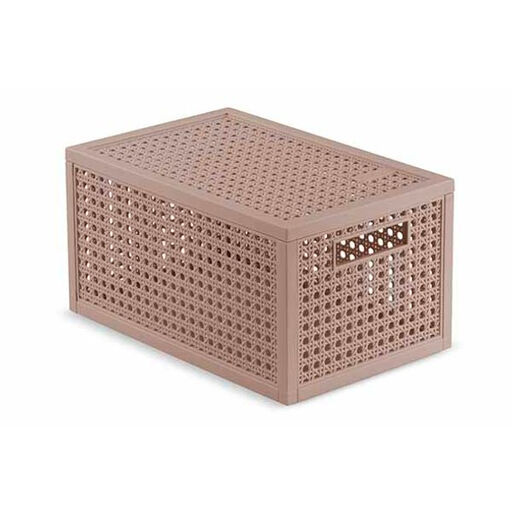
Why this choice suits this profile: Its shallow design fits easily on a shelf, desk or in a chest of drawers, even in tight spaces. It can hold remote controls, accessories, magazines or small toys.
Its detailed dimensions reduce the risk of choosing a container that's too tall for a niche or drawer.
A breathable textile structure, recycled material as stated by the manufacturer, and a lightweight design that makes it easy to move around.
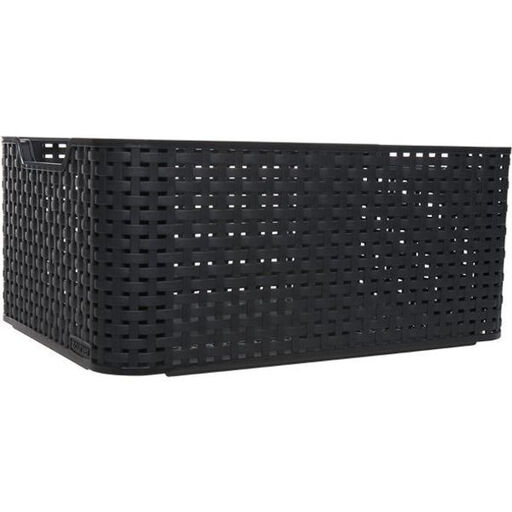
Why this choice suits this profile: Its woven look and integrated handles let you store laundry, accessories or toys in a living space without making it feel like a utility cupboard.
The model stays open, so you avoid a bulky lid when items are used every day.
Polypropylene with a rattan-look finish, integrated handles and a stated maximum load of 8 kg.
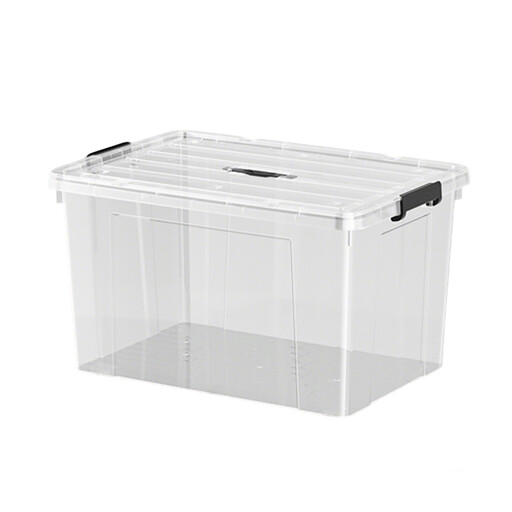
Why this choice suits this profile: This size is ideal for storing seasonal items, in the garage, on the balcony, in the car boot, or for bulky objects that need to stay protected and securely closed.
The clear plastic lets you identify the contents in an instant, while the clip-on lid protects them from dust.
A PP body stated at 2.5 mm, reinforcing ribs, integrated handles and a design intended for stacking.
We've selected a full, up-to-date range of products that meet these demanding criteria, while complying with European safety regulations.
Plastic is suitable for frequent use, dirty areas and closed storage. Fabric is lighter and collapsible, but it should be kept away from moisture. The right choice depends on the room, the weight of the items and how often you handle them.
No. Only models designed for stacking can be placed on top of each other safely. Check the shape of the lid, the stability of the base and the permitted load. Avoid stacking soft baskets that could collapse or become unstable.
Respect the stated weight limit, avoid sharp objects and clean the box according to the manufacturer's instructions. For a fabric model, air it out before first use if there's a lingering new smell, and don't submerge it in water unless stated otherwise. For plastic, a damp cloth is usually enough. Keep it away from flames and sources of high heat.