
Livraison le jour même ou le lendemain

Qualité garantie

Débloquez vos offres de bienvenue: Livraison GRATUITE | Jusqu'à -80 % | 30 jours d'essai gratuits à JoyPlus
Téléchargez l'application
A storage box can sometimes be all it takes to transform an overstuffed cupboard into a perfectly functional space. But you need to choose a model that suits what you plan to put in it. A box designed for clothes won’t necessarily work for beads, toys or bathroom products.
Before you place an order, three common pitfalls keep cropping up:
To find the right organiser, look closely at the dimensions, materials, access system and how often you expect to handle its contents.
Start by measuring the available space: shelf width, height between shelves, cupboard depth or the gap under the bed. Leave a few centimetres of clearance so you can grab the box and open its lid without difficulty.
A stackable storage box needs to sit on a stable base and have a sufficiently flat top. Plastic models with a clip-on lid are generally well suited to the garage, balcony, cellar or car boot. Fabric foldable boxes, on the other hand, are better placed in a wardrobe for storing clothes, accessories and other lightweight items.
If you have a cube shelving unit, check its internal dimensions carefully. A storage cube measuring 30 × 30 × 30 cm fits many compartments, but you should always verify the actual depth of the unit before buying.
The material should be chosen based on what the box will hold:
Don’t rely solely on claims like “large capacity” or “reinforced structure”. If the product specification lists a maximum static load, use that as a guide and avoid exceeding it. A box intended for clothes doesn’t face the same stresses as a container filled with tools or books.
A storage box with a lid offers better protection against dust, provided it stays easy to open. Clip-on fastenings are practical when you need frequent access. A zip-around lid that opens on three sides, meanwhile, makes it easier to browse clothes stored up high.
For small items, a compartmentalised insert stops beads, buttons, accessories and supplies from getting mixed up. A storage basket with a handle is especially handy for everyday essentials: you can quickly pull it off the shelf and put it back just as easily.
Also check the care instructions. Plastic can usually be wiped clean with a damp cloth. Non-woven fabric and cardboard should be gently dusted and kept in a dry place. As for a foldable storage box, it should be collapsed without force to preserve its panels and shape.
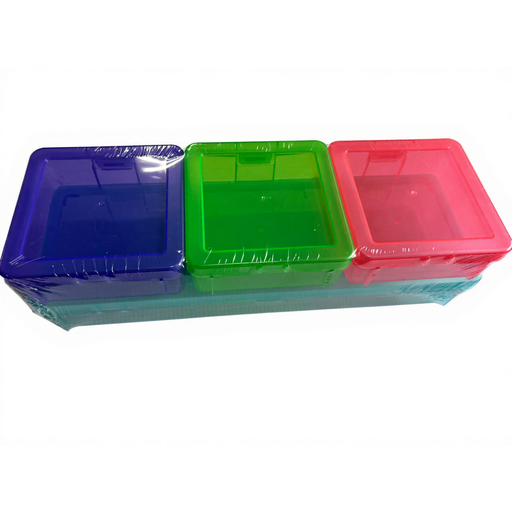
Why this choice suits this profile: this set of four containers lets you start organising remote controls, magazines, accessories and office supplies across several rooms with ease.
The multi-pack format stops you from accumulating mismatched boxes and makes it easier to sort items by category.
Four units with a uniform design, usable in the living room, bedroom or home office.
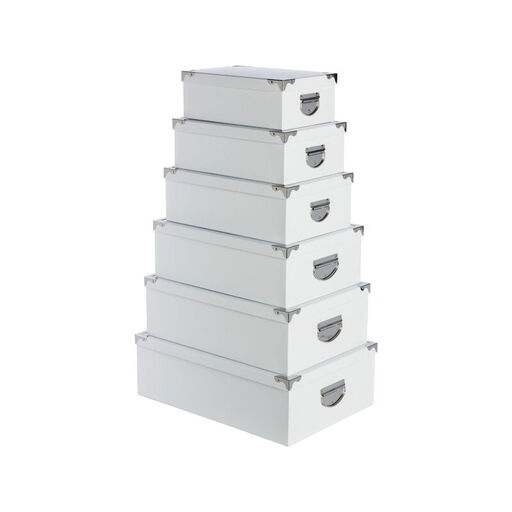
Why this choice suits this profile: its six different sizes fit into an organisation system that is both practical and decorative for photos, papers, keepsakes or craft supplies.
The detailed dimensions let you choose each box based on its location, rather than relying on an overall capacity figure.
Six sizes, metal corners and a stackable design as stated in the product specification.

Why this choice suits this profile: this format works well for seasonal clothes, accessories, baby items, garage bits and supplies that need frequent access.
The clip-on lid, integrated handles and non-slip base address the issues of closure, transport and stacking.
PP plastic stated at 2.5 mm, reinforcing ribs, transparency and the ability to stack the boxes.
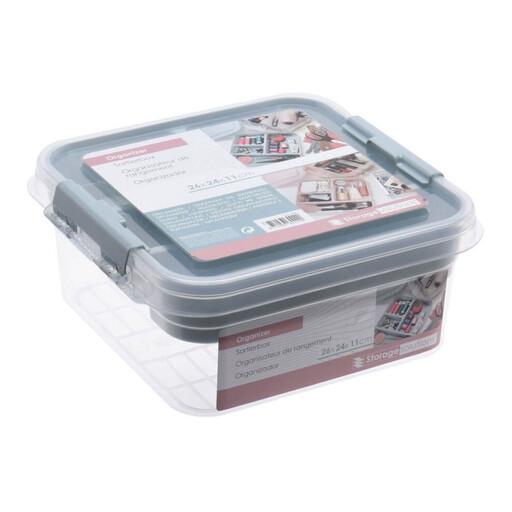
Why this choice suits this profile: its five compartments and compact size of 26 × 24 × 11 cm are ideal for beads, buttons, small tools, supplies and stationery items.
The removable compartmentalised insert stops all the small items from being lumped together in one container where they would be hard to sort.
Clip fastenings, five compartments and a size that suits a desk or shelf.
We’ve put together a comprehensive, real-time selection of products that meet these exacting criteria as well as European safety regulations.
For seasonal clothes, go for a storage box with a lid that is wide enough and easy to stack. Foldable fabric models can be stored flat when not in use. In a cellar, garage or on a balcony, plastic with a clip-on closure will generally be easier to clean.
Check that the lid has a flat surface and that the underside has a non-slip system or a stable base. Place the heaviest boxes at the bottom, respect the stated maximum load and avoid building a stack that is too high in a hard-to-reach spot.
For beads, buttons, threads and small parts, choose a storage box for arts and crafts with compartments or a removable insert. A compact model kept near your desk reduces handling and lets you quickly find each category.