
Livraison le jour même ou le lendemain

Qualité garantie

Débloquez vos offres de bienvenue: Livraison GRATUITE | Jusqu'à -80 % | 30 jours d'essai gratuits à JoyPlus
Téléchargez l'application
Is clutter taking over and you're looking for a simple solution to regain control? A storage box is often the first thing that comes to mind. Yet, an impulse buy frequently ends in disappointment: warped lids, plastic that cracks at the slightest knock, or stacks of boxes that resemble the Leaning Tower of Pisa. To avoid turning a sound investment into a regrettable purchase, it's crucial to know how to navigate the pitfalls of the storage aisle. Let's find the model that will truly, and durably, meet your needs.
As a Product Expert at Joybuy, my mission is to help you see things more clearly. Let's forget the marketing jargon and focus on what really makes a difference.
The market is flooded with options, but not all are created equal. Here are the two most common traps that turn a good idea into a bad investment.
To make the right choice, focus on these three key points. They are the true guarantee of your boxes' effectiveness and longevity.
The choice of material depends entirely on your intended use.
A quality box is recognizable by its details. Look for reinforcement ribs on the walls and under the base: they significantly increase rigidity and load-bearing capacity. Rounded corners are not just an aesthetic detail; they distribute impacts better and prevent cracks. Finally, for a stackable storage box worthy of the name, the lid and base must be designed to interlock perfectly, without any wiggle room.
A good lid must be both easy to handle and perfectly secure. Systems with sturdy clips are far more reliable than simple drop-on lids. For food containers, a silicone seal is non-negotiable for a foolproof, airtight seal. Lastly, if you need to move heavy loads, comfortable, integrated handles are not a luxury—they are a game-changer.
To illustrate these criteria in action, here are a few models that caught our eye, each tailored to a specific need.

Why this choice? Ideal for storing off-season clothing, stray toys, or archives. This set forms the foundation of a coherent and stable storage system, whether in a closet, garage, or basement. Its transparency is a real plus for finding your belongings without turning everything upside down.
Its design combines a non-slip base and a lipped lid that interlock perfectly—goodbye, wobbly stacks! The thick plastic (2.5 mm) and multiple reinforcement ribs prevent the box from deforming under weight.
A structure designed to support weight and allow for secure stacking. The integrated handles make transport genuinely easy.

Why this choice? The perfect ally for prepping weekly meals, storing leftovers, or taking lunch to the office. Stainless steel is the healthiest and most durable solution: it doesn't retain odors or stains, unlike many plastics.
Food-grade 316 stainless steel is nearly indestructible. It resists corrosion and impacts, eliminating any risk of cracks or particle migration. It won't warp and will last for years.
A 100% healthy, hygienic, and stain-proof material. It's freezer and dishwasher safe for easy maintenance.
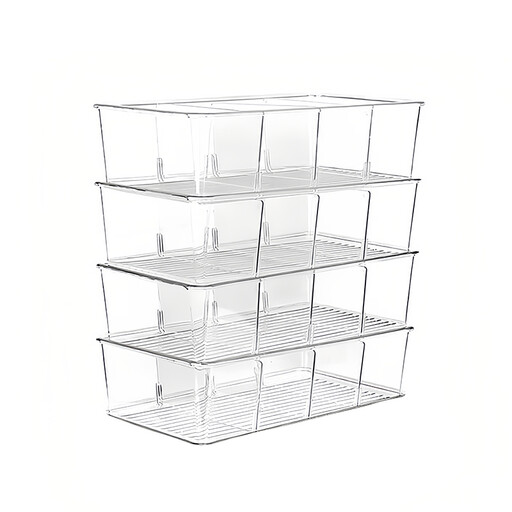
Why this choice? Perfect for taming everyday clutter: tea bags, coffee pods, pens, or makeup. Its open-top design and compartments provide immediate access and clear, visual organization.
This model forgoes a lid, often the first part to break. It bets everything on an open design and ultra-durable PET plastic, known for its clarity and strength. No weak points, no unpleasant surprises.
Its crystal-clear transparency and modular format allow you to create custom organization in drawers, cupboards, or on a desk.
Discover our full selection of products that meet our criteria for quality and durability.
1. How do I choose the right size box? Start by measuring your storage space (shelf, closet). Then, estimate the volume of what you want to store. A word of advice: it's better to opt for several medium-sized boxes than one very large one, which will quickly become too heavy and unwieldy.
2. Are all plastic boxes suitable for food contact? Absolutely not. For a food storage container, check for a "BPA-free" label and the food-safe symbol (a fork and glass icon). Polypropylene (PP, #5) is generally a safe and recommended choice.
3. Can you stack boxes from different brands? That's a very bad idea. For stable and secure stacking, it is essential to use boxes from the same product line. They are designed to interlock with precision, which is an impossible mission with mismatched models.