
Livraison le jour même ou le lendemain

Qualité garantie

Débloquez vos offres de bienvenue: Livraison GRATUITE | Jusqu'à -80 % | 30 jours d'essai gratuits à JoyPlus
Téléchargez l'application
Reclaiming an organised living space is the ultimate goal. But the quest for the perfect storage solution often turns into a nightmare. A storage box seems like an easy fix, but a poor choice can quickly turn a good idea into a source of frustration. Collapsing stacks of boxes, warping lids, plastic that cracks at the slightest impact—these are scenarios we all know too well.
As a product expert for our editorial team, my mission is to guide you through this jungle of options to find solutions that are genuinely practical and durable. Let's break down the common pitfalls to avoid and the criteria that make all the difference for a successful purchase.
Before you jump on the first discounted set you see, it's essential to review the design flaws that render so many boxes useless in the long run.
To avoid falling into these traps, here are the few technical characteristics you should focus on. These are the true hallmarks of a product's quality and suitability.
The word "plastic" is a generic term that can mean anything and everything. For a plastic storage box subjected to heavy use (garage, moving, long-term storage), polypropylene (PP) is a must. It is known for its robustness, impact resistance, and flexibility. A good rule of thumb: check if the manufacturer specifies the wall thickness (e.g., 2.5?mm) or the presence of reinforcing ribs, which dramatically increase strength.
For a desk organiser or food-grade boxes, you'll want to look for PET (polyethylene terephthalate) instead. It offers a crystal-clear transparency, similar to glass, and is generally BPA-free—a significant advantage for kitchen storage.
Stackable boxes that don't wobble are the key to successful space-saving. A good storage box with a lid must tick several boxes:
Choosing a clear storage crate may seem trivial, but it's a phenomenal time-saver in daily life. It allows you to identify the contents at a glance, without having to open everything or rely on labels that always end up peeling off. A real bonus for storing seasonal clothes, Christmas decorations, or archives.
Because every need is unique, here are a few user profiles and the solutions that meet them, based on the quality criteria we've just discussed.

Ideal for: Those who need robust, modular solutions for storing various items (clothes, toys, tools) in different rooms. This set of storage boxes offers a generous volume and a design that exudes durability.
The spec sheet mentions a thickness of 2.5 mm and reinforcing ribs, tackling the problem of brittle plastic head-on. The non-slip base and clip-on lid ensure stable stacking.
Its reinforced polypropylene (PP) structure and integrated ergonomic handles make it easy to carry, even when fully loaded. Perfect for the garage or cellar.
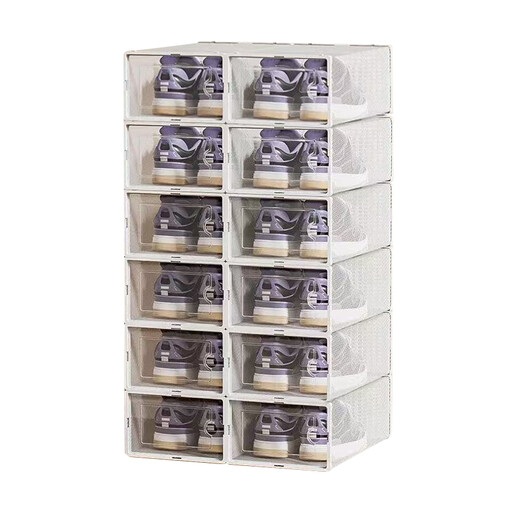
Ideal for: Enthusiasts for whom a sneaker is a collector's item. This shoe storage system is designed to display and protect your best pairs while ensuring immediate access.
It avoids the "catch-all" trap by offering a specialised solution. Unlike a classic crate, its clear, magnetic front door allows you to see and grab any pair without having to unstack the entire pile.
Its modular design allows you to create a custom "sneaker wall". The soft-close magnetic door and anti-oxidation protection are details that connoisseurs will appreciate.
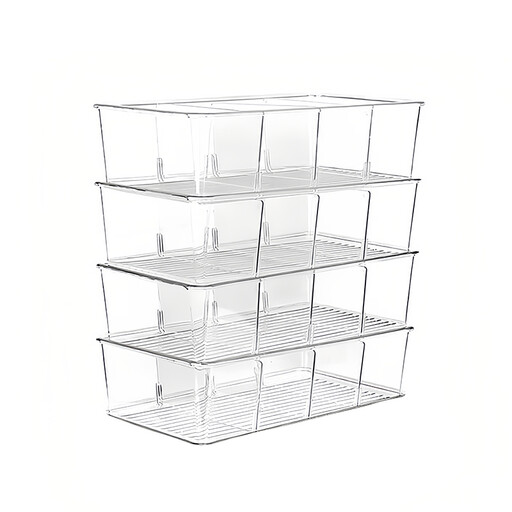
Ideal for: Taming the chaos of small items on a desk, in a kitchen drawer, or in a bathroom. A compartmentalised desk organiser will always be more effective than a large, empty box.
It tackles the infamous "mess-in-a-box" problem with its fixed compartments. Perfect for sorting tea bags, coffee pods, pens, or makeup, everything finally has its place.
The clear PET material offers near-perfect clarity, which is both aesthetically pleasing and practical. Its low-profile, open-top format is ideal for sliding into drawers or displaying on shelves.
Explore our full selection of products that meet our standards for quality and durability.
Use a soft cloth or non-abrasive sponge with warm water and a little mild soap or washing-up liquid. Rinse thoroughly and dry completely before reusing, especially for storing textiles or paper. Avoid scouring powders and hard brushes, which can scratch the surface, particularly on clear PET.
This information is rarely provided by manufacturers, but a common-sense rule applies: always place the heaviest boxes at the bottom of the stack. A good quality, reinforced PP model can support several tens of kilos, but it all depends on the weight distribution and the stability of the stack. In short, never stack higher than what feels secure.
Buying a set of storage boxes is often more economical and ensures visual and practical consistency. If you have a large volume to organise (a cellar, an attic), a set of the same size is perfect for creating stable, uniform stacks. Buying individually remains a good option for a very specific need or to complement an existing storage setup.