
Livraison le jour même ou le lendemain

Qualité garantie

Débloquez vos offres de bienvenue: Livraison GRATUITE | Jusqu'à -80 % | 30 jours d'essai gratuits à JoyPlus
Téléchargez l'application
Is clutter taking over, and are you dreaming of optimising your space? A good storage box is the obvious solution. But be careful—the wrong choice can quickly turn a great idea into a real headache. As a product expert at Joybuy, my mission is to guide you through the jungle of options to find home storage solutions that truly stand the test of time.
Before you dive in, let's break down the three critical flaws that can render a storage crate useless after just a few months.
To avoid these disappointments, here are the technical points to examine closely.
The type of plastic is the first indicator of its longevity. Polypropylene (PP) is generally an excellent choice for a plastic storage box, as it offers a perfect balance between rigidity and impact resistance.
But the material alone is not enough. Check the thickness of the walls. A thickness of 2.5?mm or more, often coupled with reinforcing ribs on the sides and bottom, is a sign of a robust design, built to support loads without deforming. A non-slip base is also a real plus for stability.
Never underestimate the lid! It is as crucial as the box itself. Sturdy clip-locking systems are far more reliable than simple drop-on lids. For storage in damp places like a cellar or garage, a set of storage boxes with lids featuring a silicone seal will provide much better protection against moisture and dust. Check that the lid fits the body of the box perfectly to ensure a secure closure.
A true stackable storage solution is much more than just the ability to place one box on top of another. The best models have flat lids with rims, or bases designed to nest into one another. This creates a stable column that optimises vertical space without risk. For organising cupboards or shelves, a storage cube or a modular storage organiser offers highly valuable flexibility.
There's a solution for every need. We have selected a few models that meet very specific uses, always keeping our criteria of durability and practicality in mind.
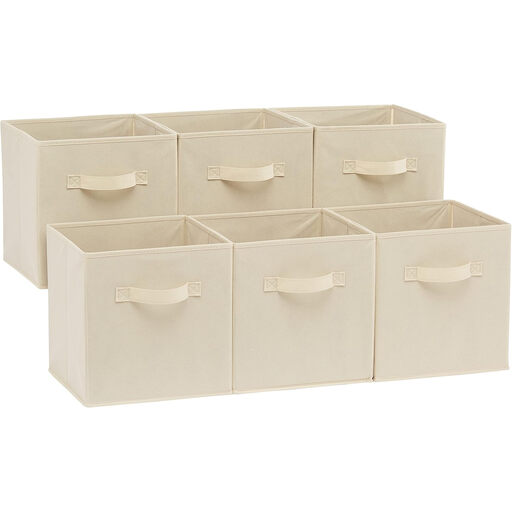
Why we chose it: Perfect for organising the inside of wardrobes, Kallax-style shelves, or walk-in closets. The collapsible feature is a bonus: they fold flat when not in use.
Designed for light, indoor use (clothing, toys...), it doesn't pretend to be a heavy-duty solution. It thus avoids the instability trap by focusing on its role: it's the right tool for the right job.
The set of six creates a clean, cohesive look in a bookcase or closet. The handles are a practical detail, making it easy to pull them from their shelves.

Why we chose it: The ideal solution for the garage, cellar, or attic. Its large capacity and robust design are built for out-of-season clothing, tools, or archives.
Its structure, made of 2.5 mm PP plastic and reinforced with ribs, directly tackles the problem of warping. The flat lid and non-slip base guarantee perfectly stable stacking.
Its reinforced design and integrated handles simplify transport, even with heavy loads. The transparent plastic is a real plus for identifying the contents at a glance.
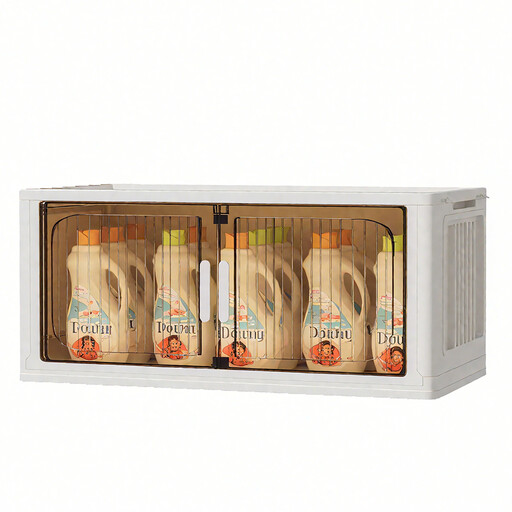
Why we chose it: For those looking for an all-in-one solution, halfway to being a true piece of furniture. This complete system is perfect for a laundry room, bedroom, or office.
As an integrated system, stability is built into the design. Goodbye to the "Leaning Tower of Pisa" risk from poorly stacked boxes.
The front-access doors are a game-changer: no more unstacking everything to get to the bottom box. Each module supports a substantial load (up to 25 kg).
We've curated a complete selection of products that meet our quality criteria and current standards.
It all depends on the quality of the plastic (PP is a good indicator of durability), its thickness, its exposure to UV light, and the weight it supports. A well-designed storage crate can last for years, whereas a low-end model will show signs of weakness (cracks, warping) in less than a year.
Choose models where the lid and base are designed to interlock. A textured or non-slip bottom is an added bonus. Also, remember not to overload the top boxes to keep a low centre of gravity and ensure the stability of the stack.
Transparent boxes are unbeatable for identifying contents at a glance, perfect for everyday items. Opaque models, on the other hand, are recommended for protecting light-sensitive items (photos, certain fabrics...) or simply for achieving a more understated and uniform look in a living space.