
Livraison le jour même ou le lendemain

Qualité garantie

Débloquez vos offres de bienvenue: Livraison GRATUITE | Jusqu'à -80 % | 30 jours d'essai gratuits à JoyPlus
Téléchargez l'application
A tidy home leads to a clearer mind. Yet, finding the ideal storage solution can often be a puzzle. Between promises of durability and the reality of everyday use, it's easy to make a mistake. As the Head of Product Selection at Joybuy, my mission is to help you see things more clearly. This guide breaks down the essential criteria for choosing a storage box that truly lives up to its promises, with no unpleasant surprises.
The market is flooded with options, but not all are created equal. Here are the most common pitfalls that turn a good intention into a purchase you'll regret.
To make an informed choice, you need to look beyond the design. Here are the three key points to scrutinise.
The choice of material determines the durability and use of your box.
Capacity in litres is often misleading. A tall, narrow box might have the same volume as a low, wide one, but won't be suitable for the same purpose. The essential step before any purchase: measure your destination space. The depth of your storage cabinet, the height between two shelves, the space under your bed... Compare these measurements with the box's external dimensions (L x W x H). It's the only way to guarantee a perfect fit.
Certain details can transform a simple box into a true organising ally.
Because every need is unique, here are our recommendations, selected for their smart design and suitability for specific uses.
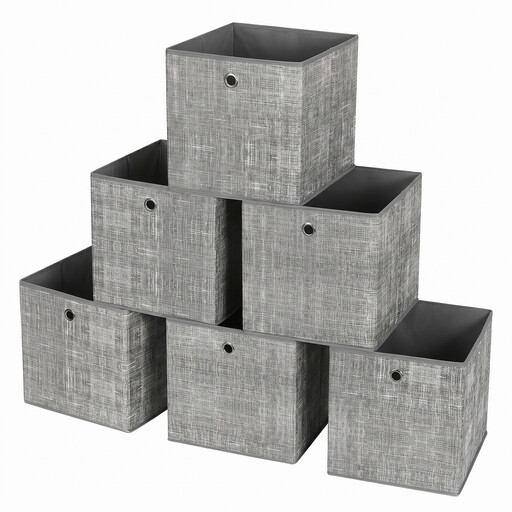
Why this choice? Ideal for students or a first home. This set of six cubes allows you to quickly organise a wardrobe or a cube shelving unit (like Kallax) at a controlled cost, without sacrificing aesthetics.
The product specifications mention an 80 g/m? non-woven fabric and cardboard, which prevents the risk of sagging common in low-end fabric boxes. Their format is designed for cube shelving units, which provide external structural support.
An excellent quantity-to-price ratio with this set of 6. Being collapsible, they can be stored flat when not in use.
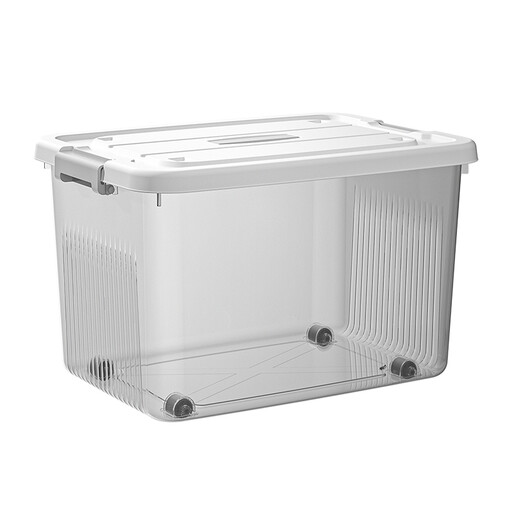
Why this choice? Perfect for organising a garage, a cellar, or storing heavy items. Here, robustness and stacking capacity are the top priorities.
The product description states a 2.5 mm thickened body, reinforcement ribs, and a non-slip base for stable stacking. These technical details directly eliminate the risk of cracking typical of low-quality plastic boxes.
A stackable design built to last. The transparent plastic allows you to identify the contents at a glance, without having to unstack everything.
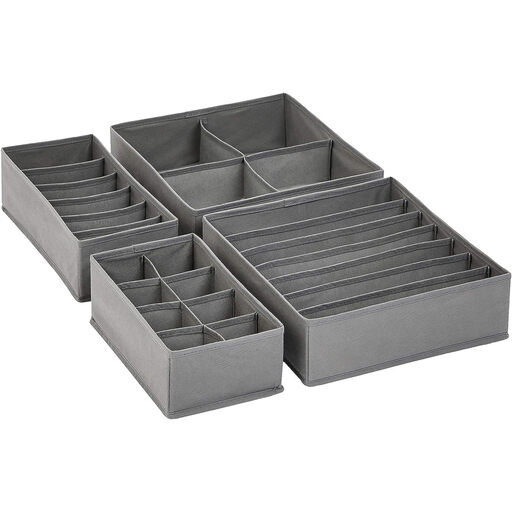
Why this choice? For those who want to optimise every nook and cranny and put an end to drawer chaos. This organiser is specifically designed for small items: socks, ties, underwear...
Its strength lies in its internal structure. The built-in compartments maintain its shape and prevent items from getting mixed up. It thus avoids the pitfall of the collapsible box that sags and loses all its utility.
A compartmentalised design for meticulous sorting. The breathable mesh fabric allows air to circulate and lets you see the contents at a glance.
Discover our full selection of products that meet our quality criteria and current standards.
1. How do I clean a fabric storage box? Most fabric boxes are not machine washable due to their cardboard inserts. It's best to clean them with a damp cloth and a little mild soap. Let them air dry completely before using them again. To combat odours, a pinch of baking soda inside for a few hours will do the trick.
2. What is the difference between polypropylene (PP) and other plastics? Polypropylene (PP) is the material of choice for storage boxes: it is lightweight, resistant to impact, fatigue (it withstands repeated bending well), and many chemicals. Other plastics like polystyrene (PS) are more brittle, while PET, often used for food containers, is less robust for heavy storage.
3. Can you really stack collapsible storage boxes? It all depends on their design. Simple fabric cubes without a rigid structure are not meant to be stacked, as they risk collapsing. However, some more advanced collapsible models incorporate a rigid metal or plastic frame that allows them to be stacked stably, even when full. Always check the manufacturer's recommendations on maximum load and stacking.