Students keeping an eye on added salt
If you want to add flavour to a dish without adding salt through the cube, look for products explicitly labelled “salt-free”. Still, check the recipe and the seasoning in the rest of your meal.


For lunch at uni, choose a stock cube labelled “salt-free” if you want to avoid adding salt to your dish with the cube. If a relative reduction is enough for you, a product advertised as having 25% less salt may be suitable, but it is not the same as a salt-free option. Also compare the amount of salt listed, the recommended quantity and the ingredients in the version you choose.
If you want to add flavour to a dish without adding salt through the cube, look for products explicitly labelled “salt-free”. Still, check the recipe and the seasoning in the rest of your meal.
When you’re putting a meal together between lectures, flavour and quantity matter just as much as a “reduced salt” label. The recommended amount of water may vary from one product to another.
A salt-related claim doesn’t tell you about allergens. Depending on the version, you’ll need to check in particular for wheat or celery, as well as any warnings about possible traces.
When seasoning lunch at uni, first distinguish between “salt-free” and “reduced salt”, then check how to prepare the cube and whether its recipe suits your dish.
| Criterion | What to check | Who it matters to |
|---|---|---|
| Added salt | Distinguish the “salt-free” claim from the advertised reduction. Compare the “salt” line in the nutritional information using the same basis. | If I want to control how much salt my stock cube adds, a relative reduction may not meet my needs. Around 36% of consumers would make this their priority. |
| Quick preparation | Check the amount of water recommended per cube and the instructions for the dish you’re making. | Between lectures, I’m mainly looking for an easy-to-measure seasoning for pasta, rice or soup. Around 29% of consumers would put quick preparation first. |
| Flavour and plant-based recipe | Check the flavour, ingredients list and, if it matters to you, whether the exact version is labelled vegan. | For a meal based on vegetables, I want a suitable flavour first and, where relevant, a recipe labelled vegan. Around 21% of consumers would prioritise this suitability. |
| Ingredients and local availability | Read the allergen information and any warnings about possible traces on the box you buy. Also check which product is available in your shop. | If I need to avoid certain ingredients, the exact recipe matters more than the flavour. I also want to be able to find a suitable product. Around 14% of consumers would make this their priority. |
The advertised reduction is relative to a comparison product. For its reduced-salt vegetable stock, Knorr says it is compared with the average stock cubes on the market, excluding reduced-salt versions. This doesn’t tell you how much salt is in your portion.
If your priority is not to add salt through the cube, look for a product labelled “salt-free”. Otherwise, compare the amounts shown on the same basis and follow the recommended quantity.
Recipes vary between versions. Auchan’s product listing for Maggi Kub chicken stock with 25% less salt mentions wheat and celery, among other ingredients. Don’t assume another product from the same brand has the same recipe.
Before using the cube, check the ingredients list and any warnings about possible traces on the box you’ve bought.
The range includes a reduced-salt vegetable stock and a vegetable version labelled “salt-free” — two claims that shouldn’t be confused.
Vegetable and chicken versions are available with an advertised salt reduction, so you can choose a flavour to suit your dish.
The range includes a 120 g box of reduced-salt chicken stock, worth considering if you’re looking for this flavour.
This vegetable stock cube is for anyone looking for a product with an advertised salt reduction to season a quick meal. If you’re looking for a “salt-free” option, check that claim on the product before choosing.
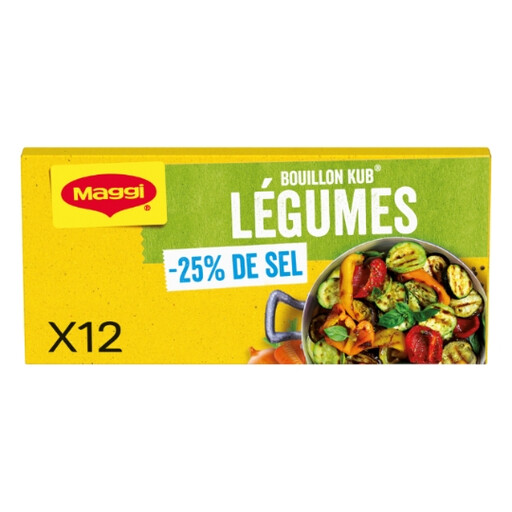 Image unavailable
A vegetable stock cube to consider for seasoning pasta, rice or soup if you’re looking for a relative reduction in salt rather than a salt-free option.
The product name indicates a 25% reduction and a 120 g pack. To find out how much salt you’ll consume, check the nutritional information and recommended quantity on the packaging. Also check the ingredients list if you need to avoid any allergens.
No. An advertised 25% reduction compares the product with a benchmark specified by the brand, while a product labelled “salt-free” is for anyone who wants to avoid adding salt through the stock cube. Read the “salt” line in the nutritional information and take the rest of your meal into account.
Follow the recommended quantity for the product you’re using rather than copying the instructions from another box. For Maggi Kub chicken stock with 25% less salt, Auchan’s listing recommends one 10 g cube in 500 ml of water. Adjust the preparation to suit your dish and taste it before adding salt.
No. The flavour doesn’t replace the ingredients list for the exact version. Check the packaging for listed allergens and possible traces, even if you already know another stock cube from the same brand.
Compare the salt claim, the nutritional information on the same basis, the recommended quantity and the ingredients list. For a pre-packed stock cube sold in France, the allergen information can also help you check whether the recipe meets your needs.