For meals around a bike ride, use a stock cube as a seasoning, not as a substitute for fuelling during exercise. If sugar is your priority, compare the ‘of which sugars’ figures for prepared portions on a like-for-like basis. If it’s salt, check the amount per portion rather than assuming anything from a ‘reduced salt’ or ‘fat-free’ claim.
Who are these criteria for?
Cyclists keeping an eye on sugar in their meals
You want to add flavour to pasta, rice or soup without choosing a cube based solely on a salt claim. Check the sugars in the prepared portion and the ingredients list: some recipes contain sugar or glucose syrup.
People watching their dietary salt
You want to keep track of the salt added to your meals. A ‘no added salt’ or ‘reduced salt’ claim can help you compare products, but the amount per portion and the rest of your meal also matter.
People checking ingredients and allergens
You use stock in vegetable or starchy dishes and need to check the ingredients in each recipe. The word ‘vegetable’ on the pack is no substitute for checking the ingredients, declared allergens and ‘may contain’ statements.
What should you check?
When choosing a stock cube for meals around your bike rides, start with the nutrient or ingredient that matters to you, then compare the figures on the same preparation basis.
| Criterion | What to check | Who is it for? |
|---|
| Sugars |
The ‘of which sugars’ figure per prepared portion, the dilution and the ingredients. |
If I want to season my meal without mistakenly assuming a ‘reduced salt’ cube is also lower in sugars, I compare recipes after preparation. Around 45% of consumers would prioritise sugars. |
| Salt |
The amount of salt per prepared portion and the exact meaning of a ‘no added salt’ or ‘reduced salt’ claim. |
If I’m keeping an eye on the salt in my meals, I want to know how much I’ll actually use, even when the pack claims it has been reduced. Salt would be the main criterion for around 33% of consumers. |
| Ingredients |
The exact recipe, declared allergens and ‘may contain’ statements. |
When I’m preparing a plant-based dish or need to avoid an allergen, the cube’s ingredients matter more than its name. Around 22% of consumers would prioritise this compatibility. |
Common mistakes to avoid
-
Confusing ‘reduced salt’, ‘fat-free’ and ‘reduced sugar’
These claims refer to different characteristics. A reduced-salt or fat-free cube may still contain sugar.
Compare ‘of which sugars’ for sugars, ‘salt’ for salt and ‘fat’ for fat, using prepared portions on a like-for-like basis.
-
Comparing only 100 g of dry stock cube
A stock cube is diluted before use, so a figure per 100 g of dry product doesn’t directly show how much is in your bowl.
Check the recommended dilution and compare figures for the same prepared volume or for the portions you’ll actually use.
-
Relying only on the words ‘vegetable’ or ‘organic’
These labels don’t rule out any particular ingredient or allergen. Recipes and ‘may contain’ statements vary by product.
Check the ingredients list and allergen information on the pack you buy.
-
Treating a cooking stock cube as a fuelling product
A stock cube is for seasoning food; its ingredients alone don’t determine what you need during a bike ride.
Follow the recommended dilution, and don’t assume that a stock is suitable as a sports drink just because you know its salt content.
Brands to compare
Knorr
The range includes no-added-salt and reduced-salt vegetable stocks. These are two different claims to bear in mind when comparing sugars, too.
- According to Knorr France, Bouillon Légumes Sans Sel contains 0.02 g of salt and 0.9 g of sugars per portion.
- According to Knorr France, Bouillon Légumes réduit en sel contains 1.4 g of salt and 0.7 g of sugars per portion. These figures apply to these two recipes, not the whole brand.
Maggi
The KUB cubes include a reduced-salt vegetable recipe that you can compare when seasoning cooked dishes.
- Carrefour’s product information for Bouillon KUB Légumes states that it contains 25% less salt than the average stock on the market, excluding reduced-salt versions.
- This comparison relates to salt, not sugars. According to Carrefour, the recipe contains sugar and celery, among other ingredients.
Auchan
The brand’s fat-free stock cubes let you look at fat, sugars and salt separately.
- For its fat-free pot-au-feu stock, Auchan claims at least 30% less fat than a standard Auchan stock.
- ‘Fat-free’ doesn’t tell you how much sugar or salt a product contains, so check the nutritional information for the specific product you choose.
E.Leclerc / Marque Repère
E.Leclerc’s range includes various stocks and sauce bases, including Rustica and Bio Village products.
- E.Leclerc’s product information for a Rustica stock lists 7.4 g of sugars per 100 g of unprepared product.
- A figure per 100 g of unprepared product doesn’t, on its own, tell you how much is in a portion after dilution, and it doesn’t apply to other recipes in the range.
Stock cubes available on Joybuy
These two cubes are intended for seasoning meals: one is a chicken stock in tablet form, while the other is a vegetable stock with a reduced-salt claim. To compare sugars, check the figures for the portion you prepare.
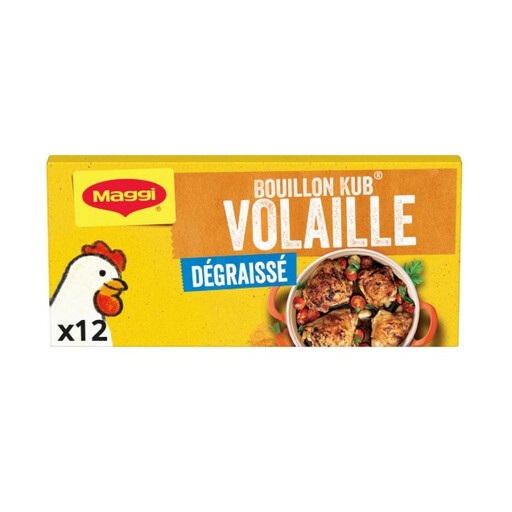 Image unavailable
Maggi Chicken Bouillon, 12 cubes
A cube format to consider for seasoning a meal. The product name refers to fat, which doesn’t tell you anything about its sugar content, so compare the figures for your preparation.
View on Joybuy
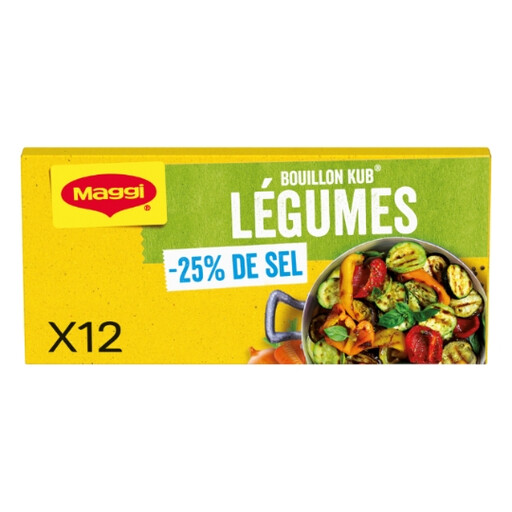 Image unavailable
Maggi KUB Vegetable, 25% less salt, 120 g
A vegetable stock cube to consider if you’re comparing reduced-salt stocks for cooking. According to Carrefour’s product information for this item, the 25% reduction is compared with the market average for stocks excluding reduced-salt versions; it doesn’t refer to sugars. Check the ingredients and prepared portion, too.
View on Joybuy
Frequently asked questions
Does a ‘reduced-salt’ cube also contain less sugar?
Not necessarily: the claim refers to salt. To compare the sugars in two cubes, check the ‘of which sugars’ figures for prepared portions on a like-for-like basis, and check the exact recipe.
Can a stock cube replace food or drink during a bike ride?
No. A stock cube is primarily a seasoning for meals or a liquid cooking ingredient. Its salt or sugar content alone doesn’t determine what you should eat or drink during exercise.
Why compare the figures after dilution?
Because figures per 100 g of dry cube and figures for prepared stock relate to different amounts of product being consumed. Follow the preparation instructions for each cube and compare the same volume of stock, or the portions you actually use.
Is the name ‘vegetable stock’ enough to rule out allergens?
No. Vegetable stock may contain declared allergens or come with ‘may contain’ statements. Check the ingredients list and labelling for the product you buy, even if you’re already familiar with the brand.


