People keeping an eye on their salt intake
You use stock in soups, vegetables, rice or sauces and want to take account of the salt this ingredient adds.


A stock cube won’t help you lose weight. Choose one as a seasoning, focusing on the salt per prepared portion, the ingredients and the recipe you have in mind. If you’re keeping an eye on your salt intake, distinguish between no-salt options and those that are simply reduced in salt. A larger pack is only worthwhile if you use it regularly and follow the storage instructions.
You use stock in soups, vegetables, rice or sauces and want to take account of the salt this ingredient adds.
You’re considering a box of several cubes for the cupboard. The number of cubes isn’t the only thing to consider: dosage and storage matter too.
You need to check for allergens or particular ingredients before choosing vegetable, chicken or beef stock.
When choosing a stock cube, start with the portion you’ll actually prepare. Then check whether the pack size and ingredients suit the way you cook.
| Criteria | What to check | Who it matters to |
|---|---|---|
| Salt per portion | Compare the salt per portion or prepared volume, as well as the stated dosage. ‘Reduced in salt’ does not mean ‘no salt’. | If I use stock often, I want to know how much salt each preparation adds to my dish. Around 40% of consumers put this first. |
| Pack size and storage | Check the number of cubes, net weight and storage instructions, especially after opening. | I cook regularly enough to use a large box without leaving the cubes to deteriorate in the cupboard. This is the top priority for around 30% of consumers. |
| Ingredients and allergens | Read the ingredient list for the exact product, check the allergens highlighted and look out for any ‘may contain’ warnings. | Before choosing a flavour, I need to make sure its ingredients are suitable for everyone who’ll be eating the dish. Around 20% of consumers prioritise this check. |
| Flavour and use | Choose a flavour that suits your recipe and follow the recommended dosage. | I’m mainly looking for a cube I can use in the soups, vegetables or starchy foods I cook. For around 10% of consumers, culinary use comes first. |
The stated reduction depends on the product it’s compared with. Knorr lists 1.4 g of salt per portion for its reduced-salt vegetable stock, compared with 0.02 g for its no-salt vegetable option.
Compare the values for the specific product and the amount you’ll prepare, then taste your dish before adding more salt.
A flavour name doesn’t tell you everything about its ingredients. Depending on the product, it may contain celery or other allergens, or state that traces may be present.
If you need to avoid an ingredient, check the packaging for the exact product, including any ‘may contain’ warnings.
A multi-cube box won’t necessarily make the same amount of stock as a pot of powder: dosages and instructions for storage after opening may differ.
Before choosing a pack for your cupboard, compare the net weight, the dosage for your needs and the storage instructions.
A cube seasons a dish; choosing this one ingredient doesn’t determine the meal as a whole.
Use the amount that suits your recipe and take account of the dish’s other ingredients and seasonings.
The range includes vegetable stock options that let you compare no-salt and reduced-salt products.
The brand offers reduced-salt vegetable cubes and Kub Or boxes containing several cubes.
The retailer offers, among other products, a reduced-salt Kub Or box containing 32 cubes and weighing 121.6 g.
The Rustica and Bio Village ranges include tablet stock in different pack sizes, depending on the product.
The retailer offers, among other products, a vegetable-flavoured stock in a box of 12 cubes.
These two products suit different uses: a vegetable cube with a comparative claim of reduced salt, and herb and olive oil stock tablets. For both, compare the dosage and nutrition information for the amount you’ll prepare.
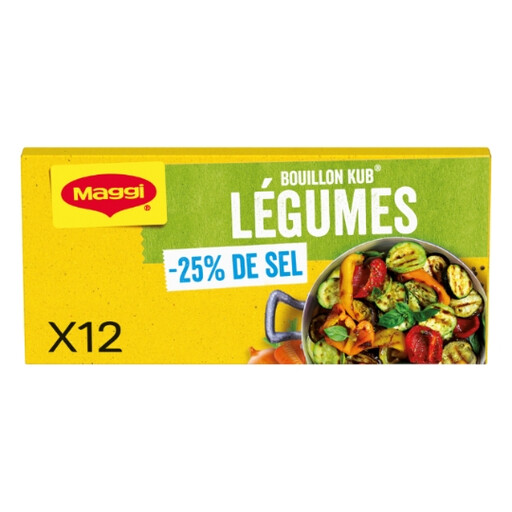 Image unavailable
Worth considering if you’re looking for a vegetable stock cube for soups or slow-cooked dishes. The stated salt reduction is comparative: it doesn’t mean the product contains no salt.
Before use, check the packaging for the dosage, the salt in your prepared portion and any allergens.
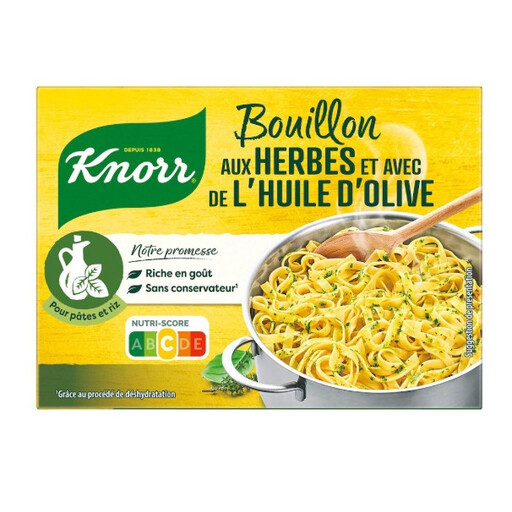 Image unavailable
Worth a look if you’re after a stock with herbs and olive oil to season a range of dishes.
Follow the dosage for your recipe and, if you’re keeping an eye on your salt intake, check how much salt is in your prepared portion.
No. ‘Reduced in salt’ describes a comparison; it doesn’t mean there’s no salt. For its two vegetable options, Knorr lists 1.4 g of salt per portion for the reduced-salt version and 0.02 g for the no-salt version. Always compare the specific product and the portion you’ll use.
First, check the ingredients list, highlighted allergens, nutrition information, net weight and dosage. In France, the DGCCRF reminds food businesses that allergens must be highlighted on food labels.
Follow the instructions for the product you’ve bought. The Joybuy product listings mentioned here advise storing stock in a cool, dry place. The listing for Knorr 900 g stock powder also says to seal the pot tightly after opening.
Not necessarily. A best-before date is not the same as a use-by date. Check that the packaging is intact and that the product has been stored as instructed. Its flavour may change after the best-before date.