People prioritising sugar content
If the sugar content of a stock cube is your main concern, check the ‘of which sugars’ line and compare values shown on the same basis. A claim about salt alone doesn’t tell you whether the sugar content is lower.


To choose a stock cube with a lower sugar content for your Easter meals, compare the ‘of which sugars’ line for specific products on the same basis. A reduced-salt or salt-free cube meets a different criterion and may still contain sugar. Then check the recommended amount for your dishes, as well as the ingredients and allergens in the product you choose.
If the sugar content of a stock cube is your main concern, check the ‘of which sugars’ line and compare values shown on the same basis. A claim about salt alone doesn’t tell you whether the sugar content is lower.
For seasoning Easter soups, vegetables or sauces, you could consider reduced-salt or salt-free stock cubes. Compare their salt content for the portion you prepare, without assuming they contain less sugar.
The exact recipe matters as much as the type of stock: some products list celery or soya, while others warn that they may contain traces of gluten, milk or eggs. Check the packaging of the stock cube you plan to use.
For your Easter dishes, start with the nutrient or dietary requirement behind your choice, then check how much stock cube to use. Values per 100 g of dry product and values for a serving of prepared stock aren’t directly comparable.
| Criterion | What to check | Who is it for? |
|---|---|---|
| Sugars | The ‘of which sugars’ line on the same basis, and exactly what any ‘reduced in sugars’ claim refers to. | For a soup or sauce, I want to choose based on sugar content without confusing it with salt. Around 37% of consumers put checking sugar content first. |
| Salt | The salt content for the prepared portion, based on the recommended amount, and any claim about a reduction. | If I season several dishes with stock, the amount of salt in each prepared dish guides my choice. Keeping salt in check comes first for around 27% of consumers. |
| Ingredients and allergens | The ingredients list and any ‘may contain’ warnings for the exact product. | When I’m cooking for people with dietary requirements, I need to check the recipe before serving the dish. Around 27% of consumers prioritise this compatibility. |
| Pack size and availability | The number of cubes, the recommended amount and whether the product is available at your chosen shop. | To prepare the planned dishes without changing the recipe at the last minute, I look for a pack I can get at my local shop. This is a priority for around 9% of consumers. |
The two claims refer to different nutrients. Carrefour lists sugar among the ingredients of its reduced-salt MAGGI vegetable stock; Knorr states that its reduced-salt vegetable stock contains 0.7 g of sugars per serving.
First decide which criterion matters for your dish, then check the ‘of which sugars’ and ‘salt’ lines separately, using comparable values.
A stock cube is measured out into water or added to a dish. A value per 100 g of dry product therefore doesn’t, by itself, show how much you’ll get in the portion you prepare.
Check the weight and number of cubes you use, then compare values for the same amount of prepared stock when the packaging provides them.
A vegetable-based recipe may list celery or soya, or warn that it may contain traces of other allergens. The recipe name is no substitute for the ingredients list.
Check the ingredients and any ‘may contain’ warnings on the exact product packaging, especially if you switch product or pack size.
These ranges include products worth checking against your main criterion; ingredients and nutritional values vary from one product to another.
The range includes a vegetable stock cube advertised as containing 25% less salt.
The vegetable stock range includes classic, reduced-salt and salt-free versions.
The brand offers, among other products, a dehydrated vegetable stock in cube form.
Both ranges include stock products whose listings show nutritional values per 100 g.
The brand offers a vegetable-flavour stock cube weighing 10 g.
This cube could be an option for seasoning Easter dishes if salt is your priority. Its reduction claim doesn’t refer to sugars: if sugar content guides your purchase, compare its nutrition declaration with those of the other products you’re considering.
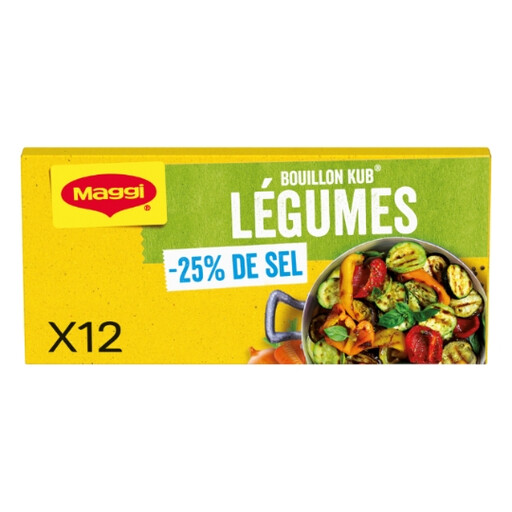 Image unavailable
Worth considering for soups or vegetable dishes if you’re primarily looking for a stock cube with a reduced-salt claim.
The ‘25% less salt’ claim refers to salt; sugar is listed among the ingredients of this product. The product listing also warns that it may contain traces of eggs, milk and gluten. Check the packaging before cooking for anyone affected by these allergens.
No. A reduction in salt doesn’t, by itself, mean there’s less sugar. The product listings for reduced-salt MAGGI and Knorr stocks also list sugar among their ingredients; Knorr states that its reduced-salt version contains 0.7 g of sugars per serving. Check both nutrition lines separately.
Compare the ‘of which sugars’ line for specific products on the same basis, then check exactly what any ‘reduced in sugars’ claim on the packaging refers to. The DGCCRF notes that nutrition claims are regulated; a claim about salt doesn’t let you draw conclusions about sugars.
Check the packaging of the product you’ve bought rather than relying on the word ‘vegetable’. The Carrefour and Auchan product listings mentioned in this article include celery or soya in some recipes, as well as warnings about possible traces of other allergens, depending on the product.
No. It doesn’t replace checking the ‘of which sugars’ line, ingredients or allergens. The DGCCRF describes Nutri-Score as a voluntary label; for this particular choice, compare the stock cubes’ nutritional values on the same basis.