If you want to limit fat when choosing stock cubes, compare the nutrition information on the same basis and take the recommended amount into account. The words ‘reduced fat’ alone aren’t enough. Check the salt, ingredients and allergens too, as reduced-salt and vegetable recipes meet different needs.
Who are these stock cubes for?
People looking for reduced-fat stock
Whether you’re making soup, a sauce or a slow-cooked dish, you may be looking for a pack labelled as reduced fat. Before choosing, compare the nutrition information for the prepared stock and check the recommended amount.
People who are also mindful of salt
You want to limit fat without overlooking the salt added to your dish. Reduced-salt stock is a separate option to consider, with its own nutrition information to check.
People who pay attention to ingredients and allergens
You’re looking for a particular flavour, a plant-based recipe or need to avoid certain ingredients. In that case, the ingredients listed on the pack you buy matter just as much as any claim about fat.
What should you check before choosing?
When choosing stock cubes in a pack to cook with less fat, start with the stock you actually prepare, then check the salt, ingredients and pack size. Figures per 100 g of product and per 100 mL of prepared stock aren’t directly comparable.
| What to consider | What to check | Who it matters to |
|---|
| Fat |
The amount per 100 mL of prepared stock, if shown on the pack, and the recommended amount. Check what any reduction claim refers to. |
For my soups and sauces, I want to compare the amount of fat I actually use, rather than relying on the word ‘reduced-fat’ alone. Around 42% of consumers rank this as their top priority. |
| Salt and quantity |
The amount of salt shown and the volume of water recommended per cube. A ‘reduced salt’ claim doesn’t, on its own, tell you anything about fat. |
If I’ve already seasoned my dish, I want to be able to measure out the stock while keeping track of the salt I add. For around 33% of consumers, managing salt comes ahead of other criteria when choosing. |
| Ingredients and allergens |
The type of stock, the ingredients list, any allergens highlighted and any ‘may contain’ statements on the pack you buy. |
If I’m making a plant-based recipe or need to avoid an ingredient, the ingredients determine which cubes I can consider. This is the top priority for around 17% of consumers. |
| Pack size |
The number of cubes, net weight and recommended amount, once you’ve decided the ingredients suit your needs. |
I only cook with stock now and then, so I like to know how many batches I can make from a pack. Pack size is the top priority for around 8% of consumers. |
Mistakes to avoid
-
Treating ‘reduced fat’ as an absolute nutrition figure
Carrefour’s product information for MAGGI Pot-au-Feu Dégraissé states that it contains 30% less fat than the average non-reduced-fat stock. This comparison alone doesn’t tell you how much fat is in the stock you prepare.
Check the figure for prepared stock and the recommended amount, then compare products using figures expressed on the same basis.
-
Forgetting about salt when choosing based on fat
Reduced fat and reduced salt are two separate features. The number of cubes you use also affects the ingredients in your finished dish.
If salt matters to you, check the relevant line in the nutrition information, follow the recommended amount and taste before adding more.
-
Assuming vegetable stock cubes are free from all allergens
Ingredients and ‘may contain’ statements vary between recipes, including vegetable stocks. In France, the DGCCRF says allergens must be declared and highlighted in the ingredients list on prepacked foods.
Check the ingredients and any ‘may contain’ statements on the pack you buy, even if you already know the brand.
Brands and ranges to know
MAGGI
The range includes a 12-cube pack of Pot-au-Feu Dégraissé, as well as vegetable stocks, including a reduced-salt option.
- Carrefour’s product information for Pot-au-Feu Dégraissé states that it contains 0.5 g of fat per 100 mL of prepared stock.
- The reduced-salt vegetable version doesn’t carry the same reduced-fat claim. Check each recipe separately.
KNORR
The products listed by Auchan include a chicken stock described as low in fat and a reduced-salt vegetable stock, both in packs of 12 cubes.
- The chicken stock product information recommends one cube per 500 mL of water.
- The chicken recipe includes ingredients such as palm fat and egg. Check the ingredients and allergens for the product you choose.
RUSTICA (Marque Repère E.Leclerc)
E.Leclerc offers a 12-cube pack of reduced-fat poultry stock.
- According to E.Leclerc’s product information, this recipe contains 30% less fat than the average poultry stock on the market.
- Before comparing it with prepared stock, check the basis used for the nutrition figures, as well as the allergens listed on the pack.
Stock cubes available on Joybuy
These two products suit different needs: vegetable stock cubes labelled as containing less salt, and chicken stock whose name includes the claim ‘Fat-Free’. If you’re choosing based on fat content, check the figures and the basis they’re measured on for each pack.
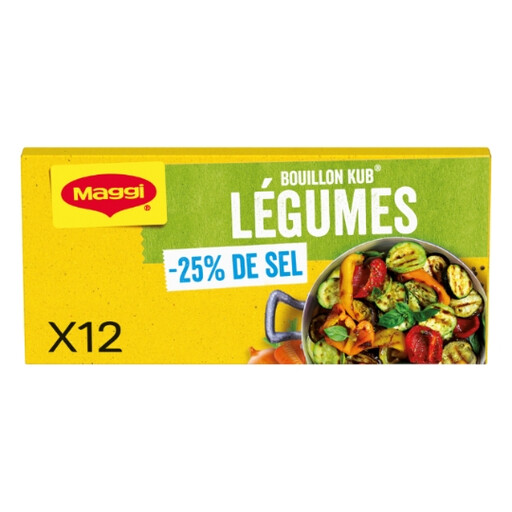 Image unavailable
MAGGI KUB vegetable stock cubes, 25% less salt, 120 g
Worth considering if you’re looking for vegetable stock and also care about salt. The reduced-salt claim doesn’t mean this product is reduced fat. Compare the fat content using figures for prepared stock, and check the ingredients, allergens and recommended amount on the pack.
View on Joybuy
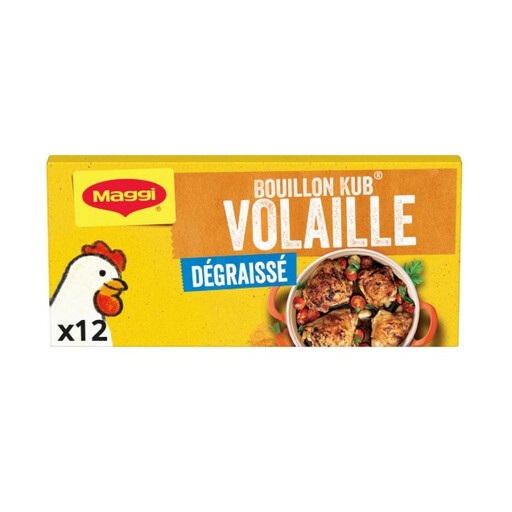 Image unavailable
MAGGI ‘Fat-Free’ chicken stock, 12 cubes
Worth considering if you’re looking for chicken stock cubes. The words ‘Fat-Free’ in the name don’t tell you how much fat is in the prepared stock; the product description also lists chicken fat among the ingredients. Check the basis used for the nutrition figures, the recommended amount and the allergens on the pack.
View on Joybuy
Frequently asked questions
Is a ‘reduced-fat’ stock cube always suitable if I want to limit fat?
No. The claim may refer to a reduction compared with other stocks, but it doesn’t tell you everything about the stock you prepare. Carrefour’s product information for MAGGI Pot-au-Feu Dégraissé and E.Leclerc’s for RUSTICA Volaille Dégraissé both state a 30% reduction, but each uses a different comparison. Check the nutrition figures on the same basis and consider how many cubes you use.
Does reduced-salt stock necessarily contain less fat?
No. A claim about salt doesn’t tell you anything about fat. For the reduced-salt vegetable stock cubes listed by Carrefour and Auchan, check both lines in the nutrition information separately and follow the recommended amount.
Where can I check the allergens in stock cubes?
Check the ingredients list and any ‘may contain’ statements on the pack you buy. The DGCCRF says allergens must be declared and highlighted on prepacked food labels. Ingredients can vary between chicken, poultry and vegetable recipes.


