Who is this choice for?

Kitchen teams following sodium-restriction guidance

For the recipes concerned, compare the amount of salt the stock adds at the intended dosage, rather than relying on the words ‘reduced salt’ alone. A salt-free product and a reduced-salt product do not meet the same need.

Kitchens focused on making meals appetising

If you reduce the salt in a soup, sauce or vegetable dish, taste the finished recipe and adjust the seasoning. Manger Bouger highlights the importance of helping older people maintain their appetite.

Those responsible for ingredients and dietary requirements

When planning menus for several residents, check the ingredients and allergen information for each product. Some reduced-salt stocks contain potassium chloride, so the appropriate team should check whether they are suitable for residents with individual dietary guidance.

What should you check before buying?

Salt-free stock cube

Choose this: when the stock should contribute virtually no salt to the recipe in question.

Bear in mind: you may need to adjust the seasoning and taste the dish before serving. Don’t apply this restriction to every resident.

Reduced-salt stock cube

Choose this: when the recipe can still include some salt from the stock and you have accounted for it.

Bear in mind: calculate the salt content at the quantity used and check the ingredients, including whether potassium chloride is present.

What matters What to check Who is this for?
Salt added to the recipe The salt content for a comparable quantity of prepared stock, and the number of cubes actually used. I need to prepare a recipe with sodium restrictions and know how much salt the stock adds to each portion served; around 36% of consumers make managing salt their top priority.
Flavour of the dish served Whether the flavour suits the recipe and whether the dish is well received after the seasoning has been adjusted. If the dish becomes less popular after reducing the salt, I need to rework the recipe rather than add more cubes; nearly 29% of consumers put appetite and enjoyment first.
Ingredients and dietary requirements The ingredients list, allergen information and whether potassium chloride is present. I prepare menus for residents with different dietary requirements and need to avoid products that are unsuitable; around 21% of consumers put these checks first.
Dosage and supply The number of cubes, dilution instructions and whether the product is available through the usual supplier. To make the same recipe with varying quantities, I need a consistent dosage and a clearly identifiable product; around 14% of consumers make this their main concern.

Kitchen mistakes to avoid

  • Assuming ‘reduced salt’ means ‘salt-free’

    A percentage reduction doesn’t tell you how much salt the stock adds to the recipe. For example, Knorr lists 1.5 g of salt per portion for its reduced-salt Chicken Stock.

    Calculate the amount added using the quantity you actually use, and choose a salt-free product when the recipe’s requirements call for it.

  • Removing salt from every menu without distinction

    Dietary guidance can vary from one resident to another. Manger Bouger advises against removing salt from someone’s diet without a medical prescription, and meals should remain appetising too.

    Follow each resident’s individual guidance and taste dishes after making any changes to a recipe.

  • Only checking the percentage on the pack

    A salt reduction alone doesn’t tell you about allergens or the presence of potassium chloride. Anses warns that salt substitutes containing potassium chloride may pose risks for some people.

    Check the label on the product you buy, and ask the appropriate team to assess whether it is compatible with individual dietary guidance.

  • Keeping the old dosage after changing stock cubes

    The number of cubes and the volume prepared determine how much stock each portion contains. Auchan lists one cube per 500 ml of water for Knorr Salt-Free Vegetable Stock.

    Update the recipe sheet with the exact product, its dilution instructions and the volume actually served.

Stock brands to consider

Knorr

The range includes salt-free and reduced-salt stocks, including vegetable and chicken varieties.

  • Knorr lists 0.02 g of salt per portion for its Salt-Free Vegetable Stock.
  • Its reduced-salt Chicken Stock contains 1.5 g of salt per portion, so the two products are not interchangeable. Check the ingredients of your chosen variety too.

Maggi

The KUB range includes stocks said to contain 25% less salt than the average standard stock, including a vegetable variety.

  • This variety could help you reduce the amount of salt added by the stock without switching to a salt-free recipe.
  • The stock still contains salt. Carrefour’s listing for Reduced-Salt Vegetable Stock mentions celery and possible traces of egg, gluten and milk. Check the product you buy.

Carrefour Original

Carrefour lists a Reduced-Salt Chicken Stock under its Carrefour Original brand.

  • This is one option to consider for a recipe that calls for chicken stock.
  • Before adding it to the menu, check the salt content, dosage and ingredients on the product you buy.

Jardin BiO étic

Auchan lists salt-free chicken stock cubes and vegetable stock cubes described as ‘salt-free and gluten-free’ under this brand.

  • The two flavours offer salt-free options to suit the type of dish you’re preparing.
  • Check the label on the variety you buy, especially its ingredients, allergen information and dosage.

Reduced-salt stock cubes on Joybuy

This selection features a reduced-salt vegetable stock cube. Consider it for recipes where the stock can still contribute some salt.
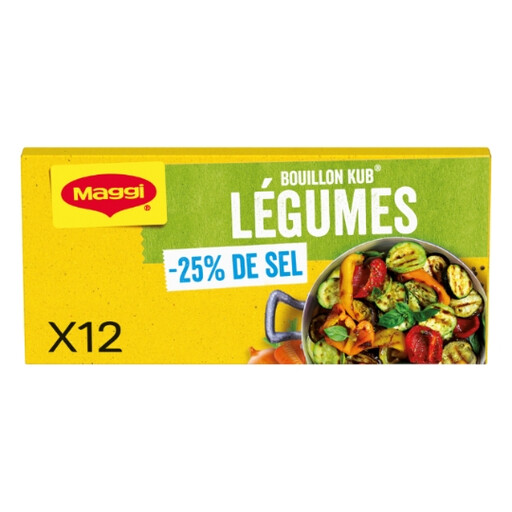
MAGGI KUB vegetable stock cubes, 25% less salt, 120 g

MAGGI KUB Vegetable Stock, 25% Less Salt, 120 g

Worth considering for a vegetable recipe where the stock can still add some salt. This 120 g pack is said to contain 25% less salt than the average standard stock. Before using it for the residents concerned, check the pack for dosage instructions, the amount of salt per portion served and the ingredients.

View on Joybuy

Frequently asked questions

Can a reduced-salt stock cube replace a salt-free one?

Not in a recipe that needs to keep the salt from the stock to a minimum. Knorr lists 1.5 g of salt per portion for its reduced-salt Chicken Stock, compared with 0.02 g for its Salt-Free Vegetable Stock. However, compare the quantities prepared and the dosage in your recipe before choosing.

Should every resident in a care home be served salt-free meals?

No. Guidance should reflect each resident’s circumstances and the care home’s protocol. Manger Bouger advises against removing salt from someone’s diet without a medical prescription, and any changes should also take account of how appetising the meals are.

Why check whether stock contains potassium chloride?

Some reduced-salt products contain it, which may matter for residents with individual dietary requirements. Anses warns that salt substitutes containing potassium chloride may pose risks for some people. If these requirements apply, ask the appropriate team to check whether the product is suitable.

Which allergens should you check before ordering stock cubes?

Check the ingredients list and any ‘may contain’ statements on the product you actually buy. Carrefour’s listings for Maggi stocks show that allergen information varies by product and may include celery, wheat, eggs or milk. Don’t assume that one variety has the same ingredients as another.