
Livraison le jour même ou le lendemain

Qualité garantie

Débloquez vos offres de bienvenue: Livraison GRATUITE | Jusqu'à -80 % | 30 jours d'essai gratuits à JoyPlus
Téléchargez l'application
A toy may be labelled “STEM”, “scientific” or “educational” without necessarily meeting a child’s real needs. For parents, relatives and teachers, choosing the right product can quickly become a headache, with options ranging from magnetic building blocks, observation kits, anatomical models and science discovery activities.
Before placing an order, three common pitfalls are worth bearing in mind:
Here are the key criteria to consider when choosing an educational construction toy or a science kit for a child, whether it is for home use, a gift or classroom activities.
The recommended age should match the child’s maturity, not simply their age on paper. A Montessori toy for 3-year-olds should offer pieces that are easy to grasp, simple shapes and intuitive handling. For a STEM toy for 6-year-olds, you can look for more instructions, assembly steps or scientific concepts.
Small parts pose a choking risk for children under 3. Even beyond this age, adult supervision is preferable when an activity involves magnets, batteries, detachable components or outdoor use.
ABS plastic is very common in construction toys. Check the stated material, look for rounded edges and make sure the connections are sturdy. An ABS construction set should also be inspected regularly: cracks, misshapen pieces, a displaced magnet or damaged surfaces are all signs that use should be stopped.
Extra care is needed with magnetic tiles for children. Swallowing several magnets can lead to serious complications. The pieces must remain completely intact and the magnets must be securely enclosed. Stated compliance in a product listing does not remove the need to check the markings and warnings on the packaging.
In France and the European Union, look in particular for the CE marking, the manufacturer’s details or those of an EU-based responsible person, as well as warnings in French. These elements alone cannot guarantee a flawless play experience, but they help you make an informed choice.
A set intended for regular use should be easy to clean, carry and store. A metal box, pouch or included storage compartment helps prevent pieces from getting lost.
For a science discovery activity, also check:
Magnetic toys are often well suited to open-ended play. By contrast, a solar system model or observation kit provides more opportunities to talk with your child and extend play through questions.

Why this choice suits this profile : With 32 pieces, this set is an affordable way to discover magnetic construction without investing in a large box. The metal storage tin is practical at home or in a bag for a weekend away.
The set is described as having ABS pieces with rounded edges and a magnetic structure designed for first-time construction. It is still essential to check the condition of the components regularly.
32 pieces, 3.75 cm magnetic squares, storage tin and a format well suited to first assemblies.
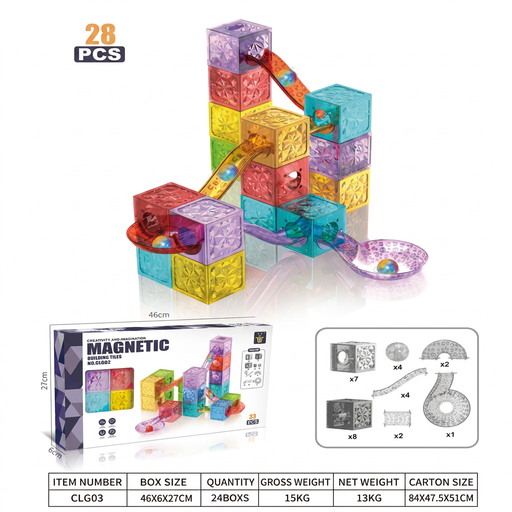
Why this choice suits this profile : Its diamond shape and 5.5 cm pieces offer something different from traditional tiles. This format is aimed at children who enjoy building in 3D and experimenting with visual patterns.
The listing mentions integrated magnets sealed using ultrasonic welding, together with rounded edges. These details do not remove the need to inspect the pieces before extended use.
28 pieces measuring 5.5 cm, storage pouch, ABS construction and stated compatibility with certain systems of the same size.
Why this choice suits this profile : This model is ideal for a supervised activity about space, a classroom demonstration or a discovery session before bedtime. It projects stars, nebulae and spacecraft.
The listing specifies an age range from 36 months to 12 years, the presence of small parts, the use of three AA batteries not included and a warning not to point the projection towards the eyes.
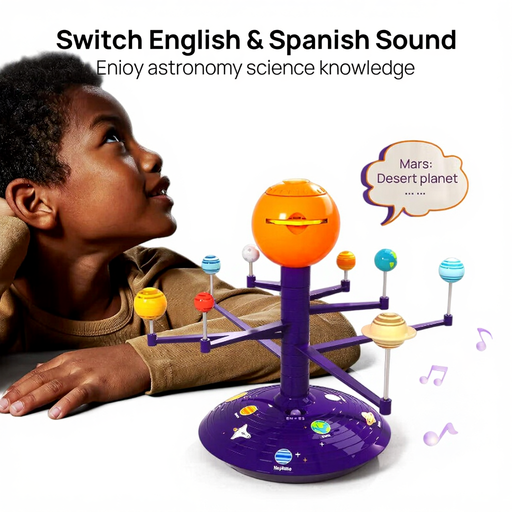
Planet model, interchangeable slides, manual rotating wheel and bilingual English-Spanish audio content.

Why this choice suits this profile : This kit turns a walk in the park or garden into a genuine observation activity. It can also be used to examine plants, provided you follow the instructions and treat the animals being observed with care.
The rotating magnifying glass, advertised with 5× magnification, comes with a lockable lid and an opening for easier cleaning. Venomous or stinging insects should not be captured without appropriate supervision.
Dimensions of 16 × 16 × 18.01 cm, 360° adjustable magnifying glass, removable opening for cleaning and intended for ages 3 to 12.
We have brought together a complete, real-time selection of products that meet these demanding criteria, as well as European safety requirements.
A set remains engaging for longer when it is accompanied by challenges that evolve with the child:
This approach turns a creative toy for children into a regular activity, without making every play session feel like schoolwork.
Choose pieces that are easy to grasp, a reasonable number of components and a clearly displayed age recommendation. Magnetic tiles for children may be suitable, but supervision remains essential because of the magnets and small parts.
Most magnetic blocks work without a power supply. However, a talking model or one with a projection function, such as the solar system set, requires three AA batteries, which are not included. Remember to check this detail so you are not left waiting before using it for the first time.
It depends on its durability, the quality of the storage and the child’s interest. An open-ended construction set can keep pace with their development, while a themed kit will last longer if you create several activities using its components. Always inspect the equipment before giving it to a child.